

Daikokuten
Also known as: Daikoku, Daikoku-sama, Okuninushi (syncretic)
Mythological Narrative
One of the Seven Lucky Gods. God of wealth, farmers, and the kitchen. Derived from the Hindu deity Mahakala but merged with the native kami Okuninushi in Japan.
Scholarly Commentary & Evolution
## The God of Wealth and the Household
**Daikokuten** is a smiling, portly deity who brings wealth, good harvests, and prosperity to households. As one of the **Shichifukujin** (Seven Lucky Gods), he is often paired with Ebisu—the two are frequently depicted together as a duo bringing commercial success and domestic prosperity.
### Syncretic Origins
Daikokuten's history demonstrates the religious blending characteristic of Japanese spirituality. He originated as **Mahakala**, a wrathful Buddhist protector deity derived from the Hindu god Shiva. When Mahakala reached Japan, the kanji for his name (大黒) could also be read as *Okuninushi*, leading to his merger with the beloved Shinto kami **Okuninushi**, ruler of Izumo and god of nation-building. This fusion transformed the fearsome Mahakala into the jovial household deity worshipped today.
### Iconography
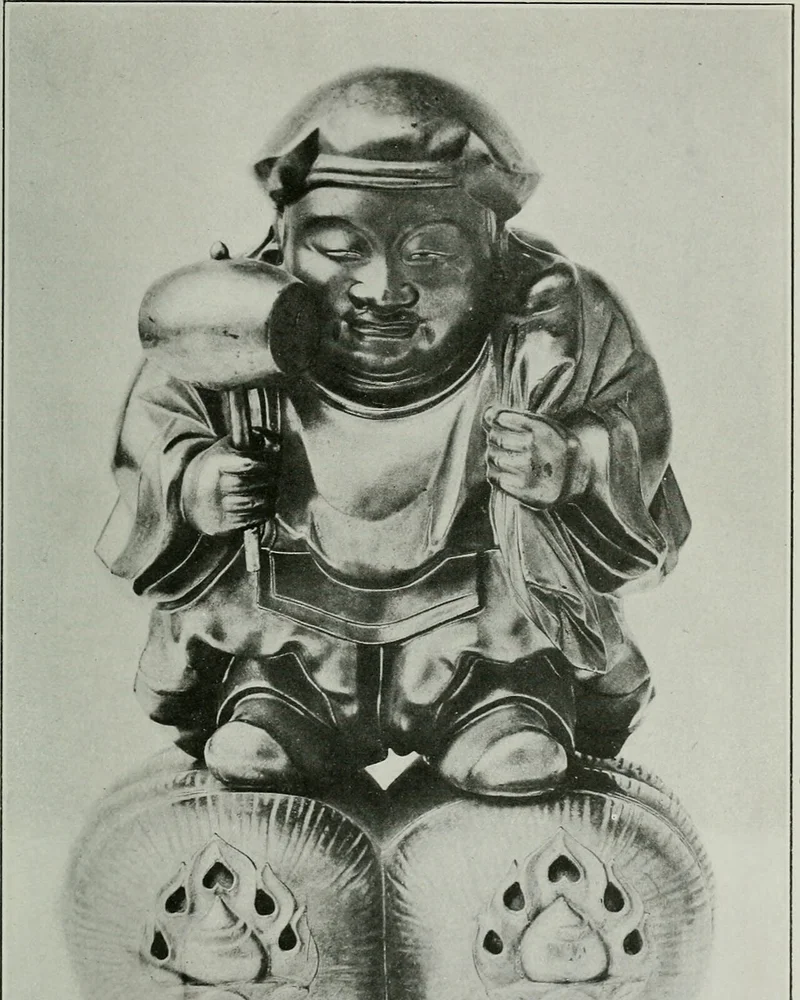
Daikokuten appears as a plump, smiling figure sitting atop two bales of rice. He wears a flat black cap and carries two essential objects: a bulging **treasure sack** slung over his shoulder containing all the wealth he bestows upon worshippers, and the **uchide no kozuchi** (magic mallet or lucky hammer). Each strike of this mallet produces gold coins or grants wishes. Mice or rats are often depicted near his rice bales—rather than being pests, they are considered his messengers.
### The Kitchen God
In many Japanese households, Daikokuten's image is placed in the kitchen, particularly near the kamado (cooking stove). Here he guards the food supply and ensures the family never goes hungry. His association with rice—Japan's staple crop and once a form of currency—made him central to agricultural and economic prosperity.
### New Year Traditions
Daikokuten plays a prominent role in Japanese New Year celebrations. Images of him alongside Ebisu appear on **engimono** (lucky charms) sold at temples and shrines. The tradition of the **Takarabune** (treasure ship) depicts all Seven Lucky Gods sailing into port with their treasures—Daikokuten's mallet and sack prominently displayed—bringing good fortune for the coming year.
Cross-Pantheon Parallels & Archetypes
Academic Discussion & Critique
Exchange peer-reviewed hypotheses, comparative Indo-European etymologies, and archaeological field interpretations regarding Daikokuten.
You Might Also Like
Plutus
The god of wealth, son of Demeter and the hero Iasion, born in a thrice-plowed field on Crete. Originally the wealth of the harvest, he became the personification of riches in general, most memorably as the blind god of Aristophanes' comedy.
Shiva
The three-eyed god of destruction and renewal, blue-throated and moon-crowned, the Ganges falling through his matted hair. From Mount Kailash he dances the universe to its end and rebirth.
Aje
The Orisha of prosperity and material wealth. Aje blesses commerce and brings financial abundance to her devotees.
Amaterasu
The sun goddess who rules Takamagahara and heads the imperial mythic lineage; her retreat into the Heavenly Rock Cave plunged heaven and earth into darkness.