

Shiva
Also known as: Mahadeva, Rudra, Nataraja, Maheshvara
Mythological Narrative
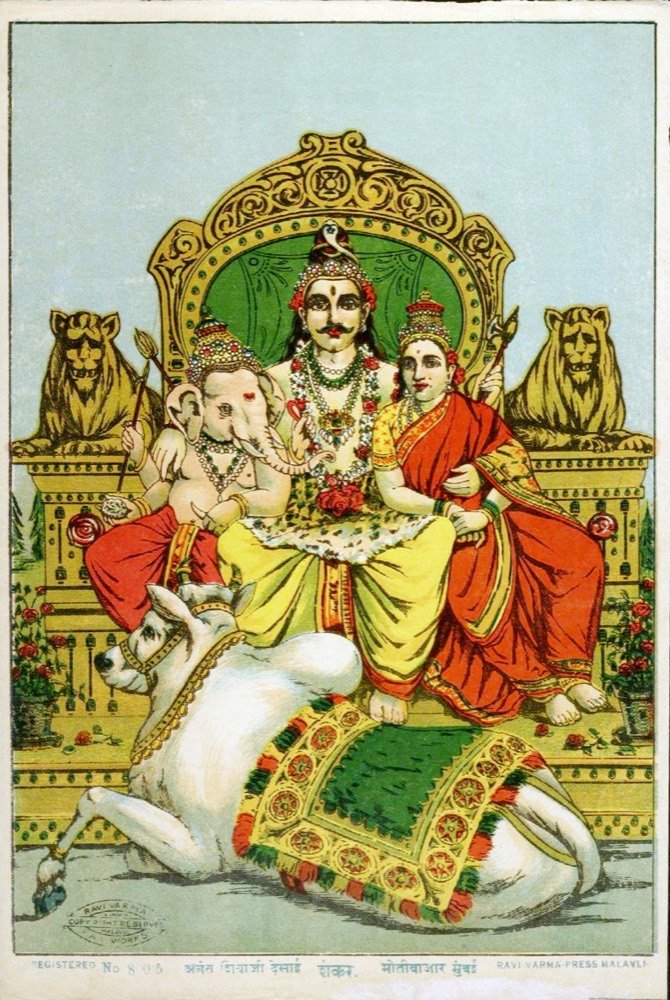
Shiva wears the guise of an ascetic: his pale body smeared with cremation ash, a cobra coiled at his throat, a tiger skin about his waist, a crescent moon in his matted hair, through which the Ganges falls from heaven. A third eye stands upright on his brow; its fire once burned Kama, god of desire, to ash. His throat is dark blue—when the poison halahala rose from the churning ocean and threatened the three worlds, he swallowed it and held it there, earning the name Nilakantha. He carries the trident, sounds the damaru drum, rides the white bull Nandi, and dwells on Mount Kailash with his wife Parvati and their sons Ganesha and Kartikeya.
His Vedic ancestor is Rudra, the feared storm god of the Rigveda. As Nataraja, Lord of the Dance, he dances within a ring of flame, one hand drumming creation into being, another bearing the fire of dissolution, one foot pressing down a dwarf who embodies ignorance. The Chola bronzes of south India (9th–13th century) fixed this image as one of the most celebrated forms in Indian art.
Shiva is chiefly worshipped as the linga, an upright stone pillar. Twelve Jyotirlinga temples, among them Kashi Vishwanath at Varanasi, form the great pilgrimage circuit of Shaivism, and on the night of Maha Shivaratri devotees keep vigil bathing the linga until dawn.
Scholarly Commentary & Evolution
## The Destroyer and Transformer
Shiva is the third god of the **Trimurti**, the cosmic destroyer who dissolves the universe at the end of each cycle to enable its recreation. Far from merely destructive, Shiva transforms and regenerates, making way for new creation.
### Nataraja - The Cosmic Dancer
As **Nataraja**, Shiva performs the **Tandava**, the cosmic dance of creation, preservation, and destruction. His dance within a ring of fire represents the eternal cycle of the universe. One foot crushes the demon of ignorance (*Apasmara*).
### The Third Eye and the Ganges
Shiva's **third eye** on his forehead represents wisdom and can emit flames to destroy evil. The holy river **Ganges** flows from his matted locks—he caught her in his hair when she descended from heaven to prevent Earth's destruction. The crescent moon adorns his head, and serpents coil around his neck.
### Mount Kailash and Shaivism
Shiva resides on **Mount Kailash** with his consort **Parvati** and sons **Ganesha** and **Kartikeya**. Shaivism, devoted to Shiva worship, is a major Hindu denomination. The festival **Maha Shivaratri** honors him. His mantra **"Om Namah Shivaya"** is among the most sacred in Hinduism.
Cross-Pantheon Parallels & Archetypes
Modern Cultural Echoes
From AAA video games and Hollywood cinema to classic anime and multinational brand names, discover how Shiva's mythic archetype continues to shape contemporary storytelling.
Final Fantasy (Summon Series)
One of the signature summons across the Final Fantasy universe, famous for Diamond Dust, though stylized as an elemental ice deity divergent from traditional Shaivite iconography.
Record of Ragnarok
Depicted as the four-armed peak of 1,116 Indian deities, entering the arena with the rhythmic dance of the cosmos (Tandava) against sumo legend Raiden Tameemon.
Classical Art & Museum Artifacts
High-resolution museum artifacts, classical sculptures, pottery reliefs, and bronze idols preserving authentic historical representations of Shiva.
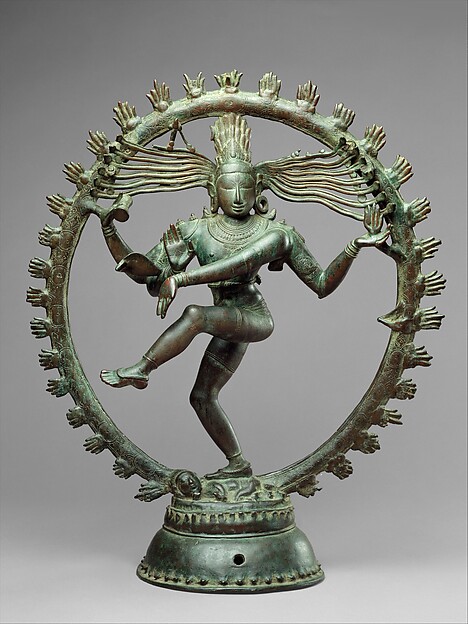
Shiva as Lord of Dance (Nataraja)

Shiva Seated with Uma (Umamaheshvara)
Academic Discussion & Critique
Exchange peer-reviewed hypotheses, comparative Indo-European etymologies, and archaeological field interpretations regarding Shiva.
You Might Also Like
Brahma
The four-faced creator god, born from a lotus rising from Vishnu's navel. First of the Trimurti, yet temples dedicated to him are famously rare.
Durga
The ten-armed goddess on a lion, forged from the combined powers of the gods to slay the buffalo demon Mahishasura, whom no male god could defeat. Bengal's Durga Puja is among India's greatest festivals.
Ganesha
The pot-bellied, elephant-headed god of wisdom, son of Shiva and Parvati, riding a mouse. Every beginning—a journey, a ledger, a book—opens with an invocation to him.
Kali
The night-black goddess with lolling tongue and a garland of severed heads, sword in hand, standing on the prone Shiva. She drinks demon blood, yet devotees revere her as the fiercest of mothers.