

Amaterasu
Also known as: Amaterasu-omikami
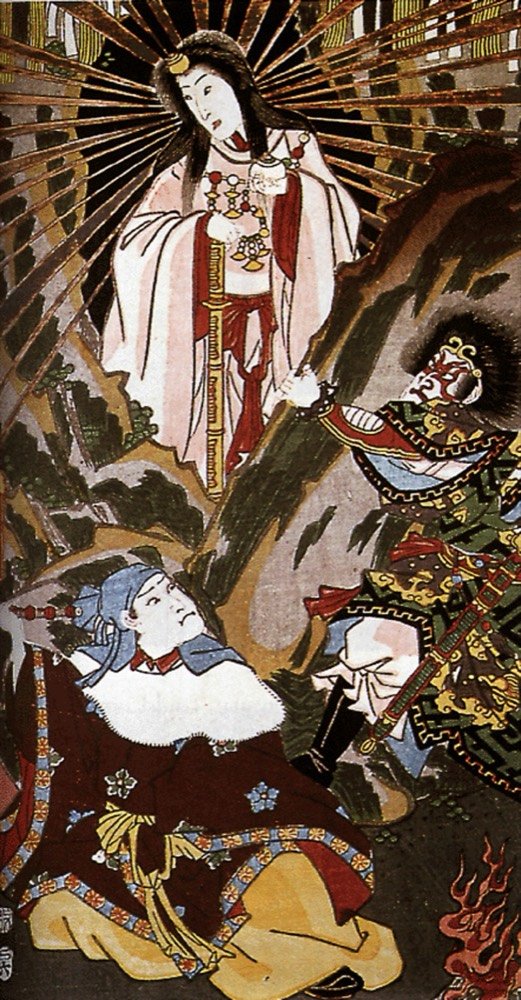
Mythological Narrative
Amaterasu Omikami is the sun goddess of Japanese myth and ruler of Takamagahara, the Plain of High Heaven. According to the Kojiki she was born when the creator god Izanagi, purifying himself in a river in Hyuga after escaping the land of the dead, washed his left eye; the moon god Tsukuyomi and the storm god Susanoo emerged from his right eye and nose in the same rite, making up the three noble children.
Her defining episode is that of the Heavenly Rock Cave. When Susanoo wrecked her rice-field ridges, defiled her hall, and hurled a flayed piebald colt into her weaving house, killing a weaving maiden, Amaterasu shut herself inside Ame-no-Iwato and both heaven and earth went dark. The assembled gods lured her out with a great mirror, curved jewels, and the wild dance of Ame-no-Uzume. She later sent her grandson Ninigi down to earth bearing the mirror, sword, and jewel, the descent through which the eighth-century chronicles trace the imperial line back to her.
The Inner Shrine of Ise enshrines Amaterasu with the mirror Yata-no-Kagami as its sacred object, and its buildings are rebuilt every twenty years in the shikinen sengu rite, a practice still observed today.
Scholarly Commentary & Evolution
## The Supreme Sun Goddess
**Amaterasu-omikami** stands as the most important deity in Shinto, embodying the sun itself and serving as the divine ancestor of Japan's Imperial family. Her name translates to "Great Divinity Illuminating Heaven," reflecting her role as the source of all light and life in the cosmos.
## The Cave Myth
The most famous myth surrounding Amaterasu involves her retreat into the **Ama-no-Iwato** (Heavenly Rock Cave). After her brother Susanoo's destructive rampage through her rice fields and sacred weaving hall, a grieving Amaterasu hid herself away, plunging the world into darkness. The eight million kami gathered outside the cave, and the goddess **Ame-no-Uzume** performed a wild, ecstatic dance that provoked such laughter among the gods that Amaterasu's curiosity drew her out. As she emerged, a mirror was held before her, and she was captivated by her own radiant reflection.
## Imperial Connection
Amaterasu bestowed upon her grandson Ninigi the **Three Sacred Treasures**—the mirror Yata no Kagami, the sword Kusanagi, and the jewel Yasakani no Magatama—symbols still central to Japanese imperial regalia today. Through Ninigi's lineage, she is considered the direct ancestor of the Japanese emperors.
## Worship and Shrines
The **Ise Grand Shrine** in Mie Prefecture is Amaterasu's holiest sanctuary, rebuilt every twenty years in an ancient tradition of renewal. Millions of pilgrims visit annually during festivals such as the **Kannamesai** harvest celebration. She represents not only agricultural fertility but also the spiritual purity and continuity of the Japanese nation.
Cross-Pantheon Parallels & Archetypes
Classical Art & Museum Artifacts
High-resolution museum artifacts, classical sculptures, pottery reliefs, and bronze idols preserving authentic historical representations of Amaterasu.

Luring the Sun Goddess Amaterasu Out of a Cave with Music; Death of the Historical Buddha
Academic Discussion & Critique
Exchange peer-reviewed hypotheses, comparative Indo-European etymologies, and archaeological field interpretations regarding Amaterasu.
You Might Also Like
Izanagi
The male creator who stirred the sea into islands with Izanami and fathered the land and its gods; after a failed descent to the underworld, his purification produced the three noble children.
Susanoo
Amaterasu's tempestuous younger brother. Expelled from heaven, he descended to Izumo, got the eight-headed serpent drunk on strong sake, slew it, and drew the sword Kusanagi from its tail.
Tsukuyomi
The moon god born from Izanagi's right eye, given the realm of night. The chronicles record almost nothing of him beyond one episode: his killing of the food goddess Ukemochi.
Ama-no-Iwato
Outraged by Susanoo's violence, Amaterasu sealed herself in a rock cave and the world went dark, until the gods lured her out with a mirror, jewels, and Ame-no-Uzume's wild dance.