

Ebisu
Also known as: Yebisu, Hiruko, Kotoshironushi
Mythological Narrative
One of the Seven Lucky Gods (Shichifukujin). God of fishermen, merchants, and honest labor. The only purely Japanese deity among the Seven, known for his cheerful disposition.
Scholarly Commentary & Evolution
## The Laughing God of Fortune
**Ebisu** is the cheerful, rotund deity of fishermen, merchants, and prosperity through honest work. He is one of the beloved **Shichifukujin** (Seven Lucky Gods) and holds the distinction of being the only member of this group who originated entirely within Japan—the others derive from Chinese or Indian traditions.
### The Leech Child
One origin story connects Ebisu to **Hiruko** (Leech Child), the malformed first child of Izanagi and Izanami who was set adrift on the primordial waters because he could not stand at age three. Rather than perishing, Hiruko drifted to the shores of Ezo (Hokkaido) where the Ainu people found and raised him. He eventually became Ebisu, transforming his early rejection into a symbol of perseverance and the unexpected blessings that can come from the sea.
### Iconography
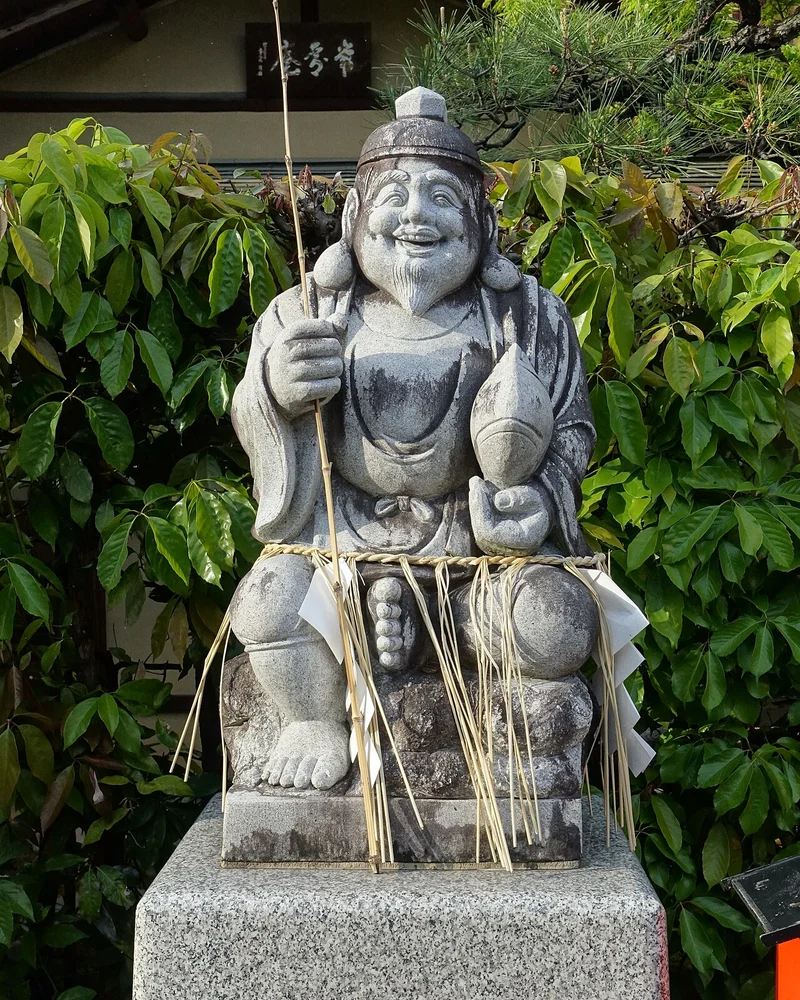
Ebisu is instantly recognizable in Japanese art: a plump, smiling figure wearing the tall **eboshi** cap of a nobleman, holding a fishing rod in one hand and clutching a large **tai** (sea bream) under his other arm. The sea bream, colored red and associated with celebrations, puns with the word *medetai* (auspicious). His ever-present grin reflects the contentment that comes from honest labor rewarded.
### The Deaf God
A curious tradition holds that Ebisu is slightly deaf. During the **Kannazuki** (Godless Month) of October, when all the kami travel to Izumo Grand Shrine for their annual assembly, Ebisu remains behind—he simply does not hear the summons. Communities hold special **Ebisu-ko** festivals during this time, honoring the one god who stays to watch over them.
### Merchant's Patron
Beyond fishing communities, Ebisu became the patron of merchants and commerce during the Edo period. Shopkeepers display his image for good fortune in business. The famous Japanese beer brand Yebisu takes his name, and January 10th—**Toka Ebisu**—sees merchants across Japan visiting his shrines to pray for a prosperous year.
Cross-Pantheon Parallels & Archetypes
Academic Discussion & Critique
Exchange peer-reviewed hypotheses, comparative Indo-European etymologies, and archaeological field interpretations regarding Ebisu.
You Might Also Like
Hermes
God of messengers, commerce, thieves, and travelers. Son of Zeus and the nymph Maia, known for his cunning and speed.
Inari
Kami of rice, fertility, agriculture, industry, and prosperity. One of the most popular kami in Japan. Associated with foxes (kitsune) as messengers.
Amaterasu
The sun goddess who rules Takamagahara and heads the imperial mythic lineage; her retreat into the Heavenly Rock Cave plunged heaven and earth into darkness.
Ame-no-Uzume
Goddess of dawn, mirth, and revelry. Her wild, comedic dance lured Amaterasu from the Heavenly Rock Cave, restoring light to the world. Ancestral deity of performing arts.