

Perseus
Also known as: Slayer of Medusa, Son of the Golden Rain
Mythological Narrative
Scholarly Commentary & Evolution
## The Gorgon-Slayer
**Perseus** is among the greatest of the Greek heroes, predating Heracles and representing the archetypal monster-slayer favored by the gods. His myths are preserved in Apollodorus's *Bibliotheca*, Ovid's *Metamorphoses*, and fragments of earlier traditions.
### The Golden Rain
King **Acrisius** of Argos imprisoned his daughter **Danae** in a bronze chamber (or underground vault) after the Delphic oracle prophesied that her son would kill him. Zeus desired Danae and came to her as a shower of golden rain that streamed through the roof. She bore Perseus in secret, but Acrisius discovered the child and, unable to kill his own kin, cast both mother and son into the sea in a wooden chest. They washed ashore on **Seriphos**, where the fisherman **Dictys** rescued them.
### The Quest for Medusa's Head
Years later, King **Polydectes** of Seriphos desired Danae. To remove Perseus, he demanded the head of **Medusa**, the only mortal Gorgon, whose gaze turned men to stone. The gods aided Perseus: **Athena** gave him a polished bronze shield to view Medusa's reflection, **Hermes** provided winged sandals and the sickle-sword (*harpe*), and the **Graeae** (or Nymphs, in some versions) supplied the cap of invisibility and the *kibisis*, a magical bag to safely contain the severed head.
Perseus flew to the western edge of the world where the Gorgons dwelt. Using his shield as a mirror, he approached the sleeping Medusa and beheaded her with a single stroke. From her neck sprang **Pegasus** and the warrior **Chrysaor**, children she had conceived with Poseidon. Perseus fled with the head as Medusa's immortal sisters pursued him.
### The Rescue of Andromeda
Returning home, Perseus saw **Andromeda** chained to a rock by the sea in Ethiopia. Her mother **Cassiopeia** had boasted of surpassing the Nereids in beauty, and Poseidon sent the sea monster **Cetus** to ravage the coast. The oracle demanded Andromeda as sacrifice. Perseus slew Cetus—either with his sword or by revealing Medusa's head—and claimed Andromeda as his bride. At their wedding feast, he turned her former suitor **Phineus** and his followers to stone with the Gorgon's gaze.
### Return to Seriphos and Argos
Back on Seriphos, Perseus found that Polydectes had been persecuting his mother. He entered the king's hall during a banquet and displayed Medusa's head, turning Polydectes and his courtiers to stone. He gave the head to Athena, who set it in her aegis.
Perseus then returned to Argos to reconcile with Acrisius. His grandfather fled to Larissa, but fate could not be escaped. During funeral games, Perseus threw a discus that struck and killed Acrisius, fulfilling the prophecy. Ashamed to rule Argos, Perseus exchanged kingdoms with his cousin **Megapenthes**, becoming king of Tiryns instead. He founded **Mycenae** and became ancestor to **Heracles** through his son **Electryon**.
### Legacy
Perseus was honored as founder of Mycenae and was placed among the stars as the constellation that bears his name. His myth exemplifies the Greek hero's journey: divine parentage, exile, quest, monster-slaying, marriage, and the establishment of a royal line.
Cross-Pantheon Parallels & Archetypes
Classical Art & Museum Artifacts
High-resolution museum artifacts, classical sculptures, pottery reliefs, and bronze idols preserving authentic historical representations of Perseus.
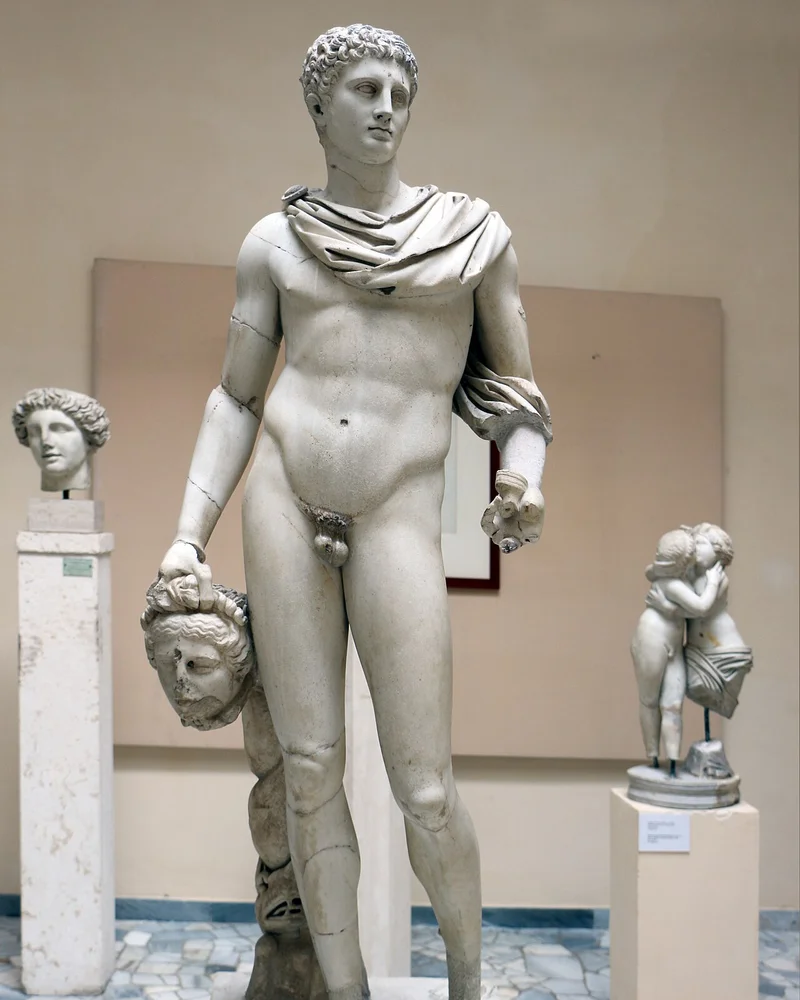
Perseus with the Head of Medusa
Academic Discussion & Critique
Exchange peer-reviewed hypotheses, comparative Indo-European etymologies, and archaeological field interpretations regarding Perseus.
You Might Also Like
Rama
Hero of the Ramayana: exiled fourteen years to honour his father's word, he led an army of monkeys and bears across the sea to Lanka, slew Ravana, rescued Sita, and returned to be crowned.
Aphrodite
Goddess of love and beauty, born from sea foam in Hesiod's account and landing on Cyprus. Her victory in the Judgement of Paris set the Trojan War in motion.
Apollo
God of light, prophecy, music, and healing, son of Zeus and Leto, born on Delos. He slew the serpent Python and founded his oracle at Delphi.
Ares
God of war, violence, and bloodshed. Son of Zeus and Hera, representing the brutal and chaotic aspects of warfare.