

Aphrodite
Also known as: Venus, Kypris
Mythological Narrative
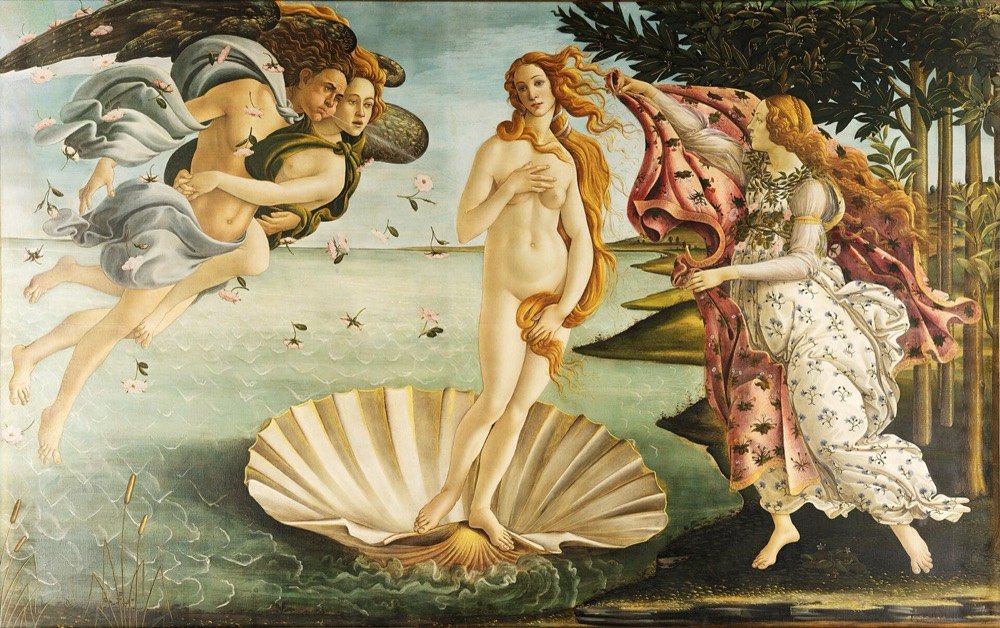
Aphrodite is the goddess of love and beauty. In Hesiod's Theogony she is born from sea foam: when Cronus castrated his father Uranus with a sickle, the severed flesh fell into the sea and white foam gathered around it, from which the goddess rose, passing Cythera before stepping ashore at Paphos on Cyprus, grass springing up beneath her feet. Homer instead makes her a daughter of Zeus and Dione. Doves, swans, and myrtle are sacred to her, and the embroidered band at her waist kindles desire in gods and mortals alike.
Married to the smith god Hephaestus, she loved Ares; the eighth book of the Odyssey sings of how her husband snared the pair in an invisible net of gold, fine as spider silk, before the laughing assembly of the gods. Her promise of the world's most beautiful woman won her the golden apple over Hera and Athena in the Judgement of Paris, and Paris carried off Helen of Sparta in consequence. Her sanctuary at Paphos on Cyprus received worshippers from the late Bronze Age for over a thousand years, the most famous center of her cult in the ancient Mediterranean.
Scholarly Commentary & Evolution
## The Cyprian
Aphrodite is the irresistible goddess of love and beauty. Though married to Hephaestus, she had many lovers, most notably Ares. She has the power to make anyone fall in love, a power that even Zeus cannot resist.
### Birth from Foam
She was born from the white foam (*aphros*) produced by the severed genitals of Uranus when they were thrown into the sea. She washed ashore on Cyprus (or Cythera), where she was attended by the Seasons.
### Desire As Social Force
Greek myth uses Aphrodite to explain far more than romance. She drives political alliances, humiliations, marriages, rivalries, and catastrophic choices, which is why she stands near the center of stories like the Judgment of Paris and the Trojan cycle. Her sphere is desire as a civilizing and destabilizing power at the same time.
Cross-Pantheon Parallels & Archetypes
Classical Art & Museum Artifacts
High-resolution museum artifacts, classical sculptures, pottery reliefs, and bronze idols preserving authentic historical representations of Aphrodite.
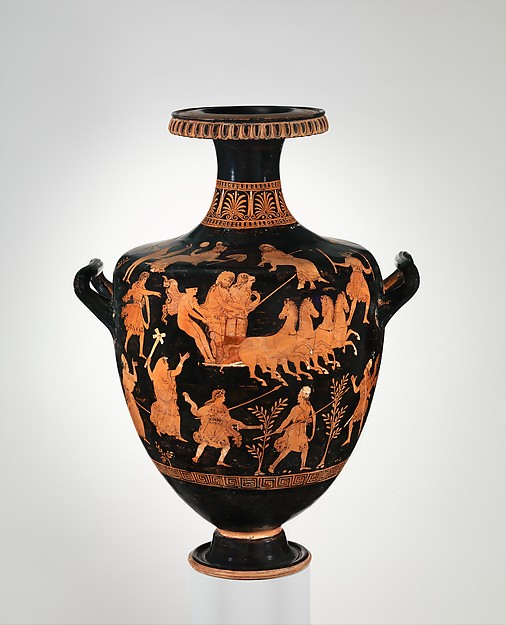
Terracotta hydria (water jar)

Marble statuette of Aphrodite

Marble statue of a crouching Aphrodite

Marble statue of Aphrodite, the so-called Venus Genetrix
Academic Discussion & Critique
Exchange peer-reviewed hypotheses, comparative Indo-European etymologies, and archaeological field interpretations regarding Aphrodite.
You Might Also Like
Zeus
King of the Olympian gods, ruler of sky and thunder. After overthrowing his father Cronus, he drew the sky when the three brothers divided the cosmos by lot.
Mount Olympus
The highest mountain in Greece, its peak Mytikas at 2,917 meters. Greeks placed the home of the twelve chief gods on its cloud-wrapped summit, hence the name Olympians.
Trojan War
The ten-year siege of Troy by a Greek coalition to recover Helen; the Iliad sings its final year, and the city fell to the wooden horse.
Freyja
Vanir-born goddess of love and fertility who wears the necklace Brisingamen and drives a cat-drawn chariot; half of all battle-slain go to her field, Folkvangr.