

Rama
Also known as: Ramachandra, Maryada Purushottama
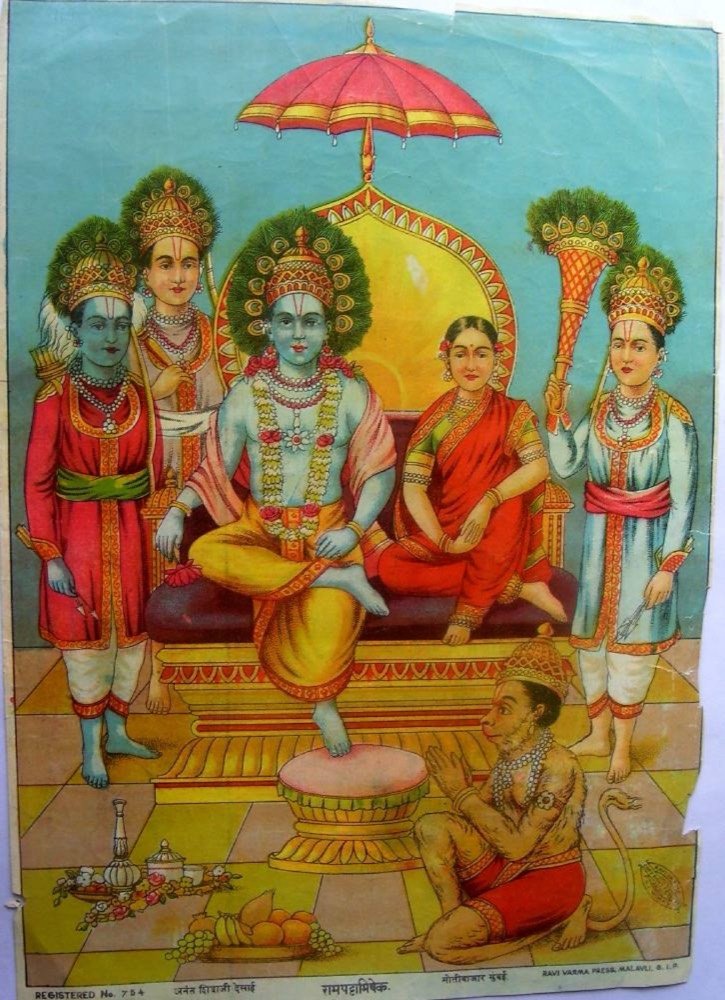
Mythological Narrative
Rama is the eldest prince of Ayodhya in the kingdom of Kosala, dark-skinned, bow on shoulder, revered as the seventh avatar of Vishnu and the very embodiment of dharma—the epic calls him the ideal son, husband and king. As a youth, studying under the sage Vishvamitra, he bent and broke the bow of Shiva that no man could string, winning the hand of Sita, daughter of King Janaka.
Valmiki's Ramayana—seven books, some 24,000 verses, composed between roughly the 5th century BCE and the early centuries CE—tells his story. On the eve of his coronation his father, bound by an old promise, exiled him for fourteen years; Rama walked into the forest without complaint, Sita and his brother Lakshmana beside him. The demon king Ravana lured the brothers away and carried Sita off to Lanka. Rama allied with the monkey king Sugriva; Hanuman leapt the ocean and found Sita; the monkey and bear armies bridged the strait with boulders—Rama's Bridge—and in the war that followed Rama drove the arrow of Brahma through Ravana's heart. When he returned to Ayodhya, the city was lit with rows of lamps: one origin of the festival of Diwali. The epic's last book turns bitter: yielding to public gossip, Rama banished the pregnant Sita, who bore him twin sons in Valmiki's hermitage and at last asked the earth, her mother, to take her back.
'Rama Rajya' remains a byword for the just kingdom. The epic spread across Asia as Thailand's Ramakien and Cambodia's Reamker, and the kings of Thailand's Chakri dynasty reign to this day under the name Rama. In modern India the site held to be his birthplace at Ayodhya became the centre of a bitter dispute; the new Rama temple there was consecrated in 2024.
Scholarly Commentary & Evolution
## The Ideal Man
Rama is the seventh avatar of **Vishnu** and the hero of the **Ramayana** epic. Known as *Maryada Purushottama* ("the perfect man who follows dharma"), he embodies the ideals of virtue, duty, honor, and righteous conduct.
### Prince of Ayodhya
Born as the eldest son of King Dasharatha of Ayodhya, Rama was exiled for fourteen years due to a palace intrigue. Accompanied by his wife **Sita** and brother **Lakshmana**, he lived in the forest, fulfilling his duty to honor his father's promise.
### The Ramayana
When Sita was kidnapped by the demon king **Ravana**, Rama allied with the monkey king Sugriva and the devoted **Hanuman** to rescue her. The war against Ravana in Lanka demonstrated Rama's prowess as a warrior and his commitment to defeating evil.
### Rama Rajya
After defeating Ravana and rescuing Sita, Rama returned to Ayodhya to rule. His reign, called **Rama Rajya**, represents the ideal kingdom of peace, prosperity, and justice. The festival **Diwali** celebrates his return, and **Ram Navami** marks his birthday. The mantra **"Sri Ram Jai Ram Jai Jai Ram"** is chanted by devotees.
Cross-Pantheon Parallels & Archetypes
Classical Art & Museum Artifacts
High-resolution museum artifacts, classical sculptures, pottery reliefs, and bronze idols preserving authentic historical representations of Rama.
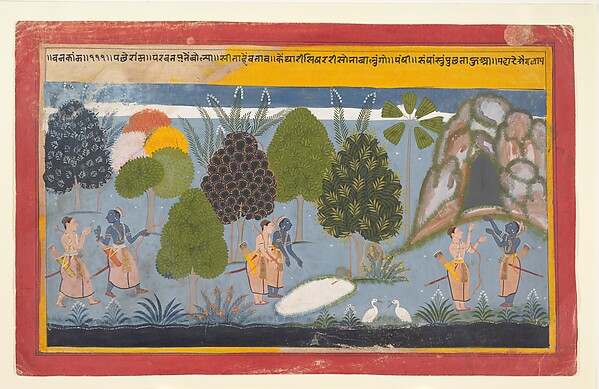
Rama and Lakshmana Search in Vain for Sita: Illustrated folio from a dispersed Ramayana series
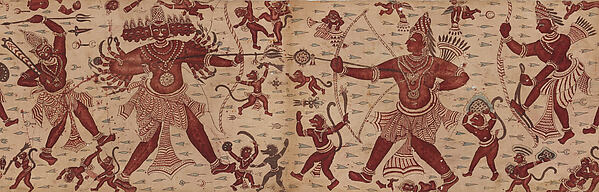
The Combat of Rama and Ravana
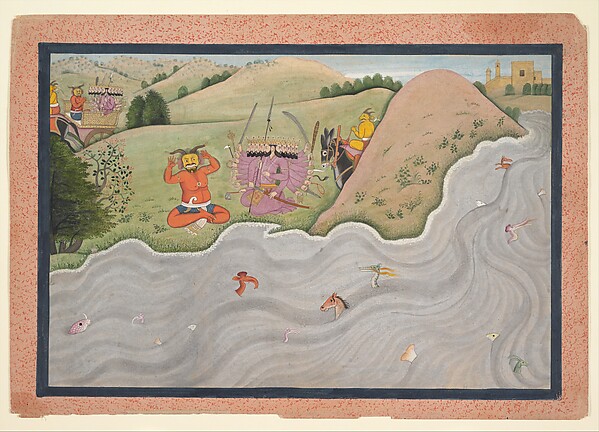
The Demon Marichi Tries to Dissuade Ravana; Illustrated folio from a dispersed Ramayana series

Hanuman Conversing
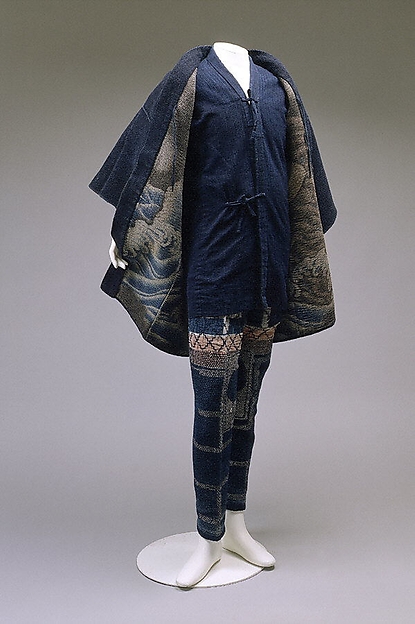
Fireman’s Jacket (Hikeshi-Banten) with Susanoo-no-mikoto Deity Scene
Academic Discussion & Critique
Exchange peer-reviewed hypotheses, comparative Indo-European etymologies, and archaeological field interpretations regarding Rama.
You Might Also Like
Vishnu
The blue-skinned preserver who reclines on the serpent Shesha upon the ocean of milk, descending as avatars—Rama and Krishna among them—whenever cosmic order fails.
Hanuman
The mighty monkey son of the wind god: he leapt the ocean to find Sita, burned Lanka with his tail, and carried a mountain of herbs to save Lakshmana. Devotion to Rama made him India's best-loved champion.
Krishna
Vishnu's eighth avatar: the blue cowherd with a flute who lifted Mount Govardhana on one finger, slew the tyrant Kamsa, and as Arjuna's charioteer spoke the Bhagavad Gita on the battlefield.
Rakshasa
Shape-shifting man-eaters strongest after dark, fanged and clawed, defilers of sacrifices. Ten-headed Ravana is their king—though some, like his brother Vibhishana, chose the side of dharma.