

Kokkuri-san
Mythological Narrative
The modern form is handed down through Japanese schoolyards: a sheet of paper with a torii gate drawn at the top, 'yes' and 'no,' and the fifty kana with numerals below; each player rests one finger on a ten-yen coin and all chant, 'Kokkuri-san, Kokkuri-san, please come.' The coin begins to slide, spelling out answers, exam questions, a crush's name, the date of one's death. The rules bristle with taboos: never lift your finger midway, always send the spirit off with 'please return home,' tear up the paper, spend the coin that day. Violators are possessed by the fox spirit. The game swept elementary and middle schools in the 1970s, trailing episodes of mass hysteria that led many schools to ban it, and the bans became part of the allure.
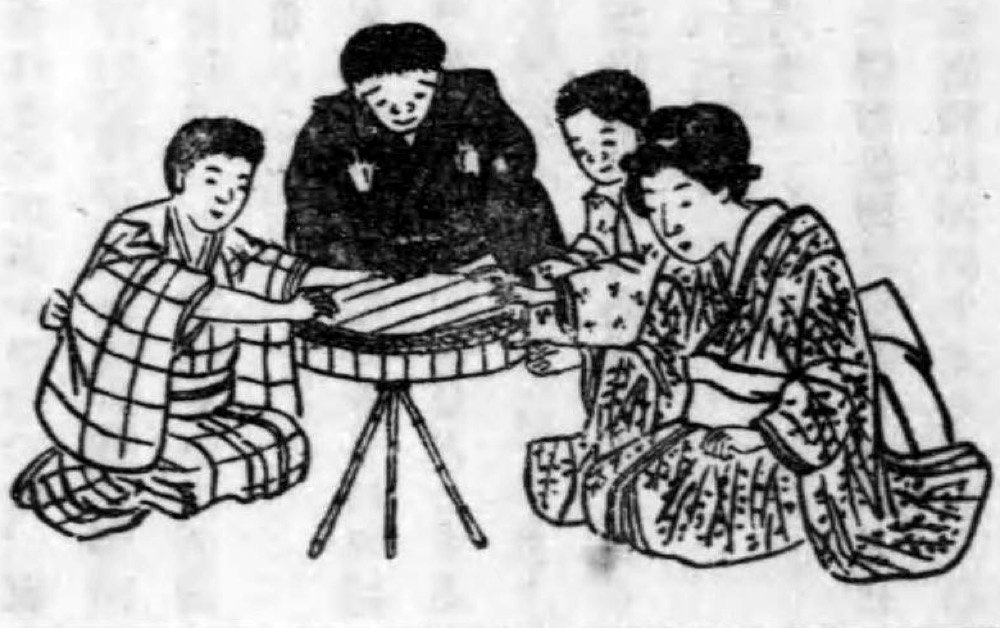
Its pedigree is imported. In 1884 sailors from a Western ship introduced table-turning, then the rage of European and American spiritualism, at the Izu peninsula; the Japanese version balanced a rice-tub lid on three bamboo stalks and read the tilting as speech. The craze crossed the country under the name kokkuri, 'the nodding,' soon dressed in the characters for fox, dog, and tanuki. The philosopher Inoue Enryo dissected it in his Yokai Gendan (1887), diagnosing unconscious muscular movement, a founding case of Meiji 'monsterology' and its campaign of disenchantment.
From the Meiji rice-tub lid to the Showa ten-yen coin, Kokkuri-san was domesticated from parlor seance into playground rite, a sibling of the Western Ouija board by parallel descent. In horror manga and film it remains the standard first scene of a door that should have stayed shut.
Academic Discussion & Critique
Exchange peer-reviewed hypotheses, comparative Indo-European etymologies, and archaeological field interpretations regarding Kokkuri-san.
You Might Also Like
Aka Manto
A voice in the toilet stall asks, 'Red cloak or blue cloak?' Red brings death drenched in blood, blue death drained of it. The earliest documented outbreak was the Aka Manto panic among Tokyo schoolchildren in February 1939.
Hanako-san of the Toilet
Knock three times on the third stall of the third-floor school toilet and ask, 'Hanako-san, are you there?' A small voice answers, 'I'm here.' The best-known figure of Japanese school ghost lore, a nationwide craze by the 1980s.
Satoru-kun
Call your own mobile from a pay phone and recite the summons: Satoru-kun phones back ever closer, finally standing behind you to answer any one question. Never turn around, never fail to ask. Spread online in the 2000s.
The Peony Lantern
Night after night the ronin Shinzaburo meets his lover Otsuyu, who arrives with a peony lantern, geta clacking. A neighbor peers in and sees a skeleton in his arms. The most romantic of Edo's great ghost tales.