

Jinmenken
Mythological Narrative
Jinmenken sightings share a fixed stage set: a garbage collection point late at night, or a highway. A stray dog nosing the trash is startled by a passerby and turns its head, and on the dog's body is an unmistakably human face, usually that of a tired middle-aged man. It speaks, most often something world-weary like 'hottoite kure,' leave me alone, then goes back to the garbage. In the highway variant it runs among the traffic at over a hundred kilometers an hour and glances back at drivers through the window; a car overtaken by the jinmenken is said to crash. It attacks no one, and those it addresses suffer at worst a run of bad luck. Within the urban-legend bestiary it is less a monster than a hermit refusing conversation.
The rumor detonated in the autumn and winter of 1989, as girls' magazines, tabloid weeklies, and late-night radio recycled one another's reader sightings, peaking in 1990; folklorists pair it with the 1979 kuchisake-onna panic as the two great rumor storms of postwar Japan. The image fit its moment exactly: Tokyo at the end of the bubble economy, and by the trash heap the face of an overworked man saying leave me alone. Commentators caught the comic melancholy at the time, and the jinmenken has been told as a joke as often as a horror.
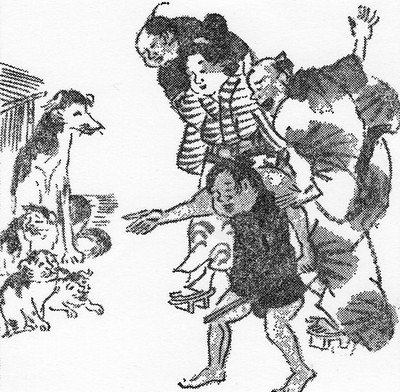
Nor was the man-faced beast unprecedented: Edo-period sideshows and broadsheets record jinmenken and man-faced cattle, and Meiji newspapers ran similar wonders. The Heisei dog was that old thread reborn in mass media, and it soon had descendants, most famously the man-faced carp photographs that made their own sensation in the early 1990s.
Academic Discussion & Critique
Exchange peer-reviewed hypotheses, comparative Indo-European etymologies, and archaeological field interpretations regarding Jinmenken.
You Might Also Like
Kuchisake-onna
A masked woman stops schoolchildren to ask 'Am I pretty?', then pulls the mask down on a mouth slit to the ears and asks again. The rumor rose in Gifu in winter 1978 and swept Japan by summer 1979.
Teke-Teke
A woman cut in half by a train survives as a torso that sprints on its elbows with a 'teke-teke' clatter and slices those it catches in two. A staple of 1980s Japanese school ghost lore.
Mary-san's Phone Call
The doll you threw away telephones: 'This is Mary. I'm at the dump now.' Each call she is closer, and the last one says: 'I'm right behind you.' Told among Japanese children since the 1970s-80s.
Aka Manto
A voice in the toilet stall asks, 'Red cloak or blue cloak?' Red brings death drenched in blood, blue death drained of it. The earliest documented outbreak was the Aka Manto panic among Tokyo schoolchildren in February 1939.