

Teke-Teke
Mythological Narrative
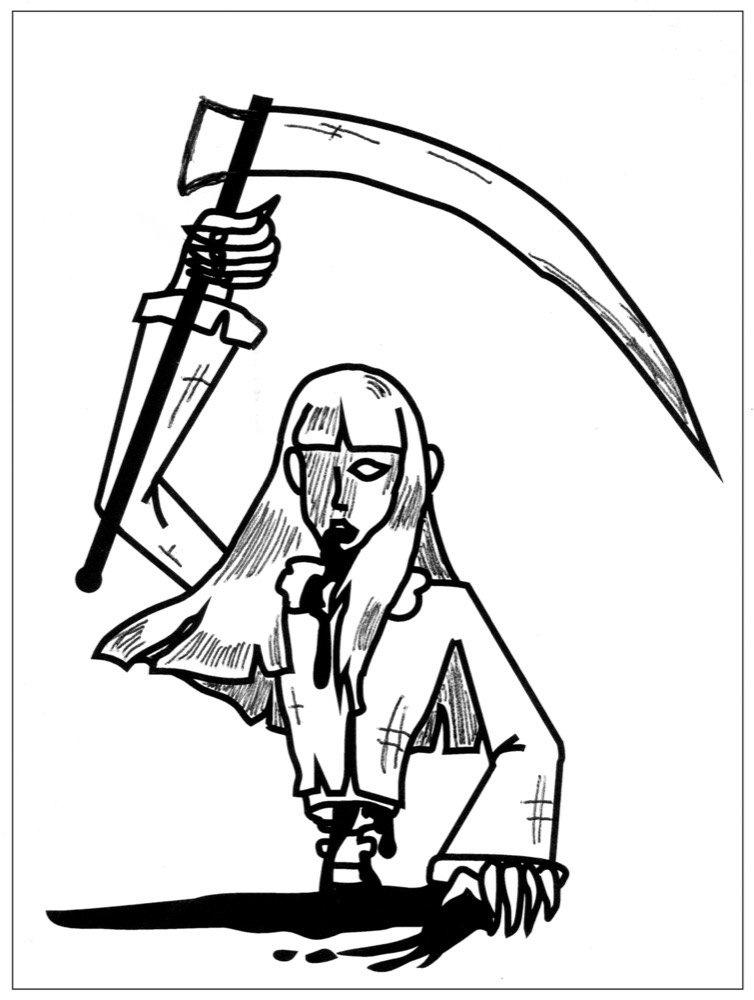
The name is the sound it makes. A woman severed at the waist propels her torso on elbows and palms, teke, teke, teke, fast enough to run down a car. In life, the story goes, she was cut in half by a train; the winter cold froze the wound and she did not die at once, dragging herself along the ballast. Now she haunts stations, footbridges, and schoolyards at dusk, and whoever meets her is scythed or sawed in two at the waist and joins her kind. Many versions close with a chain-letter clause: now that you have heard this, she will come within three days.
The figure passed by word of mouth among elementary schoolers in the 1980s and hardened into canon during the 1990s school-kaidan publishing boom. Hokkaido is often named as the legend's home ground, as it is for the closely related Kashima-san, sometimes given the full name Kashima Reiko: she telephones at night or appears at the bedside to ask, 'Where are my legs?' The wrong answer kills; the right one is 'On the Meishin Expressway,' and to the follow-up 'How do you know?' one must answer, 'Kashima-san told me.' This call-and-response grammar runs through the kuchisake-onna's questions and the summoning rituals of school lore alike.
Shiraishi Koji's two Teketeke films appeared in 2009. No documented lineage connects her to older half-bodied ghosts of the snow country or the vengeful women of the noh stage; she is a new creature, grown in the postwar landscape of railways and station platforms.
Academic Discussion & Critique
Exchange peer-reviewed hypotheses, comparative Indo-European etymologies, and archaeological field interpretations regarding Teke-Teke.
You Might Also Like
Hanako-san of the Toilet
Knock three times on the third stall of the third-floor school toilet and ask, 'Hanako-san, are you there?' A small voice answers, 'I'm here.' The best-known figure of Japanese school ghost lore, a nationwide craze by the 1980s.
Kuchisake-onna
A masked woman stops schoolchildren to ask 'Am I pretty?', then pulls the mask down on a mouth slit to the ears and asks again. The rumor rose in Gifu in winter 1978 and swept Japan by summer 1979.
Mary-san's Phone Call
The doll you threw away telephones: 'This is Mary. I'm at the dump now.' Each call she is closer, and the last one says: 'I'm right behind you.' Told among Japanese children since the 1970s-80s.
Aka Manto
A voice in the toilet stall asks, 'Red cloak or blue cloak?' Red brings death drenched in blood, blue death drained of it. The earliest documented outbreak was the Aka Manto panic among Tokyo schoolchildren in February 1939.