

Ganesha
Also known as: Ganapati, Vinayaka, Vighnaharta
Mythological Narrative
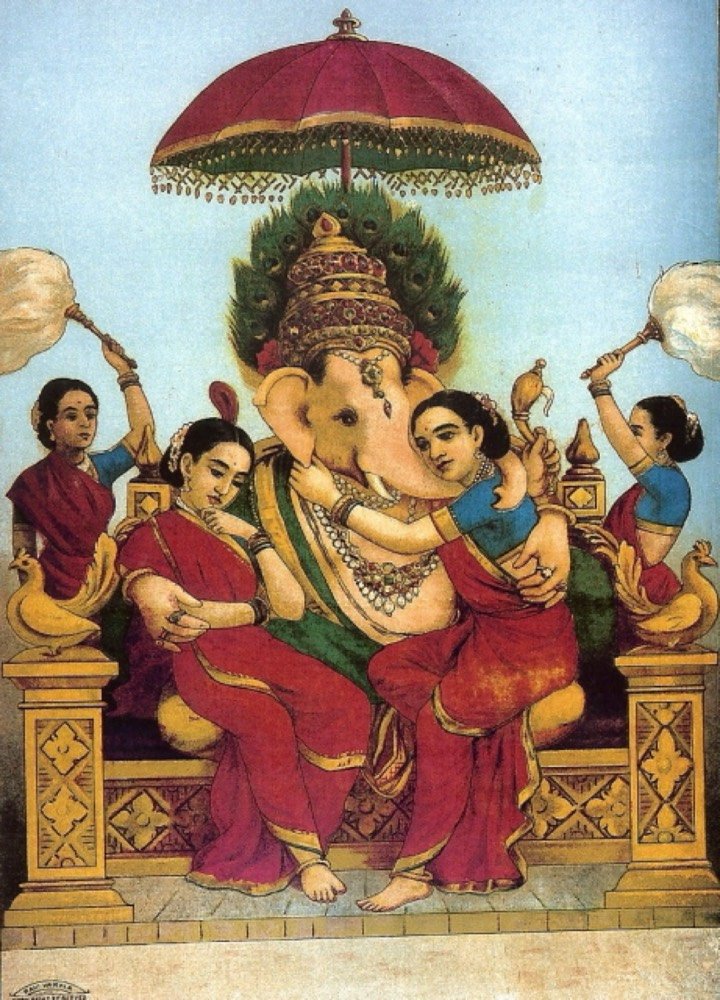
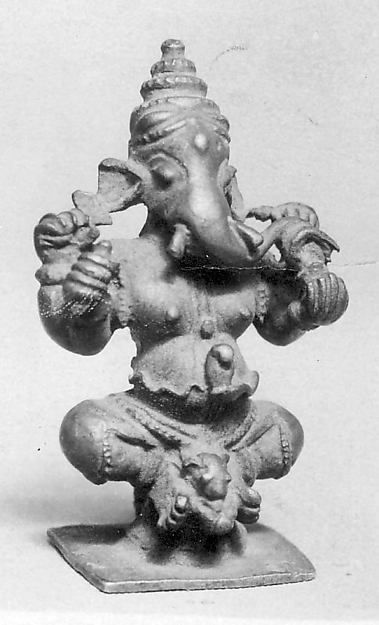
Ganesha has the head of an elephant on a boy's plump body: winnowing-fan ears, one tusk broken, a serpent knotted about his round belly, four hands holding an axe, a noose, the broken tusk and a bowl of modak sweets. His mount is a mouse named Mushika. God of wisdom, letters and commerce, he bears the title Vighneshvara, Lord of Obstacles—he who places them and, above all, removes them, which is why Hindus invoke him before any undertaking.
The Shiva Purana tells of his origin: Parvati shaped a boy from the paste of her own body and set him to guard her bath. Shiva, barred from his own door by the stranger, struck off the boy's head in fury. To calm Parvati's grief he had his attendants bring the head of the first creature they met—an elephant—and set it on the child's neck, making him chief of his attendant host, the ganas; hence the name Ganesha, Lord of the Ganas. Of the broken tusk many stories are told; the most repeated has Ganesha snapping it off to serve as a pen when the sage Vyasa dictated the hundred-thousand-verse Mahabharata without pause.
Ganesh Chaturthi, in August or September, reaches its height in Maharashtra: households and street associations install clay images of the god and, after ten days, carry them in procession to be immersed in the sea or a river—in Mumbai alone the immersions number in the hundreds of thousands. Ganesha travelled east with Hinduism and Buddhism, entering Chinese Buddhist texts as Huanxitian, the elephant-trunked deva.
Scholarly Commentary & Evolution
## The Remover of Obstacles
Ganesha is the beloved elephant-headed god of **wisdom**, new beginnings, and the remover of obstacles. Son of **Shiva** and **Parvati**, he is worshipped before any new venture, journey, or undertaking. He is also the patron of arts, sciences, and learning.
### The Elephant Head
Parvati created Ganesha from sandalwood paste and clay to guard her privacy. When Shiva returned and was blocked by the boy, not recognizing him, he beheaded him in anger. To console the grieving Parvati, Shiva replaced Ganesha's head with that of the first creature found—an elephant.
### Divine Attributes
Ganesha's **large ears** hear all prayers; his **trunk** symbolizes adaptability and strength. His **big belly** contains infinite universes. He holds an **axe** (to cut attachments), a **rope** (to pull devotees closer), a **lotus** (spiritual awakening), and a **modak** (sweet of wisdom). His mount is a **mouse**, representing controlled desires.
### Ganesh Chaturthi
The festival of **Ganesh Chaturthi** celebrates his birthday with elaborate clay idols, prayers, and processions ending in immersion. The mantra **"Om Gam Ganapataye Namah"** is recited to invoke his blessings for new beginnings.
Cross-Pantheon Parallels & Archetypes
Classical Art & Museum Artifacts
High-resolution museum artifacts, classical sculptures, pottery reliefs, and bronze idols preserving authentic historical representations of Ganesha.

Seated Ganesha
Ganesha
Academic Discussion & Critique
Exchange peer-reviewed hypotheses, comparative Indo-European etymologies, and archaeological field interpretations regarding Ganesha.
You Might Also Like
Durga
The ten-armed goddess on a lion, forged from the combined powers of the gods to slay the buffalo demon Mahishasura, whom no male god could defeat. Bengal's Durga Puja is among India's greatest festivals.
Shiva
The three-eyed god of destruction and renewal, blue-throated and moon-crowned, the Ganges falling through his matted hair. From Mount Kailash he dances the universe to its end and rebirth.
Janus
God of beginnings, gates, transitions, time, duality, doorways, passages, and endings. Uniquely Roman deity with no Greek equivalent. Depicted with two faces looking to past and future.
Krishna
Vishnu's eighth avatar: the blue cowherd with a flute who lifted Mount Govardhana on one finger, slew the tyrant Kamsa, and as Arjuna's charioteer spoke the Bhagavad Gita on the battlefield.