

Cronus
Also known as: Kronos, Saturn (Roman)
Mythological Narrative
Scholarly Commentary & Evolution
## The Titan King
Cronus was the youngest and, in Hesiod's words, "the most terrible" of the twelve Titans born to Uranus (Sky) and Gaia (Earth). At his mother's urging, he ended his father's oppressive rule of the cosmos and became king of the Titans, ruling during what later poets called the Golden Age, a time of ease and abundance before toil and old age.
### The Castration of Uranus
Uranus hated the children Gaia bore him and hid them away inside her, causing her great pain. Gaia forged a sickle of adamant and asked her sons to punish their father. Only Cronus agreed. He ambushed Uranus, castrated him, and cast the severed member into the sea, from whose foam Aphrodite was born.
### Swallowing His Children
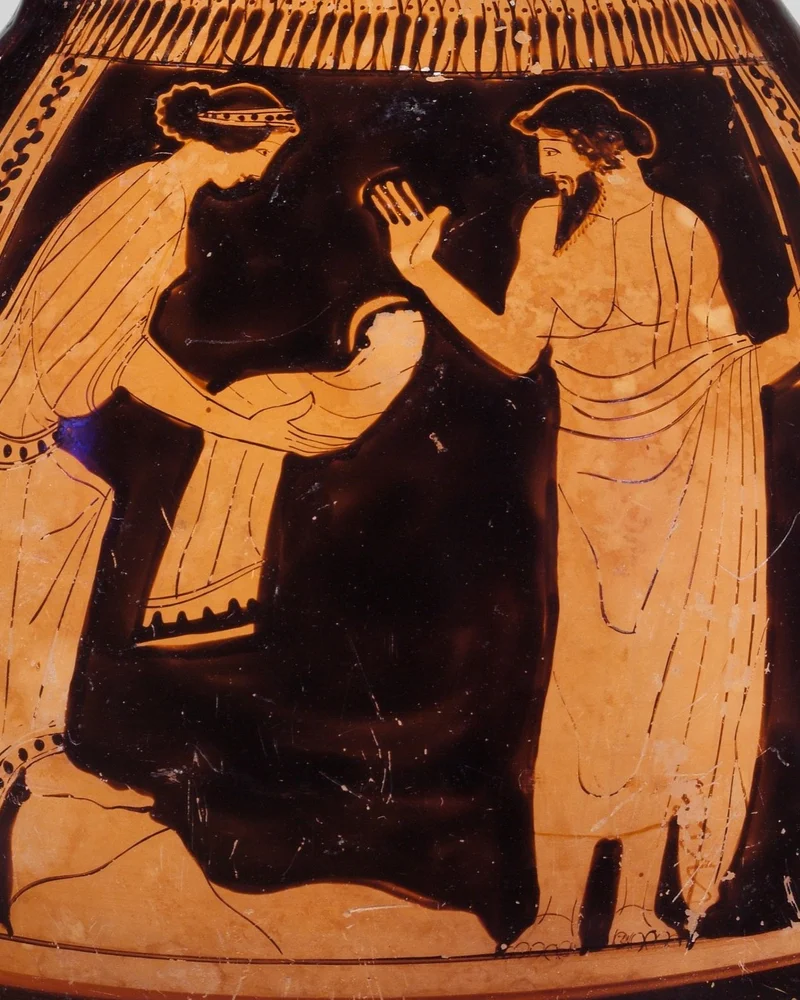
Having learned from his parents that he was destined to be overthrown by one of his own children, Cronus swallowed each child his wife and sister Rhea bore him: Hestia, Demeter, Hera, Hades, and Poseidon. When Zeus was born, Rhea hid him on Crete and gave Cronus a stone wrapped in swaddling clothes to swallow instead. Grown to maturity, Zeus forced Cronus to disgorge his siblings and led them in the ten-year war against the Titans, the Titanomachy, which ended with Cronus and most of the Titans imprisoned in Tartarus.
### The Golden Age and Later Cult
Hesiod's *Works and Days* separately describes a Golden Age of mortals who "lived like gods" under Cronus's rule, free from grief and labor. This tradition fed into the Athenian festival of the Kronia and, at Rome, the Saturnalia held for Cronus's Roman counterpart Saturn — though Saturn's own mythology diverges from Cronus's in significant ways and is not treated here.
Cross-Pantheon Parallels & Archetypes
Academic Discussion & Critique
Exchange peer-reviewed hypotheses, comparative Indo-European etymologies, and archaeological field interpretations regarding Cronus.
You Might Also Like
Tiamat
The primordial saltwater sea and mother of the gods. Avenging her consort Apsu with eleven monsters, she was netted by Marduk and split into heaven and earth; her eyes became the Tigris and Euphrates.
Aphrodite
Goddess of love and beauty, born from sea foam in Hesiod's account and landing on Cyprus. Her victory in the Judgement of Paris set the Trojan War in motion.
Apollo
God of light, prophecy, music, and healing, son of Zeus and Leto, born on Delos. He slew the serpent Python and founded his oracle at Delphi.
Ares
God of war, violence, and bloodshed. Son of Zeus and Hera, representing the brutal and chaotic aspects of warfare.