

Baal (Baʿlu Haddu)
Also known as: Hadad, Haddu, Aliyan Baal (Mightiest Baal), Rider of the Clouds, Baal Zaphon
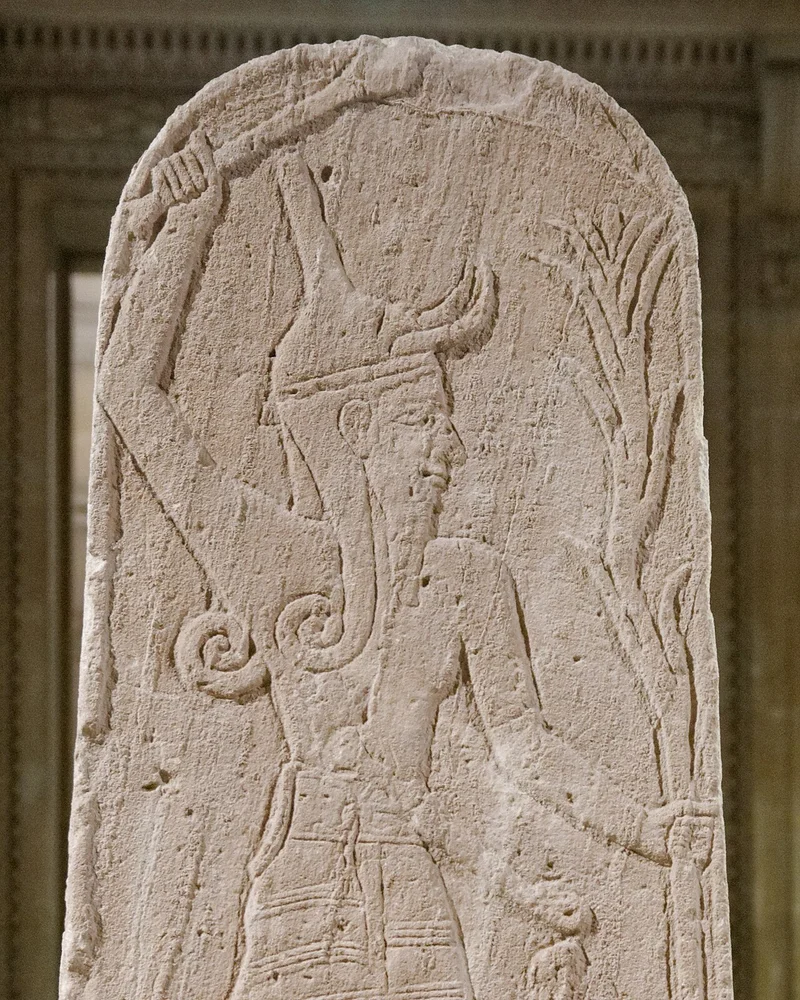
Mythological Narrative
The storm-god of Ugarit, 'Rider of the Clouds', whose rain makes the land fertile; he defeats Yamm the Sea, builds his palace on Mount Zaphon, is swallowed by Mot (Death), and returns to life.
Scholarly Commentary & Evolution
## Lord Haddu
Baal is a title, "lord", and at Ugarit it belongs above all to the storm-god whose personal name was Haddu (Hadad). He is "Mightiest Baal" (aliyn bʿl) and "Rider of the Clouds" (rkb ʿrpt), and his voice is the thunder. Ugaritic texts call him the son of Dagan, a grain-god worshipped along the middle Euphrates, even though he lives among El's family; the tension between those two statements has never been fully explained. His home is Mount Zaphon (Ṣapānu), the mountain north of Ugarit now called Jebel Aqra, and one of the two great temples on Ugarit's acropolis is generally identified as his.
## The Baal Cycle
Baal's story is told in the six tablets of the Baal Cycle (KTU 1.1-1.6). He defeats Yamm, the Sea, who had been granted kingship by El, using two clubs made by the craftsman Kothar-wa-Khasis. He then campaigns, with the help of Anat and Athirat, for a palace of his own, and when it is built on Zaphon he gives his thunder voice through a window in the clouds. Finally he challenges Mot, Death, and is swallowed; the earth dries up until Anat destroys Mot and El dreams that Baal lives. After seven years Baal and Mot fight again, and Mot yields.
## Rain and the agricultural year
Many scholars have read Baal's death and return as reflecting the eastern Mediterranean year, with its dry summer and rainy winter. The texts support a link between Baal and rain (his absence dries the furrows) but do not state that the cycle was performed annually, and this site presents that seasonal reading as an interpretation.
## Beyond Ugarit
Baal-Hadad was worshipped across the Levant and beyond, and under local titles (Baal Shamem, Baal of Tyre) into the first millennium BCE. The Hebrew Bible's polemic against "the Baals" reflects that later, wider cult; Ugarit preserves his mythology from his own worshippers.
Cross-Pantheon Parallels & Archetypes
Academic Discussion & Critique
Exchange peer-reviewed hypotheses, comparative Indo-European etymologies, and archaeological field interpretations regarding Baal (Baʿlu Haddu).
You Might Also Like
Tarhunna (the Storm-god of Hatti)
The chief god of the Hittite state: a storm-god of rain and thunder who gives the land its fertility, fights the serpent Illuyanka, and, under his Hurrian name Teššub, wins kingship in heaven in the Kumarbi cycle.
Zeus
King of the Olympian gods, ruler of sky and thunder. After overthrowing his father Cronus, he drew the sky when the three brothers divided the cosmos by lot.
Ryujin
Dragon god of the sea who dwells in an underwater palace made of red and white coral. Ruler of all sea creatures and controller of the tides through his magical tide jewels.
Freyr
One of the Vanir, god of fertility, prosperity, and fair weather. Owner of the magical ship Skidbladnir and the golden boar Gullinbursti.