

Ryujin
Also known as: Watatsumi, Owatatsumi-no-kami, Dragon King of the Sea
Mythological Narrative
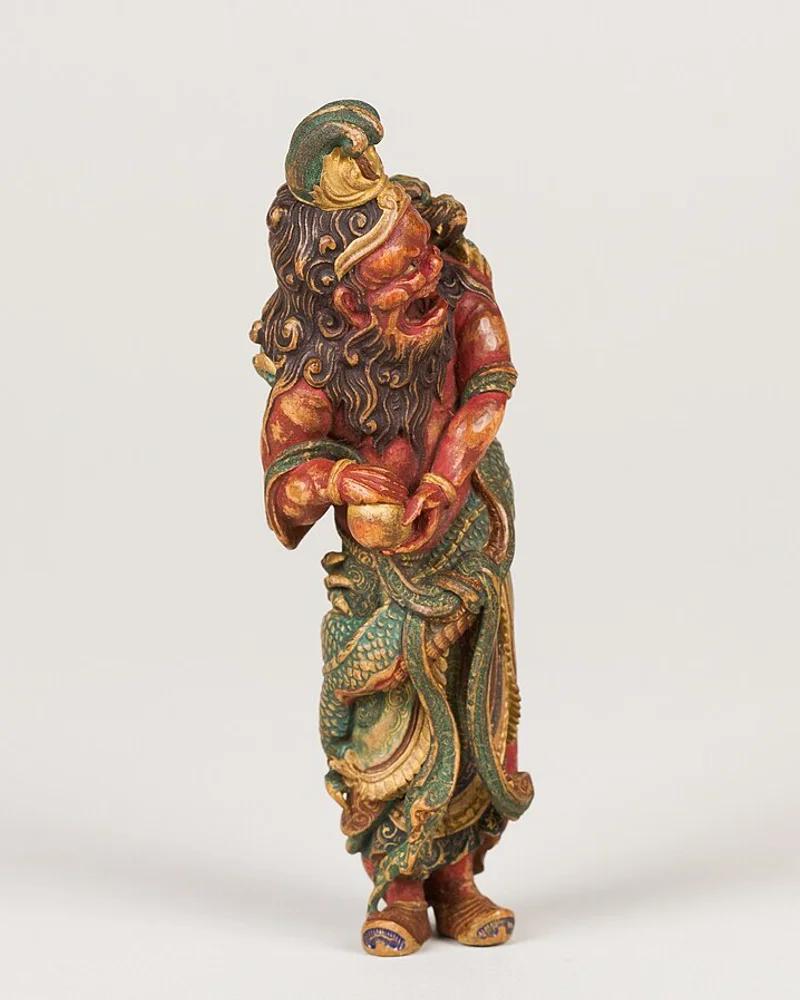
Dragon god of the sea who dwells in an underwater palace made of red and white coral. Ruler of all sea creatures and controller of the tides through his magical tide jewels.
Scholarly Commentary & Evolution
## The Dragon King of the Sea
**Ryujin** (also called Watatsumi) is the dragon deity who rules the ocean from his magnificent coral palace **Ryugu-jo** beneath the waves. He commands all sea creatures—fish, turtles, jellyfish, and other marine life serve as his messengers and attendants. His kingdom exists in a realm where time moves differently; what seems like days underwater may be centuries on the surface.
### The Tide Jewels
Ryujin possesses two powerful magical objects: the **Kanju** (tide-ebbing jewel) and **Manju** (tide-flowing jewel). These jewels control the ocean's tides and have featured prominently in Japanese legend. According to the **Nihon Shoki**, Empress Jingu used these jewels to defeat a Korean fleet by first drawing out the tide to strand enemy ships, then releasing a devastating tidal wave.
### The Imperial Lineage
Ryujin's daughter **Toyotama-hime** (Jewel Princess) fell in love with the hunter **Hoori** (also called Yamasachi-hiko) when he visited the undersea palace searching for his brother's lost fishhook. They married, and Toyotama-hime traveled to land to give birth. However, Hoori broke his promise not to watch the birth and saw her transform into a dragon. Ashamed, she returned to the sea, leaving their son **Ugayafukiaezu**, who became the father of the legendary first emperor Jimmu.
### Worship and Influence
Ryujin is venerated by fishermen, sailors, and coastal communities who depend on the sea's bounty and fear its wrath. Shrines to him dot the Japanese coastline, particularly at sites where underwater caves or unusual rock formations suggest gateways to his realm. The dragon imagery associated with Ryujin influenced Japanese art for centuries, appearing on temple decorations, festival floats, and royal regalia. His association with rain also made him important to agricultural communities praying for water during dry seasons.
Cross-Pantheon Parallels & Archetypes
Academic Discussion & Critique
Exchange peer-reviewed hypotheses, comparative Indo-European etymologies, and archaeological field interpretations regarding Ryujin.
You Might Also Like
Longwang (the Dragon Kings)
The dragon kings who rule the waters and send the rain, most famously the Dragon Kings of the Four Seas led by Ao Guang of the Eastern Sea. They govern as officials of the heavenly bureaucracy under the Jade Emperor, and their temples stood in villages across China wherever farmers prayed for rain.
Poseidon
God of the sea, earthquakes, and horses, armed with the trident. Homer calls him Earth-shaker; his wrath kept Odysseus wandering the seas for ten years.
Fujin
God of wind and air. Depicted as a demon carrying a large bag of winds. Twin to Raijin. Controls gentle breezes and destructive typhoons.
Raijin
God of thunder, lightning, and storms. Depicted as a demon beating drums to create thunder. Works with Fujin (wind god).