

Athtart (Astarte)
Also known as: Astarte, Ashtart, Name of Baal (šm bʿl)
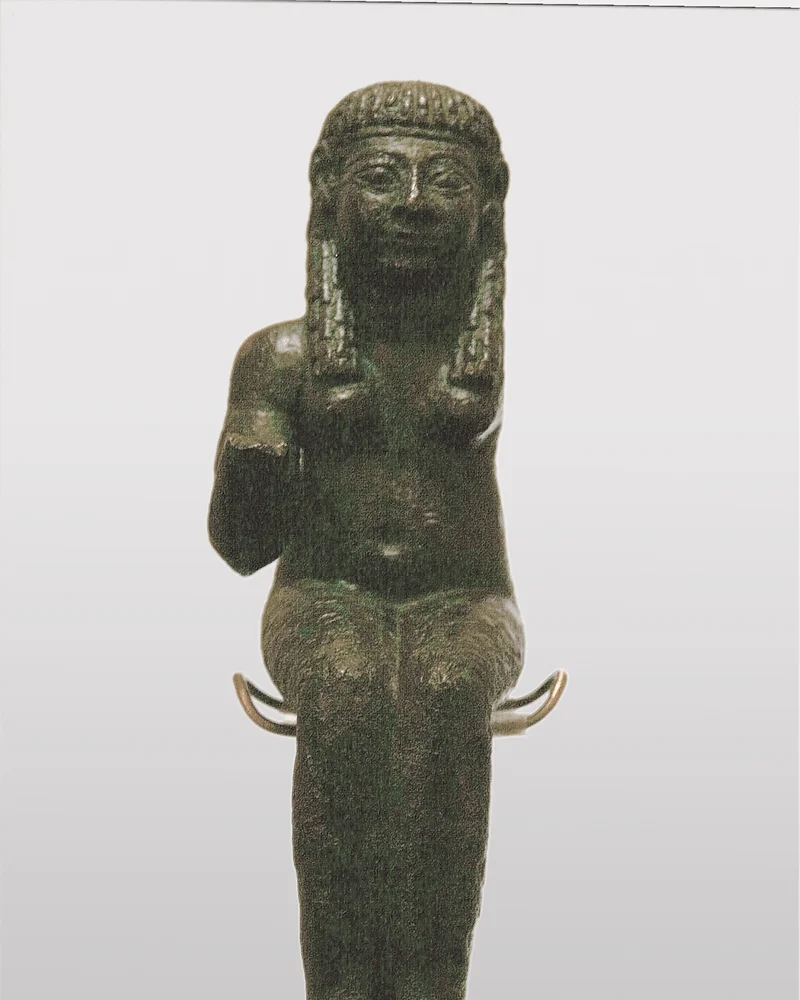
Mythological Narrative
Scholarly Commentary & Evolution
## Holding Baal back
In the Baal Cycle, when Yam's messengers demand that Baal be surrendered, Baal seizes a weapon to strike them, and two goddesses restrain him: Anat takes his right hand and Athtart his left (KTU 1.2 I). They remind him that messengers are not to be harmed.
## Urging him on
After Baal's second club fells Yam, it is Athtart who calls out to Baal, rebuking him or urging him to "scatter" the defeated Sea, since Yam is now their captive (KTU 1.2 IV). The passage is damaged and translators differ on its exact tone, but it shows her as a warrior at Baal's side.
## A hunter
In a separate Ugaritic text (KTU 1.92) Athtart goes hunting in the steppe, and she appears in Ugaritic ritual texts with an equestrian aspect. In Egyptian New Kingdom texts she is a war goddess associated with horses and chariots.
## Astarte
In the first millennium BCE, Athtart became Astarte, a major goddess of the Phoenician cities, especially Sidon and Tyre, where the royal inscription of Eshmunazar calls her "Astarte, name of Baal". Greek writers identified her with Aphrodite. The Ugaritic Athtart is a less prominent and more martial figure than that later goddess.
Cross-Pantheon Parallels & Archetypes
Academic Discussion & Critique
Exchange peer-reviewed hypotheses, comparative Indo-European etymologies, and archaeological field interpretations regarding Athtart (Astarte).
You Might Also Like
Inanna
Queen of Heaven and goddess of love and war. Inanna is the most complex and dynamic deity of the Mesopotamian pantheon, embodying both desire and destruction.
Aphrodite
Goddess of love and beauty, born from sea foam in Hesiod's account and landing on Cyprus. Her victory in the Judgement of Paris set the Trojan War in motion.
Anat
The young warrior goddess of Ugarit, Baal's sister and fiercest ally, who wades through battle, bullies El into granting Baal a palace, finds Baal's body, and destroys Mot.
Tu
The fierce god of war and human endeavor. Tu represents the aggressive, active principle necessary for survival, from warfare to hunting to the cultivation of crops.