

Obatala
Also known as: Oxala, Orishanla, Oshala
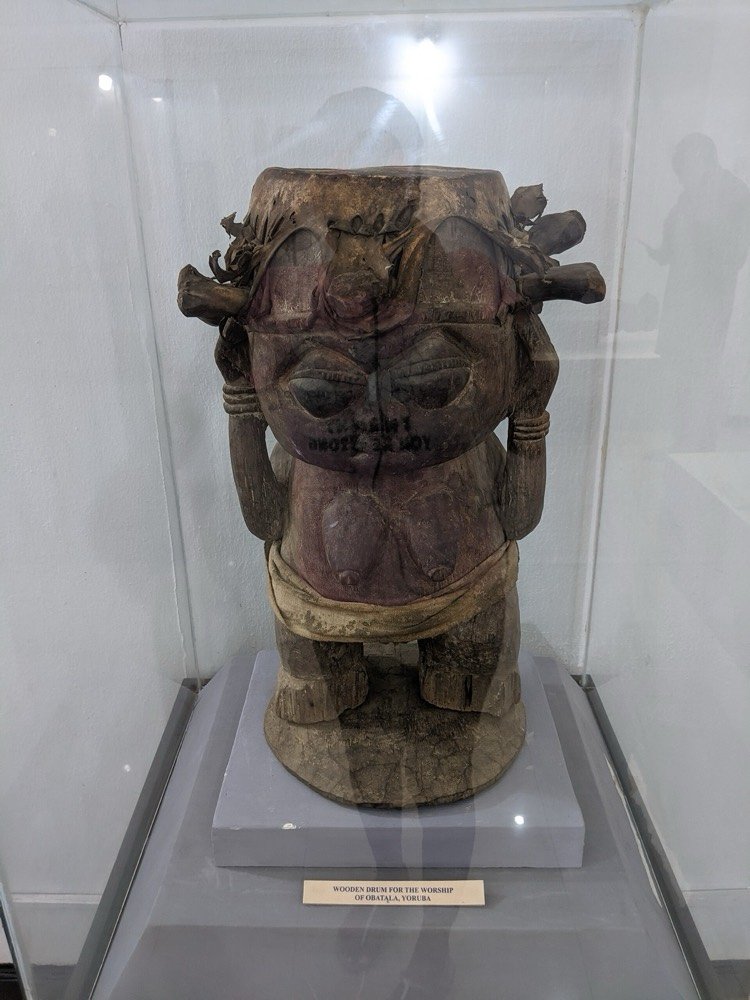
Mythological Narrative
Obatala, 'King of the White Cloth', also honored as Orishanla, the Great Orisha, is the shaper of human bodies. Everything about him is white: white cloth, white beads, powdered chalk, snails stewed in shea butter for his table. Olodumare assigned him to mold human figures from clay, into which the supreme god then breathes life.
His two central myths both turn on palm wine. In one, he drank while shaping humans and his hands slipped: hunchbacks, albinos, and the lame came from that day's work. On sobering he swore off palm wine forever and declared people born with such bodies eni orisha, his sacred charges; his devotees keep the same prohibition. In the Ife creation story he was sent to found the dry land but drank on the way and fell asleep, and Oduduwa took the snail shell of earth and finished the task; the festivals of Ife still carry traces of the two cults' rivalry and reconciliation.
His worshippers dress in white, and his principal temple stands at Ife. In Cuba he merged with Our Lady of Mercy; in Brazil he is Oxala, honored each January in Salvador when crowds in white wash the steps of the Bonfim church with scented water.
Scholarly Commentary & Evolution
## The King of the White Cloth
Obatala, whose name means 'King of the White Cloth,' is one of the most important Orishas. He was given the task of creating the physical world and shaping human bodies, making him the father of humanity.
### The Creation Story
Olodumare sent Obatala to create land from the primordial waters. He was given a chain, a snail shell filled with sand, a white hen, and a palm nut. Descending from heaven, he poured the sand on the water and set the hen loose to scatter it, forming the first land at Ile-Ife. However, Obatala became drunk on palm wine during the creation of humans, which is why some people are born with disabilities.
### The White Orisha
Obatala is associated with all things white: white cloth, white beads, white animals, and cool, calm energy. His priests wear white exclusively, and offerings to him include white foods: coconut, white yam, snails, and rice.
Cross-Pantheon Parallels & Archetypes
Academic Discussion & Critique
Exchange peer-reviewed hypotheses, comparative Indo-European etymologies, and archaeological field interpretations regarding Obatala.
You Might Also Like
Olodumare
Supreme god of the Yoruba pantheon, also called Olorun, 'Owner of the Sky'. Source of ase, the power behind all effective action, he has no shrines or images and rules through the orishas.
Oduduwa
The god who made dry land at Ife, descending on an iron chain with a snail shell of earth and a five-toed cock, and the ancestor from whom every Yoruba royal house claims its crown.
Ile-Ife
The Yoruba holy city where Oduduwa first made dry land, said to keep shrines to 401 gods. Its naturalistic brass heads of the 12th-15th centuries stunned European archaeology; the Ooni still reigns there.
Prometheus
Son of the Titan Iapetus, his name meaning forethought. For stealing fire for mankind he was nailed to a Caucasian crag, an eagle feeding daily on his liver, until Heracles freed him.