

Eshu
Also known as: Elegua, Elegba, Exu, Legba
Mythological Narrative
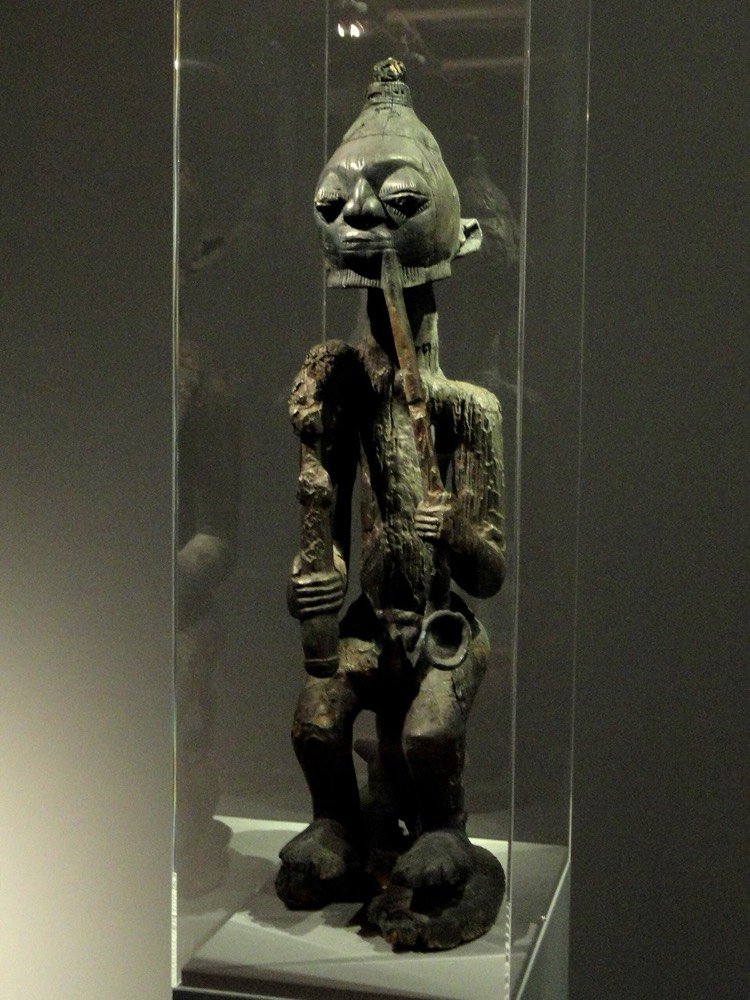
Eshu is the messenger between heaven and earth, keeper of crossroads, thresholds, and marketplaces. The first portion of every sacrifice is his, for he carries offerings up to the orisha they are meant for; his face is carved on the rim of the Ifa divination tray, and the sacrifices Ifa prescribes pass through his hands. His shrine is often no more than a chunk of red laterite called yangi, set by a doorway or a fork in the road and fed with palm oil.
In his most famous tale, two friends sworn never to quarrel worked neighboring fields. Eshu strolled down the boundary path wearing a cap red on one side and black on the other. Afterward one friend spoke of the stranger in the red cap, the other of the black; the argument grew until knives came out, and when both were dragged before the king, Eshu appeared and cheerfully claimed the work as his own. Versions of the story are told all over Yorubaland and the Americas.
In the nineteenth century Samuel Ajayi Crowther's Yoruba Bible rendered Satan as 'Eshu', a mistranslation that has dogged him ever since and that scholars and devotees still contest. In Cuba he is Elegua, owner of roads and keys, greeted first in every ceremony; in Brazil, Exu; his Fon counterpart Legba entered Haitian Vodou.
Scholarly Commentary & Evolution
## The Keeper of the Crossroads
Eshu is one of the most important yet most misunderstood Orishas. As the guardian of the crossroads, he stands at every point of decision. Nothing reaches the Orishas without passing through Eshu first, and no ritual can begin without his blessing.
### First and Last
In all Yoruba rituals, Eshu must be honored first, before any other Orisha. To neglect him is to ensure that one's prayers will not be heard.
### The Trickster
Eshu is famous for his tricks. In one famous story, he walked between two friends wearing a hat that was red on one side and black on the other. Each friend saw only one color, and they fell into a violent argument about what color the hat was, destroying their friendship.
### Colonial Misunderstanding
When Europeans encountered Eshu, they mistook him for the devil because of his trickster nature and association with crossroads. This misinterpretation fundamentally misunderstands Eshu's role as a necessary divine force.
Cross-Pantheon Parallels & Archetypes
Academic Discussion & Critique
Exchange peer-reviewed hypotheses, comparative Indo-European etymologies, and archaeological field interpretations regarding Eshu.
You Might Also Like
Ogun
Orisha of iron, war, and the road, patron of blacksmiths, hunters, soldiers, and now drivers. Only his iron cutlass could clear the gods' first path; Nigerian courts still accept oaths sworn on iron.
Olodumare
Supreme god of the Yoruba pantheon, also called Olorun, 'Owner of the Sky'. Source of ase, the power behind all effective action, he has no shrines or images and rules through the orishas.
Ifa Divination
Divination by sixteen sacred palm nuts or the eight-shell opele chain, casting one of 256 odu, each heading a corpus of memorized verses recited by babalawo priests. Inscribed on UNESCO's intangible heritage list in 2008.
Loki
Giant-born blood brother of Odin, a shapeshifting schemer who both aids and betrays the gods, engineers Baldr's death, and lies bound beneath a venomous serpent until Ragnarok.