

Qitu
Mythological Narrative
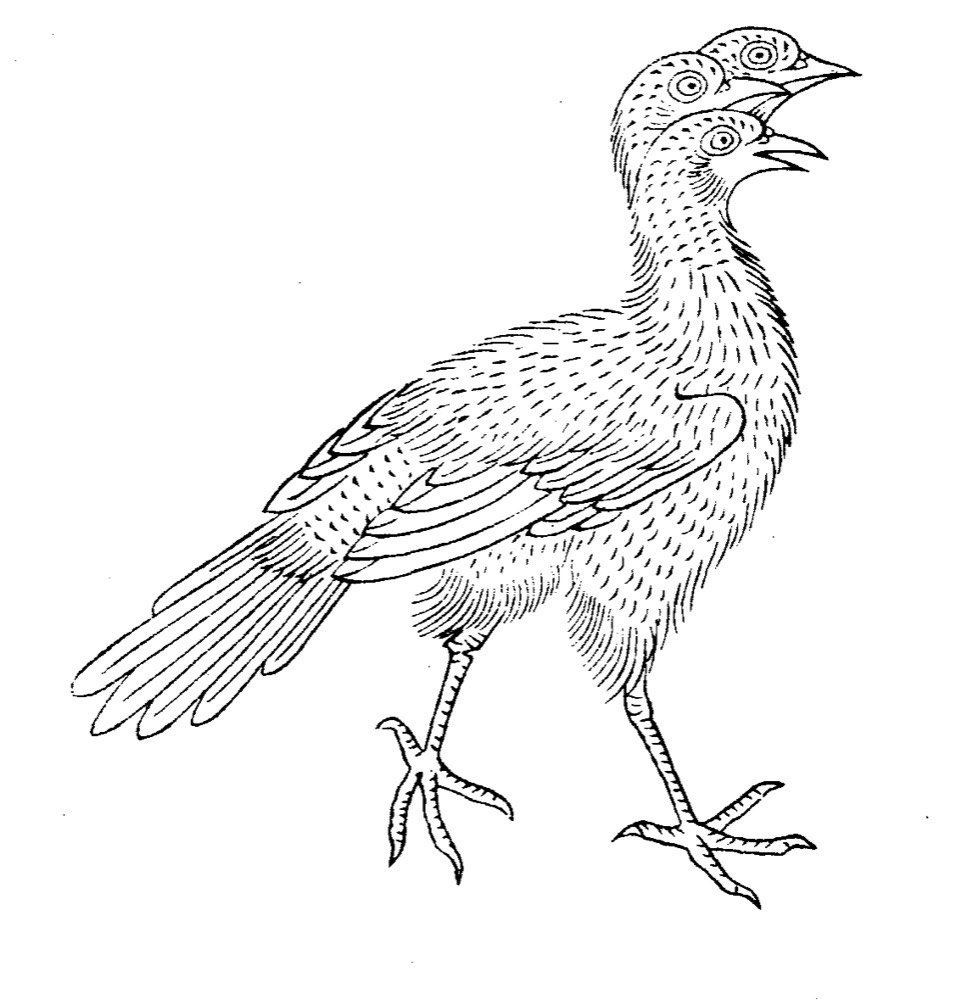
The 'Classic of the Western Mountains' places this bird on Mount Yiwang: 'shaped like a crow, with three heads and six tails, and given to laughter; its name is Qitu. Worn on the body, it keeps a person from nightmares, and it can also ward off evil.' The character yan in the formula is read as 'nightmare' — so a perpetually laughing, three-headed prodigy serves, of all things, as a charm for quiet sleep, one of the pleasant inversions in the book's logic of omens and virtues.
The 'Classic of the Northern Mountains' records another Qitu on Mount Dai: crow-like but five-colored with red markings, 'both male and female in one body', and a preventive against abscesses when eaten. The two share nothing but the name, and commentators treat them as distinct creatures.
The Qitu shares Mount Yiwang with the Huan, a one-eyed, three-tailed beast whose cry holds a hundred voices. The last mountain of the guideway grows no plants at all, yet houses the most extravagantly shaped bird and beast in the classic, and illustrated editions have traditionally drawn the pair into a single mountainscape.
Academic Discussion & Critique
Exchange peer-reviewed hypotheses, comparative Indo-European etymologies, and archaeological field interpretations regarding Qitu.
You Might Also Like
Huan
A wildcat-like beast of Mount Yiwang with a single eye and three tails, its cry like a hundred voices at once; it wards off evil, and worn on the body it cures jaundice.
Tiangou
A wildcat-like, white-headed beast of Mount Yin whose cry sounds 'liu-liu'; it wards off evil — a benign original quite unlike the later moon-devouring Tiangou.
Aohen
A man-eating beast of Mount Sanwei: shaped like an ox, white-bodied with four horns, its long hair hanging like a straw rain-cape.
Ba Serpent
A monstrous snake that swallows elephants whole and disgorges the bones only after three years; those bones, taken as medicine, cure ailments of heart and belly. Its body is mottled green, yellow, red, and black.