

Huan
Mythological Narrative
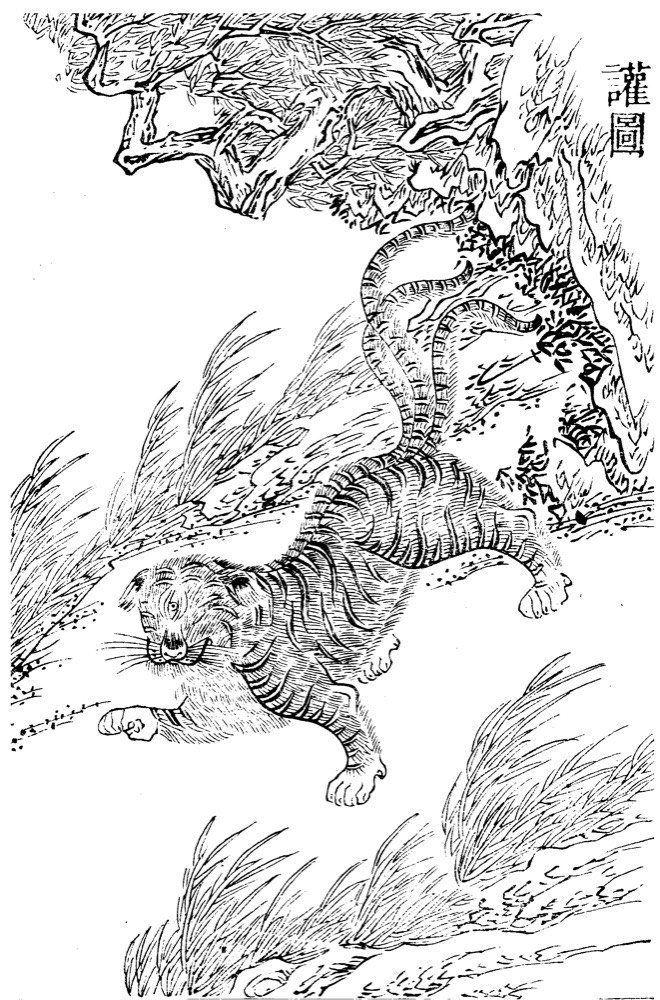
Mount Yiwang, last peak of the third western guideway, 'bears no plants, but much gold and jade'. Its beast is the Huan: 'shaped like a wildcat, with one eye and three tails, its voice as if seizing a hundred voices' — a cry in which a hundred animal calls seem to sound at once, or, on another reading, a voice that drowns out a hundred others. The text then gives its uses: kept, it wards off evil; worn on the body, it cures jaundice.
Warding off evil is a stock virtue among the western beasts — the Tiangou and the Qitu of the same classic share it — but the Huan adds a medical power, and carries three marvels in one small body: the single eye, the triple tail, the hundred voices. Ming and Qing illustrators found it irresistible, usually drawing a cat-like creature with three erect tails and one eye set in the middle of its forehead. It shares Mount Yiwang with the Qitu, a three-headed, six-tailed bird that loves to laugh; between them, the final mountain of the guideway houses two of the strangest small creatures in the entire book.
Academic Discussion & Critique
Exchange peer-reviewed hypotheses, comparative Indo-European etymologies, and archaeological field interpretations regarding Huan.
You Might Also Like
Qitu
A bird of Mount Yiwang like a crow with three heads and six tails, given to laughter; worn on the body it keeps nightmares away and wards off evil.
Tiangou
A wildcat-like, white-headed beast of Mount Yin whose cry sounds 'liu-liu'; it wards off evil — a benign original quite unlike the later moon-devouring Tiangou.
Chiru
A fish of the Ying River on Mount Qingqiu, wholly fish-bodied but with a human face and a call like a mandarin duck; eating it was said to prevent scabies.
Hujiao
A jiao-dragon of the Yin River below Mount Daoguo, with a fish's body and a serpent's tail, calling like a mandarin duck; eating it prevents swellings and cures hemorrhoids.