

Mercury
Also known as: Mercurius
Mythological Narrative
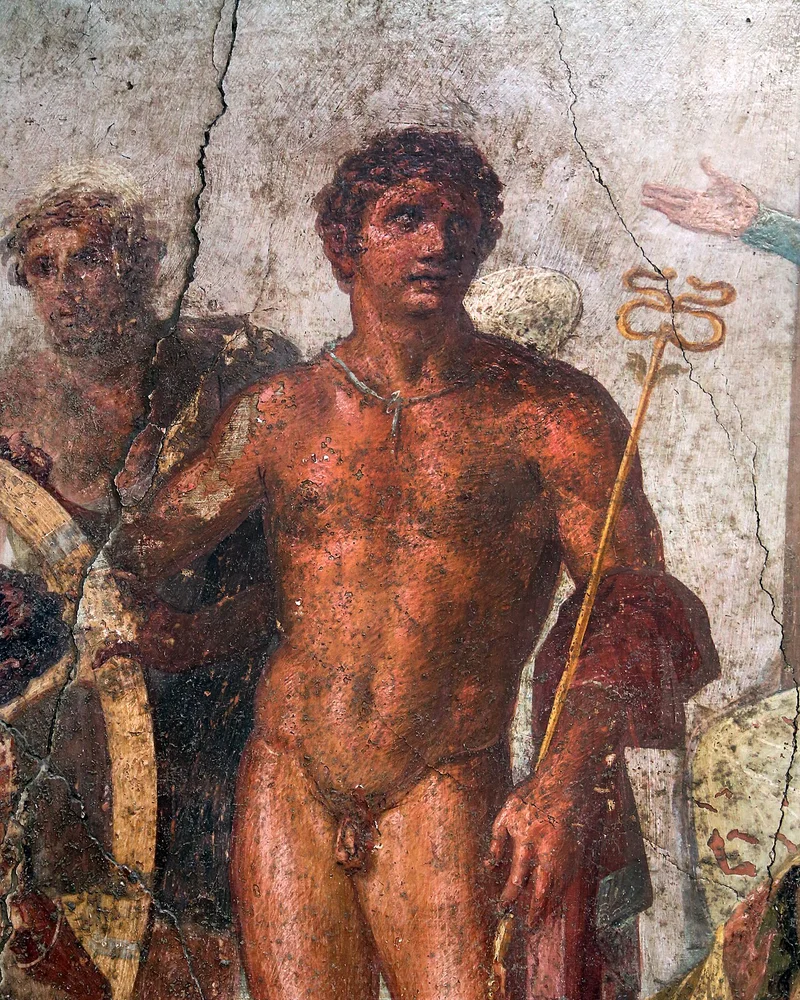
Messenger of the gods and god of commerce, eloquence, messages, travelers, boundaries, luck, and thieves. Guide of souls to the underworld. Roman equivalent of Hermes.
Scholarly Commentary & Evolution
## Mercury of the marketplace
Mercury is the god of messages, thieves, travelers, and, above all in Rome, **commerce**. His temple on the Aventine was dedicated in 495 BCE and associated with a merchants' guild, the Mercuriales. The caduceus and winged hat come from Hermes. The shopkeeper's prayer is Latin.
### Guide and boundary
Like Hermes he leads souls toward the underworld and watches over crossings: roads, doors, deals. He is eloquent because speech is a tool of trade and of deceit. Ovid's Fasti gives him a festival in May when merchants asked pardon for past fraud and luck for the next bargain.
### Psychopomp in a trading city
The Greek trickster remains visible in the cattle-theft of his first day. Rome adds the Forum's noise. When a Roman invoked Mercury, the request was often about goods in motion, not only about cleverness for its own sake.
Cross-Pantheon Parallels & Archetypes
Academic Discussion & Critique
Exchange peer-reviewed hypotheses, comparative Indo-European etymologies, and archaeological field interpretations regarding Mercury.
You Might Also Like
Hermes
God of messengers, commerce, thieves, and travelers. Son of Zeus and the nymph Maia, known for his cunning and speed.
Lugh
The master of all skills and arts. A youthful warrior king who led the Tuatha Dé Danann to victory against the Fomorians.
Odin
One-eyed chief of the Aesir who pledged an eye at Mimir's well and hung nine nights on the world tree to win the runes.
Apollo
God of the sun, music, poetry, prophecy, healing, and archery. One of the few gods whose name remained unchanged from Greek to Roman. Patron of the Sibylline Books and protector of Augustus.