

Hawaiki
Mythological Narrative
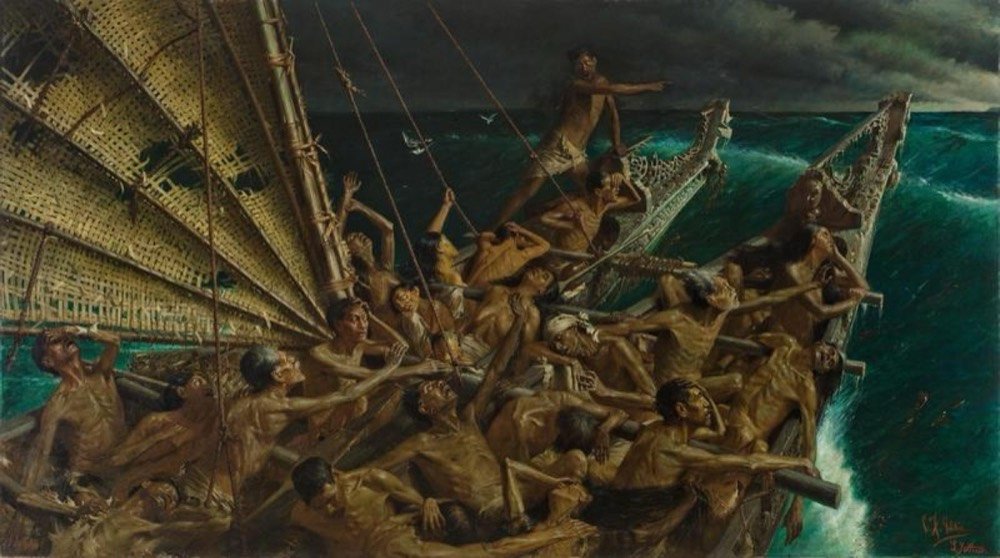
Hawaiki is the homeland held in common memory across Polynesia. Every Maori tribal tradition of migration begins there: the ancestral canoes — Te Arawa, Tainui, Aotea and the rest — set out from Hawaiki across the ocean to New Zealand, and each tribe's whakapapa genealogy counts down from someone aboard. Hawaiki also closes the circle of life: the spirits of the dead travel north along the North Island to Te Rerenga Wairua, the "leaping place of spirits" at Cape Reinga, slide down the roots of an old pohutukawa tree on the cliff into the sea, and return the way the ancestors came.
The name is scattered across the whole ocean. Samoa's largest island is Savaii; the Hawaiian archipelago and its biggest island bear the name; Havaiki in the Marquesas and Tuamotus doubles as the underworld, as does Avaiki in the Cook Islands. Raiatea in the Society Islands was anciently called Havaii, and in the Tahitian traditions recorded by Teuira Henry it was the hub of the East Polynesian religious and voyaging network: its great marae Taputapuatea, center of the cult of Oro, supplied foundation stones for daughter marae across the islands, and the site was inscribed on the UNESCO World Heritage List in 2017.
The ethnologist Te Rangi Hiroa (Peter Buck), in Vikings of the Sunrise (1938), read the Hawaiki narratives as the memory of real voyaging history, and linguistics, archaeology and the traditional genealogies broadly agree, pointing to an expansion outward from central East Polynesia. Hawaiki thus exists twice over: as the starting point of genealogy and destination of souls, and as a route home that can be roughly redrawn on a chart.
Academic Discussion & Critique
Exchange peer-reviewed hypotheses, comparative Indo-European etymologies, and archaeological field interpretations regarding Hawaiki.
You Might Also Like
Maui
The trickster demigod known across Polynesia: he fished up land from the sea floor, snared the sun to slow it, stole fire, and died trying to win immortality for humankind.
Tane
The Maori god of forests and birds. He thrust sky and earth apart to let in light, shaped the first woman from red earth, and climbed the heavens to bring back three baskets of knowledge.
Taniwha
Beings of Maori tradition dwelling in deep pools, river bends and sea caves — tribal guardians to some, man-eaters in the old tales. In 2002 a taniwha's lair rerouted State Highway 1.
Tiki
The first man of East Polynesian tradition, made by the gods in Maori accounts; in the Marquesas he shaped the first woman from sand. The name also covers carved human figures such as the Maori hei-tiki pendant.