

Sraosha
Also known as: Srosh, Sorush
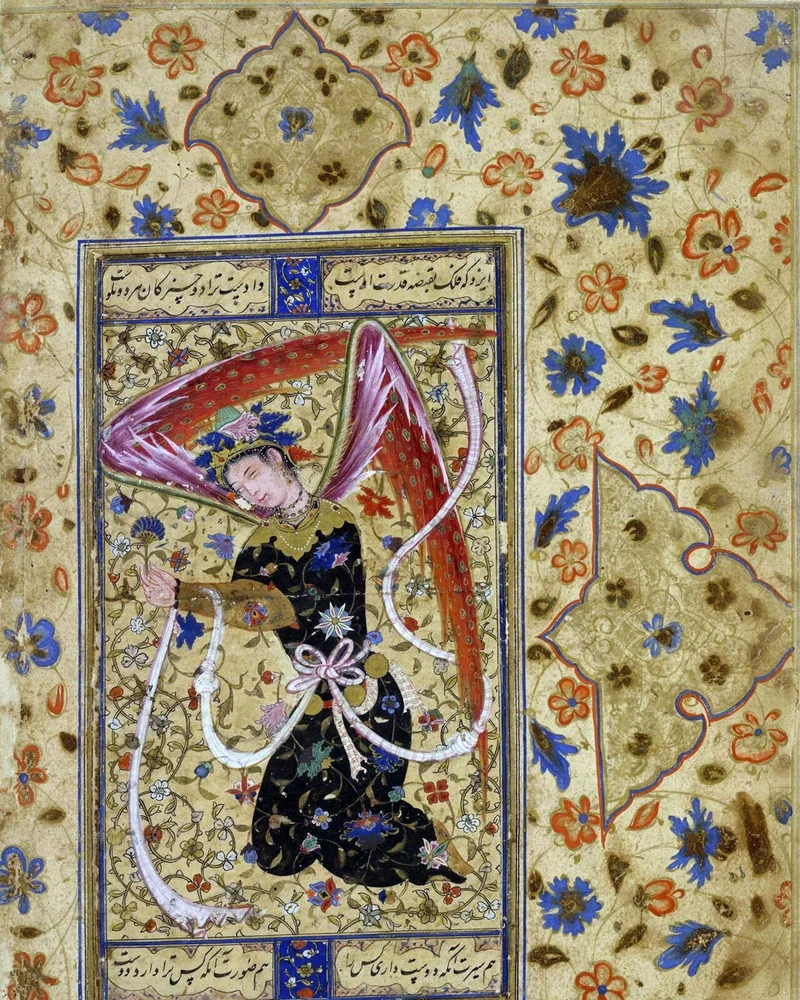
Mythological Narrative
The yazata of 'hearkening' to the divine word, who guards the world by night against the demons, protects the soul for three nights after death, and judges it at the Chinvat Bridge with Mithra and Rashnu; in the Shahnameh, as Sorush, a heavenly messenger.
Scholarly Commentary & Evolution
## The hymn of Sraosha
The Srosh Yasht (Yasna 57) praises Sraosha as the first to worship Ahura Mazda with the sacred twigs and the first to sing the Gathas, and as a warrior who strikes down Aeshma, the demon of fury. He never sleeps, but watches over the world through the night, when the demons are strongest; the rooster, which wakes people for dawn prayer, is his bird.
## Guardian of the dead
In Zoroastrian tradition the soul of the dead remains near the body for three nights, protected by Sraosha, and prayers to him (the Srosh Baj) are recited during that time. On the fourth dawn the soul comes to the Chinvat Bridge, where Mithra, Sraosha, and Rashnu weigh its deeds.
## Sorush in the Shahnameh
Ferdowsi's Sorush is a heavenly messenger who appears at crucial moments: he warns King Kayumars of the demon who has killed his son, and he instructs Fereydun not to kill the defeated Zahhak but to chain him in Mount Damavand.
Academic Discussion & Critique
Exchange peer-reviewed hypotheses, comparative Indo-European etymologies, and archaeological field interpretations regarding Sraosha.
You Might Also Like
Ahura Mazda
Supreme god of Zoroastrianism, the "Wise Lord" who created the world and the order of asha, locked in a cosmic struggle with the destructive spirit Angra Mainyu.
Anahita
Goddess of rivers and fertility, "the moist, the strong, the immaculate." She pours from the divine mountain into the world sea; heroes and tyrants alike offered her sacrifice for victory.
Angra Mainyu
The destructive spirit opposed to Ahura Mazda, known in Middle Persian as Ahriman. He corrupts creation with vermin, disease, and death, and will be defeated at the world's renovation.
Atar
Fire as a divine being, 'son of Ahura Mazda', the visible focus of Zoroastrian worship, who in the Zamyad Yasht faces down the three-mouthed dragon Azhi Dahaka in the struggle for the royal Glory.