

Anahita
Also known as: Ardvi Sura Anahita, Anahid, Nahid, Anaitis
Mythological Narrative
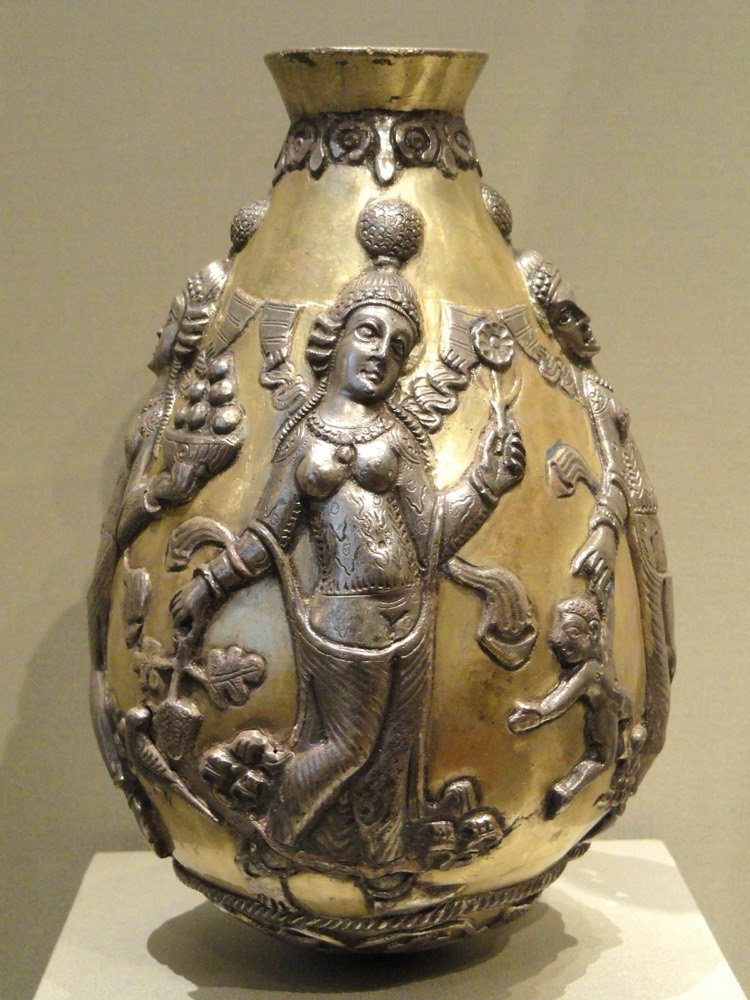
Anahita, in full Aredvi Sura Anahita, "the moist, the strong, the immaculate," is the Zoroastrian goddess of the waters, of fertility and increase. The fifth Yasht of the Avesta, the Aban Yasht, is devoted entirely to her and dresses her in exact detail: a strong fair maiden, high-girdled, wearing a gleaming mantle of thirty beaver skins and a golden crown set with a hundred stars and eight rays, with earrings and a necklace of gold. Her river falls from the peak of Hukairya into the world sea Vourukasha, equal in volume to all the rivers of the earth together, and her chariot is drawn by four horses: wind, rain, cloud, and sleet.
The Aban Yasht catalogues her petitioners, a miniature roll of Persian legend: righteous men such as Yima and Thraetaona — the later Jamshid and Fereydun — sacrifice to her and are granted victory, while the three-headed dragon Azhi Dahaka offers a hundred horses, a thousand oxen, and ten thousand sheep, praying to empty the earth of men, and is refused. Her standing rose sharply in the late Achaemenid period: Artaxerxes II (r. 404-358 BCE) names her beside Ahura Mazda and Mithra in his inscriptions, and classical authors record that he set up her statues in the great cities of the empire. The Sasanians made her a patron of kingship; the family of Ardashir I, founder of the dynasty, served as hereditary priests of the Anahid fire temple at Istakhr, and the great stone platform at Kangavar in western Iran has long been associated with her worship.
Scholarly Commentary & Evolution
## The Aban Yasht
Yasht 5 is Anahita's hymn. Ahura Mazda commands sacrifice to 'this spring of mine', a river as large as all the waters on earth that runs from the height Hukairya down to the sea Vouru-Kasha, and from which all the waters of the seven regions of the world flow. She purifies the seed of males and the wombs of females and brings safe birth and milk. The hymn then catalogs heroes and villains who sacrificed to her, granting the prayers of the righteous and refusing the wicked, and it ends with a vivid description of her as a tall, strong maiden in a golden mantle, with golden earrings, a crown of stars, and robes of beaver skins.
## A royal goddess
Artaxerxes II (r. 404-358 BCE) names Anahita with Ahuramazda and Mithra in his inscriptions, and the Babylonian priest Berossus, quoted by later Greek authors, says that he set up statues of 'Aphrodite Anaitis' in cities across the empire, an innovation in a religion that had not used cult images. Under the Sasanians, the dynasty's ancestor Sasan was remembered as the custodian of a fire temple of Anahid at Istakhr, and Sasanian kings honored her.
## Name and identifications
The name combines several epithets: *aredvi* ('moist' or 'high'), *sura* ('strong'), and *anahita* ('undefiled'). Scholars have long compared the heavenly river with the Vedic river-goddess Sarasvati, whose name is cognate with the Iranian region Harahvaiti, and Greek writers equated Anahita with Artemis or Aphrodite.
Cross-Pantheon Parallels & Archetypes
Academic Discussion & Critique
Exchange peer-reviewed hypotheses, comparative Indo-European etymologies, and archaeological field interpretations regarding Anahita.
You Might Also Like
Ahura Mazda
Supreme god of Zoroastrianism, the "Wise Lord" who created the world and the order of asha, locked in a cosmic struggle with the destructive spirit Angra Mainyu.
Mithra
The yazata of covenant and oath, thousand-eared and ten-thousand-eyed, who rides ahead of the sun and watches over all who break their word. His name later traveled to Rome.
Azhi Dahaka
The three-headed, six-eyed dragon of the Avesta, creature of the destructive spirit; in the Shahnameh he becomes Zahhak, the tyrant with snakes on his shoulders, chained inside Mount Damavand.
Aphrodite
Goddess of love and beauty, born from sea foam in Hesiod's account and landing on Cyprus. Her victory in the Judgement of Paris set the Trojan War in motion.