

Jumong
Also known as: King Dongmyeong, Chumo, Go Jumong
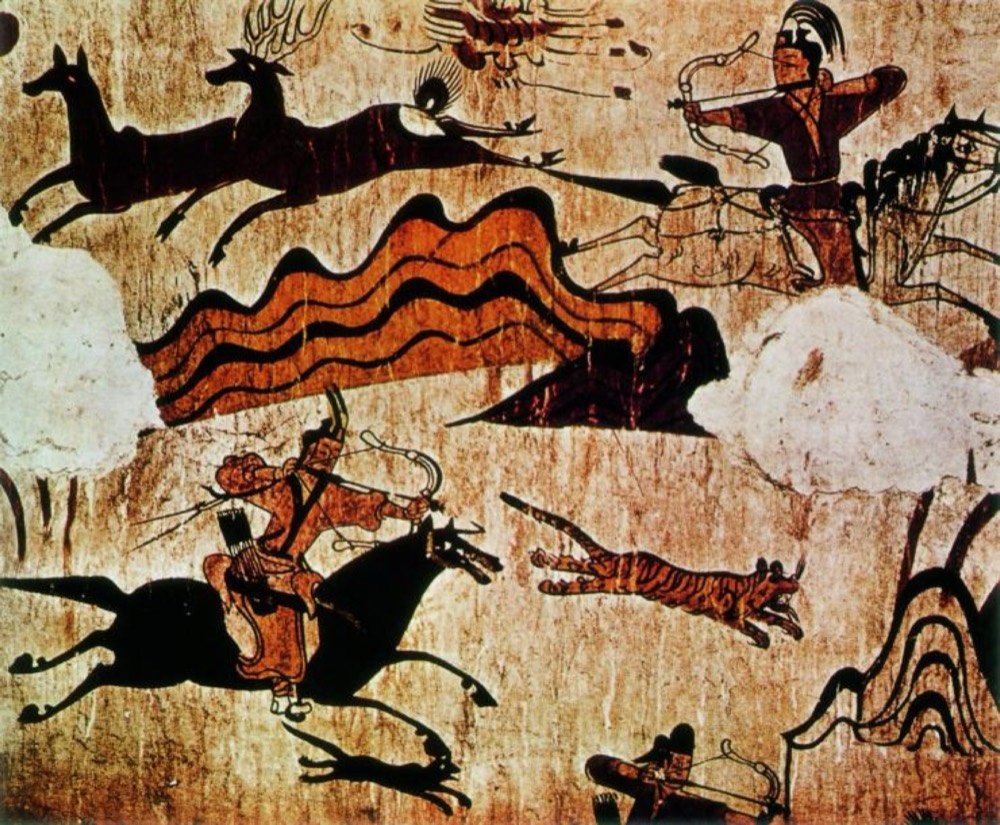
Mythological Narrative
The Samguk Sagi tells that Yuhwa, daughter of the river god Habaek, was cast out by her father after meeting Hae Mosu, a self-proclaimed son of heaven, and was taken in by King Geumwa of Eastern Buyeo. Sunlight followed her body wherever she moved, and she conceived, giving birth to an egg the size of five measures. The king threw it to dogs and pigs, which refused to eat it; oxen and horses stepped around it on the road; birds and beasts sheltered it with their wings. Since it could not be split, it was returned to its mother, and a boy soon broke out of the shell. By seven he was making his own bows and hitting every mark, so people called him Jumong, the Buyeo word for a great archer.
Geumwa's sons, led by the heir Daeso, plotted to kill him. Jumong fled south with three companions, Oi, Mari, and Hyeopbo. Blocked by a great river with pursuers close behind, he called out his lineage, son of heaven and grandson of the river god, and fish and turtles surfaced to form a bridge, scattering once he had crossed. He founded his state at Jolbon in 37 BCE, named it Goguryeo, and took Go as his surname, aged twenty-two. He reigned nineteen years and died at forty.
The earliest surviving record of the tale is carved in stone: the Gwanggaeto Stele of 414 CE, standing at present-day Ji'an, Jilin, opens by recounting how the founder Chumo, son of heaven and child of the river god's daughter, broke from the egg, and how at his death a yellow dragon came down to bear him up to heaven. In 1193 Yi Gyu-bo expanded the story into the long poem Dongmyeongwang-pyeon. Wunü Mountain Fortress at Huanren, Liaoning, is identified with Jolbon.
Scholarly Commentary & Evolution
## The earliest account
The Gwanggaeto Stele of 414 CE, the oldest written source for any Korean foundation myth, says that King Chumo, son of the Heavenly Emperor and the daughter of Habaek, broke from an egg; traveling south, he reached a great river and declared himself son of heaven and grandson of Habaek, and reeds joined and turtles surfaced to let him cross. He founded his capital on the mountain west of Holbon. Tired of the world, he was fetched by a yellow dragon sent from heaven and rose to heaven from a hill east of Holbon, standing on the dragon's head.
## The Samguk Sagi
Kim Busik's history (1145) gives the fuller version. Born from Yuhwa's egg in the palace of King Geumwa of East Buyeo, the boy made his own bow and arrows at seven and never missed, and 'Jumong', the Buyeo word for a good archer, became his name. Geumwa's sons plotted to kill him. Set to tend the king's horses, he starved the best horse and fattened the poor ones; the king took the fat horses and left him the fine thin one. Warned by his mother, he fled with three companions. At the Eomsa River, with pursuers behind him and no bridge, he declared himself son of Heaven and grandson of Habaek, and fish and turtles rose to make a bridge, sinking again after he crossed. He founded Goguryeo at Jolbon in 37 BCE, at the age of twenty-two, and took the surname Go.
## Worship
Goguryeo worshipped its founder at a royal shrine, and Chinese histories name a Goguryeo god 'Gaodeng', the son of the Buyeo goddess, generally identified with Jumong. The traditional date of 37 BCE is not independently confirmed.
Academic Discussion & Critique
Exchange peer-reviewed hypotheses, comparative Indo-European etymologies, and archaeological field interpretations regarding Jumong.
You Might Also Like
Dangun
Legendary founder of Gojoseon, son of the heavenly prince Hwanung and the bear-woman Ungnyeo; tradition dates his kingdom to 2333 BCE, and he ended his days as a mountain god.
Hou Yi
When ten suns rose together and scorched the crops, the archer Yi shot down nine and slew the monsters ravaging the land; the elixir he won from the Queen Mother was taken by his wife Chang'e.
Rama
Hero of the Ramayana: exiled fourteen years to honour his father's word, he led an army of monkeys and bears across the sea to Lanka, slew Ravana, rescued Sita, and returned to be crowned.
Asadal
The city to which Dangun moved his capital and the mountain into which he finally withdrew as a mountain god; its name is often read as 'land of morning,' its location still disputed.