

Hoichi the Earless
Mythological Narrative
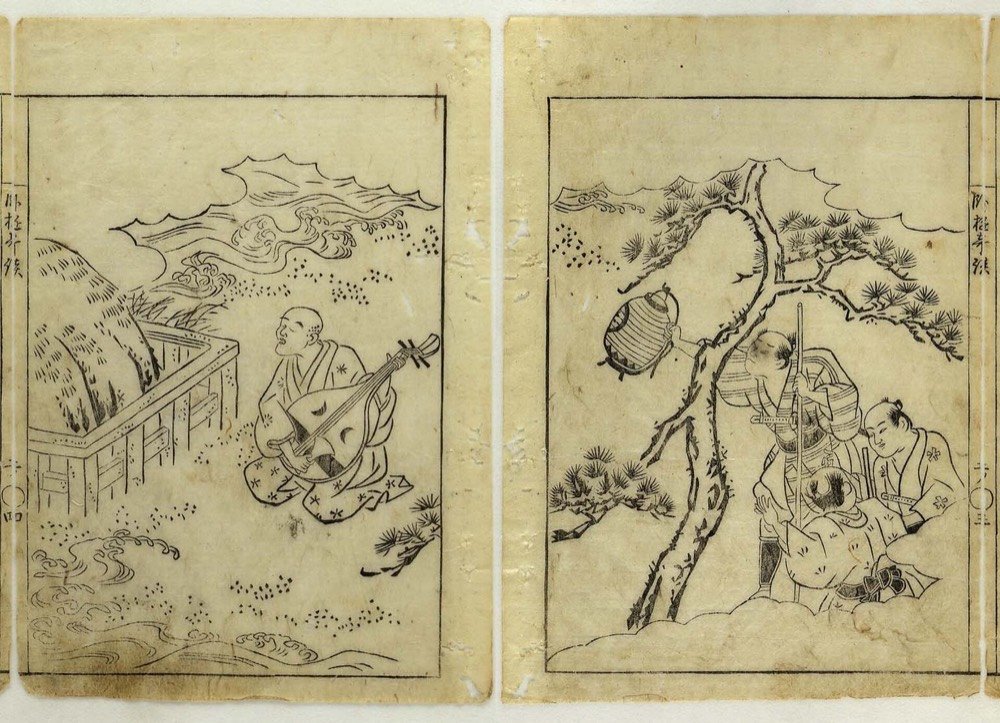
Hoichi was a blind biwa-playing lay priest lodged at Amidaji temple in Akamagaseki, now Shimonoseki, famed for his recitation of the sea battle of Dan-no-ura, where the Heike clan perished in these straits in 1185 and the child emperor Antoku drowned in his grandmother's arms. One night an armored samurai summons him to perform before a great personage. Night after night Hoichi vanishes; when temple servants finally track him with lanterns, he is sitting alone in the cemetery before the memorial tomb of Antoku, ghost-fires flickering around him, playing until his voice cracks to ranks of mossy gravestones. The nobleman's mansion is the burial ground of the Heike.
Knowing the ghosts will tear the player apart once the whole tale is sung, the head priest has the Heart Sutra written over every inch of Hoichi's body and orders him to sit motionless and silent. When the samurai returns he sees nothing in the darkness but two ears hanging in air, the one part of the body the scribe forgot. Unwilling to return empty-handed, he wrenches them off. Hoichi endures without a sound, survives, and as 'Hoichi the Earless' becomes the most sought-after performer in the land.
The early-modern source is 'Biwa no hikyoku yurei o nakashimu' in the 1782 collection Gayu Kidan; Lafcadio Hearn's retelling opened his Kwaidan (1904) and carried the story worldwide. Amidaji became the Akama shrine in the Meiji era, where a small hall to Hoichi and the graves of the Heike still stand; the Hoichi episode of Kobayashi's film Kwaidan (1964) restaged Dan-no-ura as one of Japanese cinema's great set pieces.
Academic Discussion & Critique
Exchange peer-reviewed hypotheses, comparative Indo-European etymologies, and archaeological field interpretations regarding Hoichi the Earless.
You Might Also Like
The Peony Lantern
Night after night the ronin Shinzaburo meets his lover Otsuyu, who arrives with a peony lantern, geta clacking. A neighbor peers in and sees a skeleton in his arms. The most romantic of Edo's great ghost tales.
Yotsuya Kaidan (Oiwa)
The ronin Iemon poisons his wife Oiwa; her face hideously disfigured, she dies cursing him and returns as a vengeful ghost. Tsuruya Nanboku's 1825 kabuki play made her the archetype of the Japanese onryo.
Aka Manto
A voice in the toilet stall asks, 'Red cloak or blue cloak?' Red brings death drenched in blood, blue death drained of it. The earliest documented outbreak was the Aka Manto panic among Tokyo schoolchildren in February 1939.
Hanako-san of the Toilet
Knock three times on the third stall of the third-floor school toilet and ask, 'Hanako-san, are you there?' A small voice answers, 'I'm here.' The best-known figure of Japanese school ghost lore, a nationwide craze by the 1980s.