

Cerberus
Mythological Narrative
Cerberus, offspring of Typhon and Echidna, is the hound that guards the gate of the underworld. Hesiod gives him fifty heads and a voice like bronze; the standard later image has three heads, a serpent for a tail, and snakes bristling from his neck. He crouches at the threshold beside the river of the dead, fawning on the souls who enter and devouring any who try to leave, so that the realm of the dead admits all and releases none.
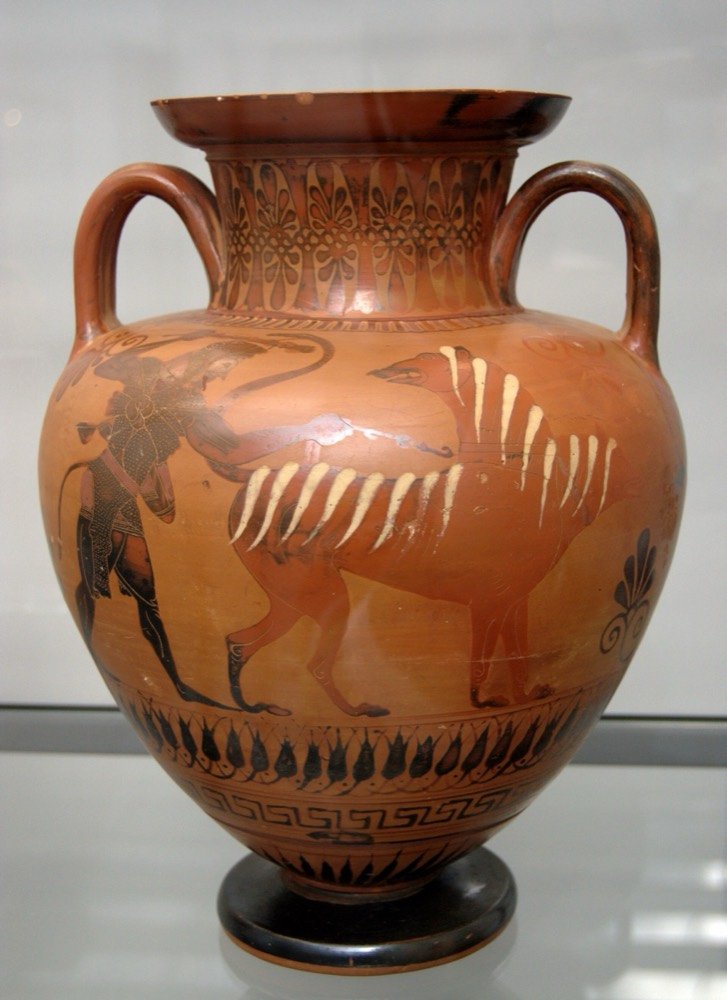
The twelfth labor of Heracles was to fetch him alive. Eurystheus forbade weapons, so with Hades's leave the hero wrestled the dog into submission with his bare hands, carried him on his shoulders to Mycenae — where Eurystheus hid in a storage jar at the sight — and then returned him below. Orpheus lulled the hound asleep with his lyre when he descended for Eurydice, and in Virgil's Aeneid the Sibyl of Cumae feeds him a cake soaked in honey and drugged herbs so that Aeneas may pass, the origin of the proverbial 'sop to Cerberus.'
Scholarly Commentary & Evolution
## Hound of the Gate
Kerberos is the many-headed dog of Hades, set to keep the dead inside. Hesiod gives him fifty heads; later vase-painters and poets settle on three, with a serpent tail and a mane of snakes. Heracles' last labor is to haul him to the sunlit world and return him unharmed.
Virgil's Aeneas drugs the beast with honeyed cake. The job is architectural, not decorative: the underworld needs a lock, and the lock has teeth.
## Honey-cake and the leash
The dog's lineage in the *Theogony* makes him a sibling of the Hydra and the Chimera, children of Typhon and Echidna. Apollodorus (2.5.12) sets the terms of Heracles' twelfth labour: Hades allows him to take the hound if he masters it without weapons, and he does so bare-handed, wrapped in the Nemean lion's skin. The Sibyl's honeyed, drugged cake in *Aeneid* 6 became the proverbial 'sop to Cerberus', a small bribe paid to get past a gatekeeper.
Classical Art & Museum Artifacts
High-resolution museum artifacts, classical sculptures, pottery reliefs, and bronze idols preserving authentic historical representations of Cerberus.

Sardonyx cameo fragment with Hercules tying up Cerberus
Academic Discussion & Critique
Exchange peer-reviewed hypotheses, comparative Indo-European etymologies, and archaeological field interpretations regarding Cerberus.
You Might Also Like
Typhon
Child of Gaia and Tartarus, with a hundred serpent heads and fire in his eyes. He challenged Zeus for kingship and lies defeated beneath Mount Etna.
Hades
King of the underworld, brother of Zeus and Poseidon, who drew the realm of the dead by lot. Greeks avoided his name, calling him Plouton, the wealthy one.
Heracles
Son of Zeus and the mortal Alcmene, the strongest of Greek heroes, who performed twelve labors in atonement and was received into Olympus as a god after death.
Chimera
A fire-breathing hybrid monster with the head of a lion, body of a goat, and tail of a serpent. Slain by the hero Bellerophon while riding the winged horse Pegasus.