

Serpopard
Mythological Narrative
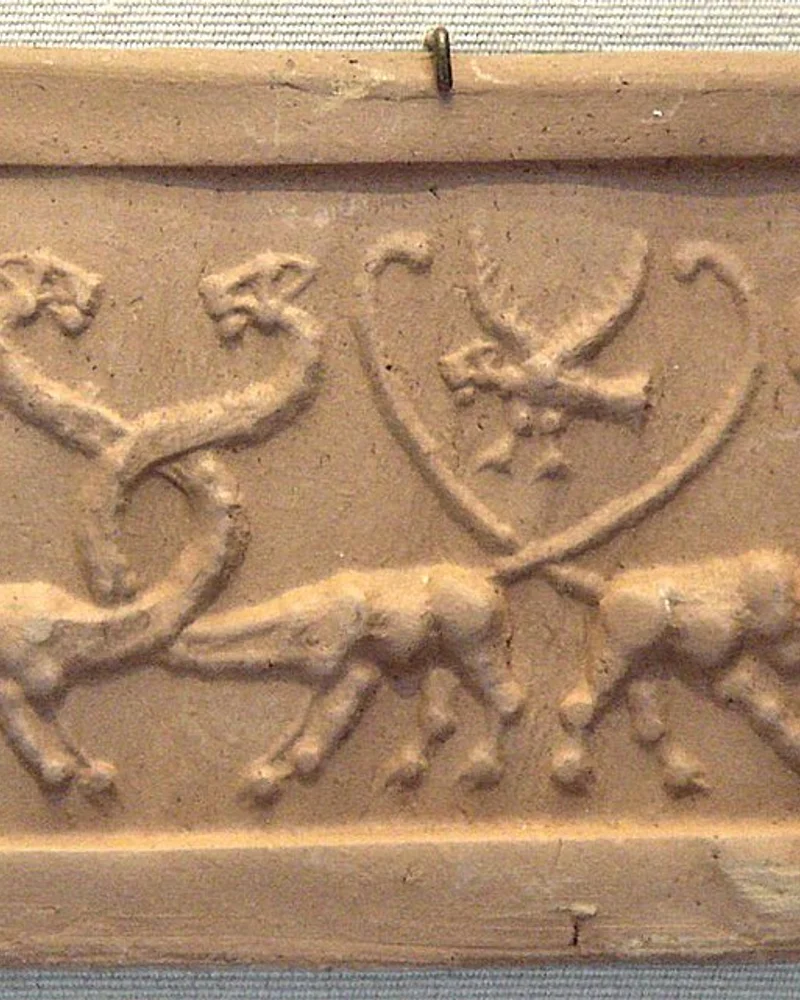
A mythical creature with the body of a leopard and an impossibly long serpentine neck. Depicted on the Narmer Palette, it represents the chaotic forces tamed by the pharaoh.
Scholarly Commentary & Evolution
## Long Necks on the Palette
The serpopard is an art-historical name for the leopard-bodied, serpent-necked beasts whose intertwined necks form a mixing well on the Narmer Palette. No surviving Egyptian story explains them. They belong to late Predynastic visual language of chaos bounded by the king. What we have is the stone; a hunt-myth does not survive.
## Mesopotamian cousins
Similar long-necked, feline creatures with entwined necks appear on Mesopotamian cylinder seals of the Uruk period, and art historians see the Egyptian serpopards as a borrowing from that tradition during a time of contact in the late 4th millennium BCE. After the early dynastic period the motif disappears from Egyptian art, which is one reason no narrative about the creature survives.
Academic Discussion & Critique
Exchange peer-reviewed hypotheses, comparative Indo-European etymologies, and archaeological field interpretations regarding Serpopard.
You Might Also Like
Ammit
The Devourer of the Dead, a demon with the head of a crocodile, torso of a lion, and hindquarters of a hippopotamus. She consumes the hearts of those found unworthy in the Hall of Judgment.
Apep
The giant serpent embodying chaos, Greek Apophis, who attacks the solar barque every night in the netherworld — forever repelled, never destroyed; temples burned wax images of him in ritual.
Bennu
The sacred bird perched on the primeval mound at creation, shaped like a heron with two long crest plumes, whose first cry set time in motion; the Greek phoenix legend grew from it.
Egyptian Sphinx
A benevolent guardian with the body of a lion and head of a pharaoh. Unlike its Greek counterpart, it protects sacred sites and represents royal power and divine wisdom.