

Huitzilopochtli
Also known as: Hummingbird of the South
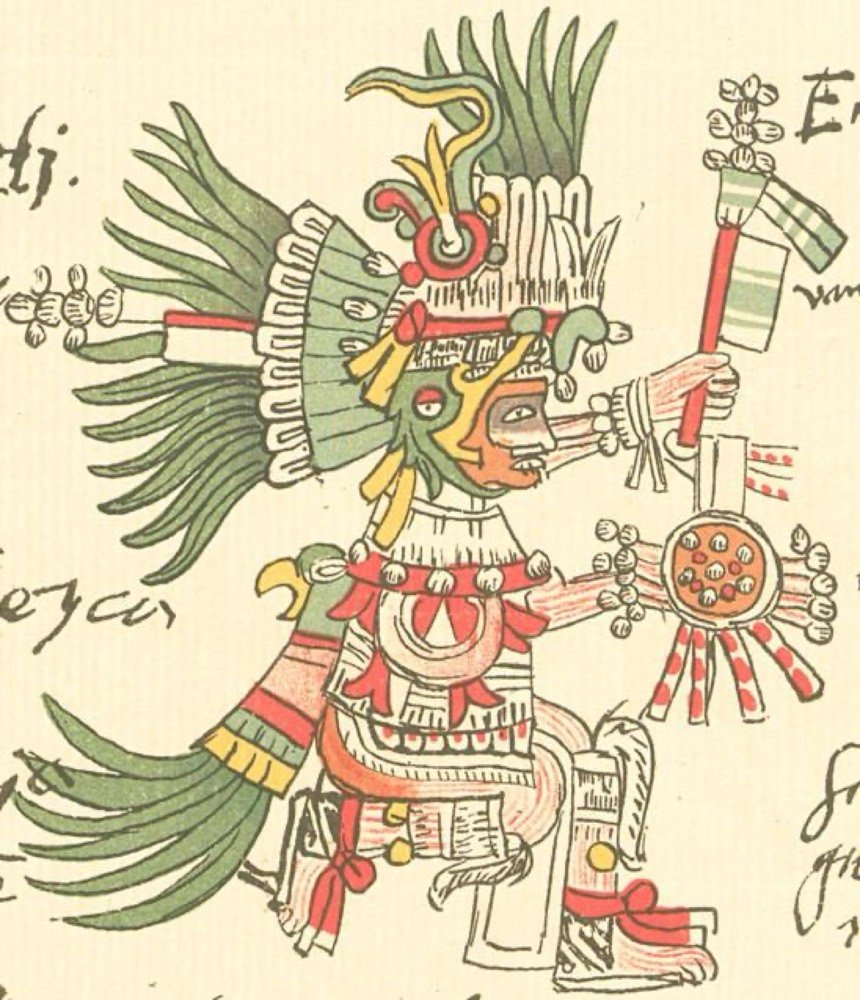
Mythological Narrative
Huitzilopochtli, Hummingbird of the Left — the left hand of the sun's path, the south — appears as a young warrior with blue-striped face paint, a hummingbird helmet, and a feathered left leg, carrying a mirrored shield and the blue fire serpent Xiuhcoatl. He was the Mexica's own tribal patron, god of war and of the sun at its height; warriors who fell in battle or on the sacrificial stone escorted the sun across the sky, and after four years returned as hummingbirds and butterflies among the flowers.
His birth is the most famous scene in Mexica myth. While the earth goddess Coatlicue swept the temple on Coatepec, Serpent Hill, a ball of feathers slipped into her bosom and left her pregnant. Her daughter, the moon goddess Coyolxauhqui, raged at the disgrace and led the Centzon Huitznahua, the four hundred southern stars, up the hill to kill her. At the last moment Huitzilopochtli sprang from the womb fully armed, struck off Coyolxauhqui's head with the fire serpent, hurled her dismembered body down the slope, and scattered the four hundred — a battle read as the sun's daily rout of moon and stars at dawn.
Migration lore says it was he who ordered the Mexica out of Aztlan, speaking through the priests who carried his bundled effigy, and who, after some two centuries of wandering, gave the sign of an eagle perched on a stone-borne cactus that fixed the site of Tenochtitlan. The southern shrine of the Templo Mayor was his, paired with Tlaloc's on the north; the great Coyolxauhqui stone unearthed at its foot in 1978, about 3.25 meters across, shows the dismembered moon goddess lying exactly where sacrificed bodies once rolled down the steps.
Scholarly Commentary & Evolution
## The Hummingbird of the South
Huitzilopochtli was the **supreme deity of the Aztecs**, the divine patron of their empire, and the god who guided them from their mythical homeland of Aztlan to found the great city of **Tenochtitlan**. His name means "Hummingbird of the Left (South)" - the hummingbird symbolizing the souls of fallen warriors who accompanied the sun across the sky.
## Solar Warrior and Blood Sacrifice
As the sun god, Huitzilopochtli fought an eternal battle each night against the forces of darkness, particularly his sister **Coyolxauhqui** (the moon) and the **Centzon Huitznahua** (the 400 stars). The Aztecs believed the sun would fail to rise without the nourishment of **human blood and hearts**, making sacrifice essential to cosmic survival. Warriors captured in the sacred **Flower Wars** were offered to sustain the sun's journey.
## The Great Temple (Templo Mayor)
The twin pyramids of **Templo Mayor** in Tenochtitlan's center featured Huitzilopochtli's shrine at its summit alongside Tlaloc's. Annual festivals including **Panquetzaliztli** celebrated his birth with elaborate ceremonies, ritual combat, and human sacrifice. The great stone of Coyolxauhqui found at Templo Mayor's base depicts her dismembered body.
## The Aztec Migration
Huitzilopochtli spoke to his people through priests, directing their centuries-long migration from Aztlan. He promised they would find their destined home where an eagle perched on a cactus devoured a serpent - the image now central to Mexico's flag.
Cross-Pantheon Parallels & Archetypes
Academic Discussion & Critique
Exchange peer-reviewed hypotheses, comparative Indo-European etymologies, and archaeological field interpretations regarding Huitzilopochtli.
You Might Also Like
Xiuhcoatl
The Turquoise Serpent, a weapon of living fire with which the newborn Huitzilopochtli slew the moon goddess Coyolxauhqui. Two fire serpents encircle the rim of the Sun Stone.
Coatlicue
She of the Serpent Skirt, the earth mother who conceived Huitzilopochtli from a ball of falling feathers. Her colossal statue, unearthed in 1790, is a masterwork of Aztec sculpture.
Tezcatlipoca
The Smoking Mirror, god of the night sky, sorcery, and fate. He sees all hearts in his obsidian mirror; his right foot, lost baiting the earth monster, is replaced by a mirror.
Tlaloc
The rain god, masked with goggle eyes and jaguar fangs. His helpers pour rain from jars at the four directions; those killed by water or lightning go to his green paradise, Tlalocan.