

Bahamut
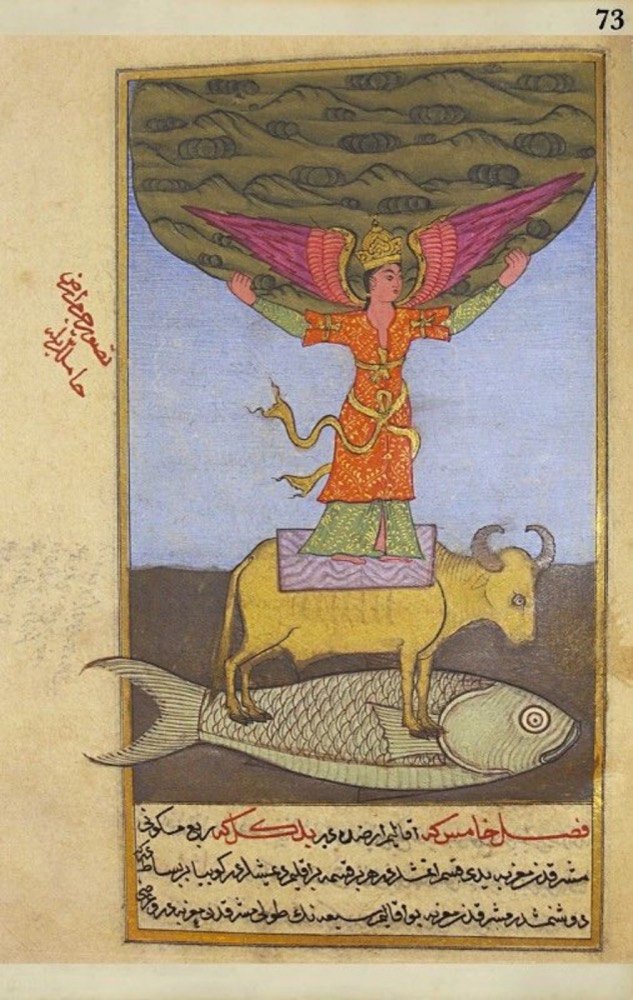
Mythological Narrative
In the layered world-picture of medieval Arab cosmography, Bahamut lies at the bottom of everything. When the earth was created it swayed, so God sent an angel to bear it up; the angel needed footing, so a rock of gem was set beneath him; under the rock stands a colossal bull, often called Kuyutha, with uncounted eyes and horns; and the bull stands on the back of a fish — Bahamut. Beneath the fish is water, beneath the water wind, beneath the wind darkness, and there human knowledge ends. Cosmographies such as al-Qazwini's thirteenth-century Wonders of Creation record the scheme, along with a famous measure of the fish's size: all the seas of the world, set in one of its nostrils, would be as a mustard seed in a desert.
The name descends from the Hebrew Behemoth, the land beast of the Book of Job, which in Arabic tradition became a fish of the abyss — trading elements, as it were, with the watery Leviathan. In Burton's English translation of the Thousand and One Nights, the 496th night grants Isa (Jesus) a vision of Bahamut; he falls senseless for three days.
Borges gave the fish an entry in The Book of Imaginary Beings, reading the tower of angel, rock, bull and fish as a figure for the infinite regress of causes. Modern fantasy rebuilt the creature entirely: Dungeons and Dragons crowned Bahamut a platinum dragon god, Final Fantasy made him the king of summoned dragons, and the silent back that carries the world in the old texts is now the least-known thing about him.
Academic Discussion & Critique
Exchange peer-reviewed hypotheses, comparative Indo-European etymologies, and archaeological field interpretations regarding Bahamut.
You Might Also Like
Roc
The giant bird of Arab seafaring lore, its egg the size of a dome, able to carry off elephants to feed its young. Sinbad escaped an island tied to its leg; Marco Polo placed it in the seas off Madagascar.
Mount Qaf
The emerald mountain range encircling the inhabited world; the sky takes its colour from its reflection. Mother of all mountains, its roots joined underground, with the lands of the jinn beyond. To cross Qaf is to leave the human world.
Ghoul
A shapeshifting man-eater of the Arabian desert, often female, luring lone travellers off the road to devour them, or digging up graves. The pre-Islamic poet Ta'abbata Sharran claimed to have killed one; English 'ghoul' derives from its name.
Aladdin's Lamp
A shabby oil lamp from an underground treasure cave; rub it and a jinni appears, slave to whoever holds it. No early Arabic manuscript contains the tale — the Syrian Hanna Diyab told it to Galland in 1709.