

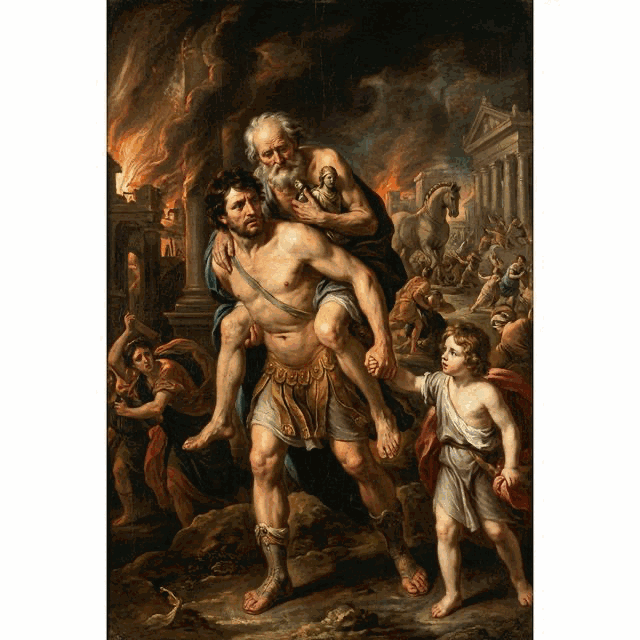
Flight from Troy
When the Greeks poured out of the Wooden Horse and Troy fell to flames, the hero Aeneas, son of the goddess Venus and the mortal Anchises, fought bravely but was told by the ghost of Hector that hope for the city was lost. His destiny lay elsewhere. Shouldering his elderly father Anchises and leading his young son Ascanius by the hand, Aeneas fled the burning city, carrying with him the household gods (Penates) of Troy. He gathered a band of refugees and set sail, beginning a long and perilous odyssey to find a new home in the west.
The Passion of Dido
After years of wandering, blown off course by Juno (who hated the Trojans), Aeneas washed ashore in Carthage, a rising city in North Africa ruled by Queen Dido. Venus caused Dido to fall madly in love with Aeneas to ensure his safety. For a time, Aeneas forgot his mission, living in luxury with the queen.
But Jupiter sent Mercury to remind Aeneas of his destiny: he was not born to rule Carthage but to found a great empire in Italy. Reluctantly, placing duty (pietas) above love, Aeneas secretly prepared to leave. When Dido discovered his betrayal, she cursed him and his descendants—foretelling the Punic Wars between Rome and Carthage—before taking her own life upon a burning pyre as his ships sailed away.
Descent into the Underworld
Upon reaching Italy, Aeneas visited the Sibyl of Cumae, a prophetess who guided him into the Underworld to consult the shade of his father. There, in the Elysian Fields, Anchises showed his son a procession of future souls waiting to be born: the great heroes and leaders of Rome, culminating in Augustus Caesar. This vision of Rome's glorious future renewed Aeneas's resolve.
War for Italy
Aeneas arrived in Latium, where the local king Latinus offered him his daughter Lavinia in marriage. However, Turnus, a local prince who had been betrothed to her, was incited to war by the fury Allecto (sent by Juno). War erupted between the Trojans and the Rutulians.
The conflict was brutal and bloody, mirroring the Trojan War. Finally, the war came down to single combat between Aeneas and Turnus. Aeneas wounded Turnus, who begged for mercy. Aeneas hesitated, considering sparing him, until he saw the sword-belt of his young friend Pallas (whom Turnus had slain) on his enemy's shoulder. Consumed by rage and grief, Aeneas drove his sword through Turnus's chest, ending the war and securing the foundation of the Roman race.