

Yingzhao
Mythological Narrative
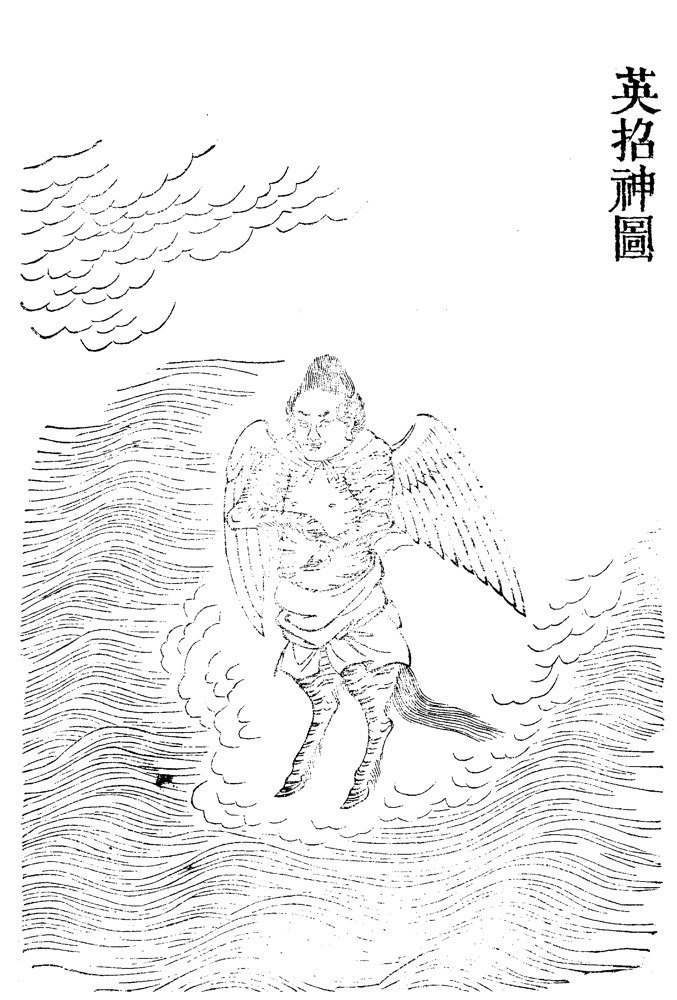
Mount Huaijiang 'is in truth the level garden of the High God' — the paradise later ages called the Hanging Garden — and the god Yingzhao keeps it. The 'Classic of the Western Mountains' gives him a horse's body and a human face, tiger stripes and bird's wings; he 'makes his circuit of the four seas', proclaiming the God's commands, with a voice like water drawn through a pipe.
From Huaijiang one looks south to Kunlun, 'its light blazing, its vapors billowing'; westward lies the great marsh where the spirit of Houji, lord of millet, lies hidden; the mountain itself yields gold, realgar, and langgan gems. The garden thus sits on a terrace overlooking Kunlun, and the Huainanzi counts the Hanging Garden as one rung of the ladder that leads up the mountain to heaven — whoever climbs it 'becomes numinous, able to command wind and rain'.
Yingzhao pairs naturally with Luwu, warden of Kunlun: both are human-faced, beast-bodied tutelary gods of the far west, one seated in the God's capital, the other ranging out from the God's garden across the four seas.
Academic Discussion & Critique
Exchange peer-reviewed hypotheses, comparative Indo-European etymologies, and archaeological field interpretations regarding Yingzhao.
You Might Also Like
Luwu
Tutelary god of the Mound of Kunlun: tiger-bodied with nine tails, a human face and tiger claws, keeper of heaven's nine regions and the seasons of the God's park.
Mount Kunlun
The great mythic mountain of the far west, the High God's capital on earth and home of the Queen Mother of the West; to climb its successive terraces was to gain deathlessness and reach heaven.
Kaiming Beast
Guardian of Kunlun's nine gates: a body like a giant tiger crowned with nine human-faced heads, standing atop the mountain facing east, warding the abode of the hundred gods.
Qinyuan
A venomous bird of Kunlun, wasp-shaped but the size of a mandarin duck; birds and beasts it stings die outright, and trees it stings wither.