

Quru
Mythological Narrative
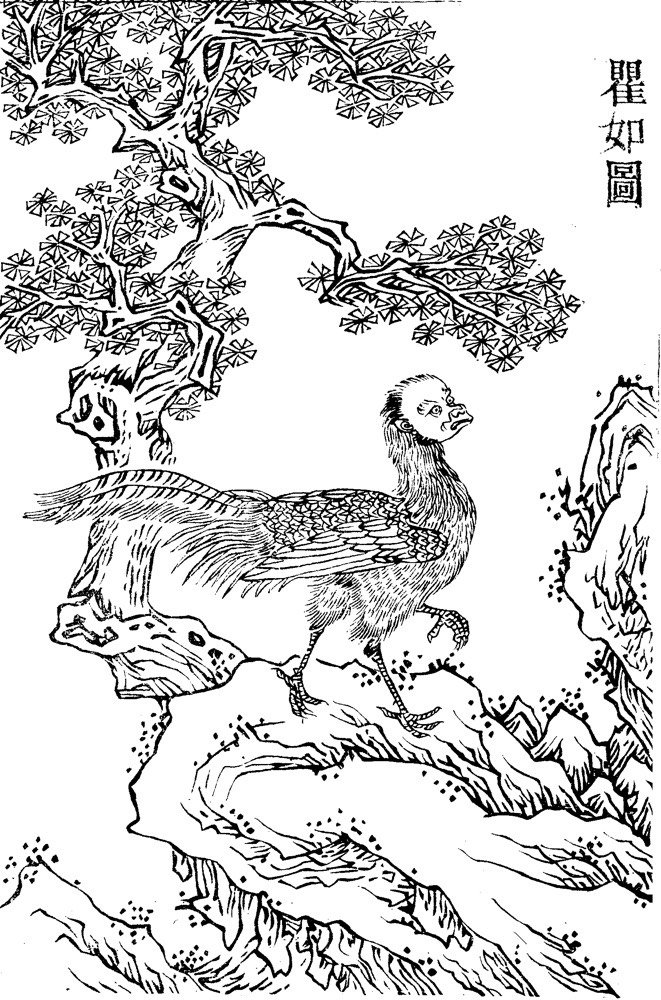
Mount Daoguo, whose lower slopes teem with rhinoceroses, buffalo, and elephants — one of the book's rare glimpses of tropical fauna — is also home to the quru. The Classic of the Southern Mountains describes a bird shaped like the jiao, a duck-like waterbird that old commentators identify with small herons, but with a white head, a human face, and three legs. Its cry, the text adds, is its own name.
That last clause follows a recurring formula in the book's science of names. The zhu of Mount Ju 'calls its own name'; so does the drought-bird Yong of Mount Lingqiu. The practical origin is plain — the easiest way to name an unknown bird is to transcribe its call — but the text reverses cause and effect, so that the bird seems to announce itself, every cry a self-introduction. Unusually, the quru comes with no prescription and no portent: in a ledger otherwise ruled by 'eat it and', 'wear it and', 'when seen', it is simply observed and recorded — a white-headed thing on three legs at the water's edge, shouting its own name.
Academic Discussion & Critique
Exchange peer-reviewed hypotheses, comparative Indo-European etymologies, and archaeological field interpretations regarding Quru.
You Might Also Like
Yong
A bird of Mount Lingqiu shaped like an owl, with a human face, four eyes, and ears, calling out its own name; wherever it appears, great drought follows across the land.
Hujiao
A jiao-dragon of the Yin River below Mount Daoguo, with a fish's body and a serpent's tail, calling like a mandarin duck; eating it prevents swellings and cures hemorrhoids.
Guanguan
A bird of Mount Qingqiu shaped like a turtledove, its call like people scolding one another; wearing its feathers was said to keep one from confusion.
Aohen
A man-eating beast of Mount Sanwei: shaped like an ox, white-bodied with four horns, its long hair hanging like a straw rain-cape.