

Lei
Mythological Narrative
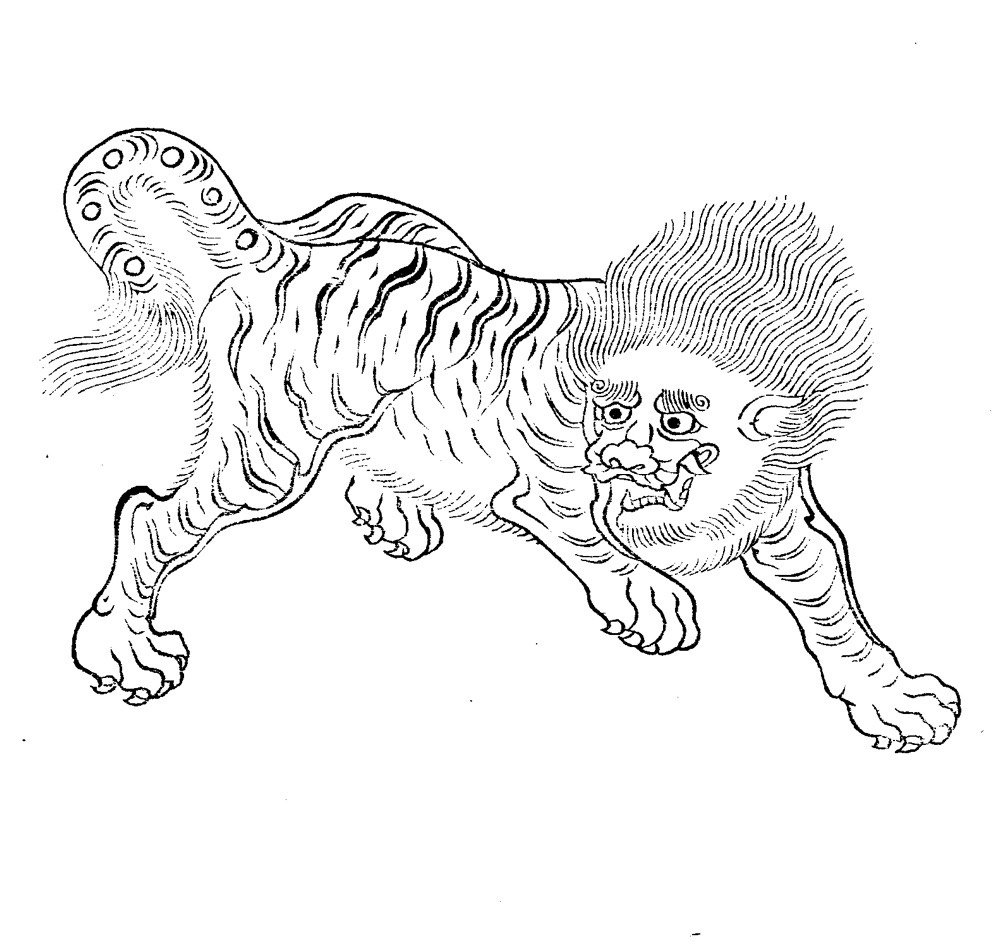
Mount Chanyuan abounds in water, grows nothing, and is too sheer to climb. Its beast, the lei, looks like a wildcat draped in long hair, and its wonder lies in a single phrase: it is 'its own male and female', both sexes complete in one body, mating with itself to breed.
The prescribed effect follows the form by classic sympathetic logic. Jealousy springs from the division of the sexes and the rivalries it breeds; a creature that contains both sexes wants nothing from any other, and so its flesh, eaten, dissolves envy — 'the eater does not become jealous'. Later commentators seeking a real original mostly point to the civets: their prominent perineal scent glands make the sexes hard to tell apart, which early observers took for true hermaphroditism, and Li Shizhen's Bencao Gangmu repeats of the civet the very formula 'it is its own male and female'. The beast's name wavered in transmission, as Guo Pu's notes record variant readings, but the eight characters of its strange prescription travelled unchanged — what readers of the Shanhaijing remembered was always the remedy.
Academic Discussion & Critique
Exchange peer-reviewed hypotheses, comparative Indo-European etymologies, and archaeological field interpretations regarding Lei.
You Might Also Like
Lu
A fish of Mount Di shaped like an ox yet living on hillsides, with a serpent's tail and wings sprouting beneath its ribs; it dies each winter and revives each summer, and eating it prevents tumorous swellings.
Boshi
A beast of Mount Ji shaped like a goat, with nine tails, four ears, and eyes set on its back; wearing its hide was said to banish fear.
Chiru
A fish of the Ying River on Mount Qingqiu, wholly fish-bodied but with a human face and a call like a mandarin duck; eating it was said to prevent scabies.
Hujiao
A jiao-dragon of the Yin River below Mount Daoguo, with a fish's body and a serpent's tail, calling like a mandarin duck; eating it prevents swellings and cures hemorrhoids.