

Jianmu
Mythological Narrative
Within the southern seas, between the Black and Green rivers, lie nine mounds ringed by water, says the final chapter. There grows a tree with green leaves, a purple trunk, black flowers, and yellow fruit: the Jianmu, the 'Erected Tree'. It rises a hundred ren without a single side branch, bearing nine twisting boughs only at its crown and nine coiling roots at its base; its fruit is like hemp seed, its leaves like those of the mang tree. Taihao — Fuxi — passed up and down by it, and the Yellow Emperor, in the old commentaries' reading, planted and tended it.
The Huainanzi states its cosmic office: 'The Jianmu is in Duguang, whence the assembled gods ascend and descend. At noon it casts no shadow; a shout raises no echo; for it stands at the very center of heaven and earth.' The final chapter describes the plain around it: Houji, lord of millet, is buried there; rich beans, rice, and millets grow of themselves, sowable in winter and summer alike, while luan-birds sing and phoenixes dance unbidden. At the foot of the world-axis lies a field that farms itself.
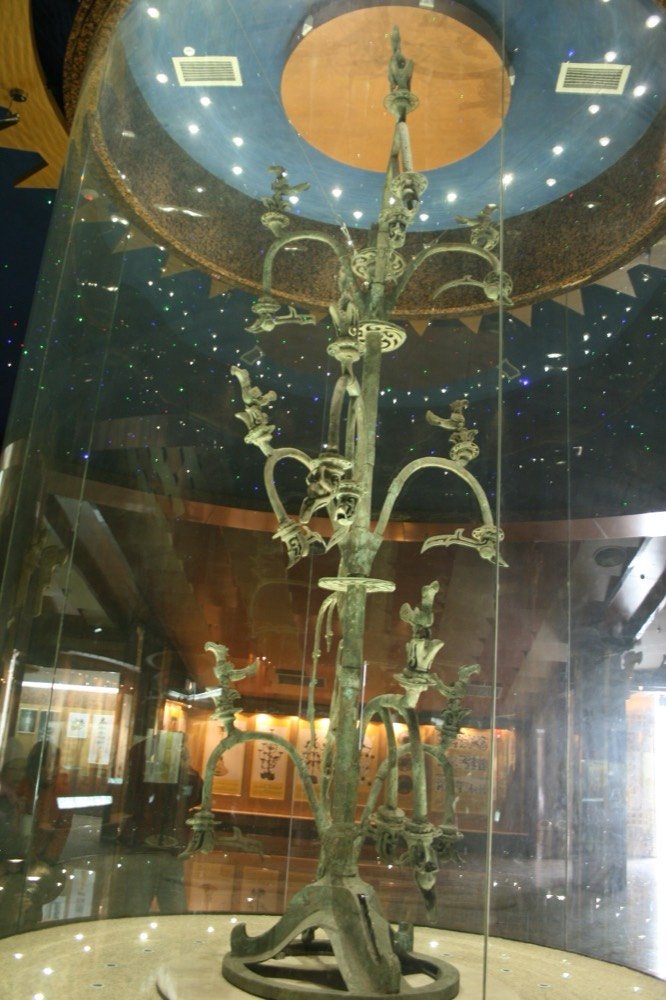
With the Fusang lifting the suns in the east and the Ruomu receiving them in the west, the Jianmu completes the tree-frame of the book's cosmos. Scholars following Meng Wentong identify Duguang with the Chengdu Plain, and when researchers discuss the four-meter bronze trees unearthed at Sanxingdui in 1986, tiered with perching birds, Jianmu and Fusang remain the two names most often invoked.
Academic Discussion & Critique
Exchange peer-reviewed hypotheses, comparative Indo-European etymologies, and archaeological field interpretations regarding Jianmu.
You Might Also Like
Fusang and the Ten Suns
In the sunrise valley of Tanggu grows the Fusang tree where the ten suns roost — nine on the lower branches, one on the upper — carried into the sky by crows, one returning as the next departs.
Fuxi
First of the Three Sovereigns, serpent-bodied like his consort Nüwa. He devised the eight trigrams from the patterns of sky and earth, taught net-fishing, and instituted marriage rites.
The Yellow Emperor
Xuanyuan, first of the Five Sovereigns, who defeated Yandi at Banquan and Chiyou at Zhuolu. The calendar, writing, and music were credited to his reign; he rose to heaven on a dragon.
Country of Wuxian
A nation of shamans in the far west, each gripping a green snake in the right hand and a red one in the left; Mount Dengbao is their ladder to heaven, and all medicines grow on nearby Mount Ling.