

Gudiao
Mythological Narrative
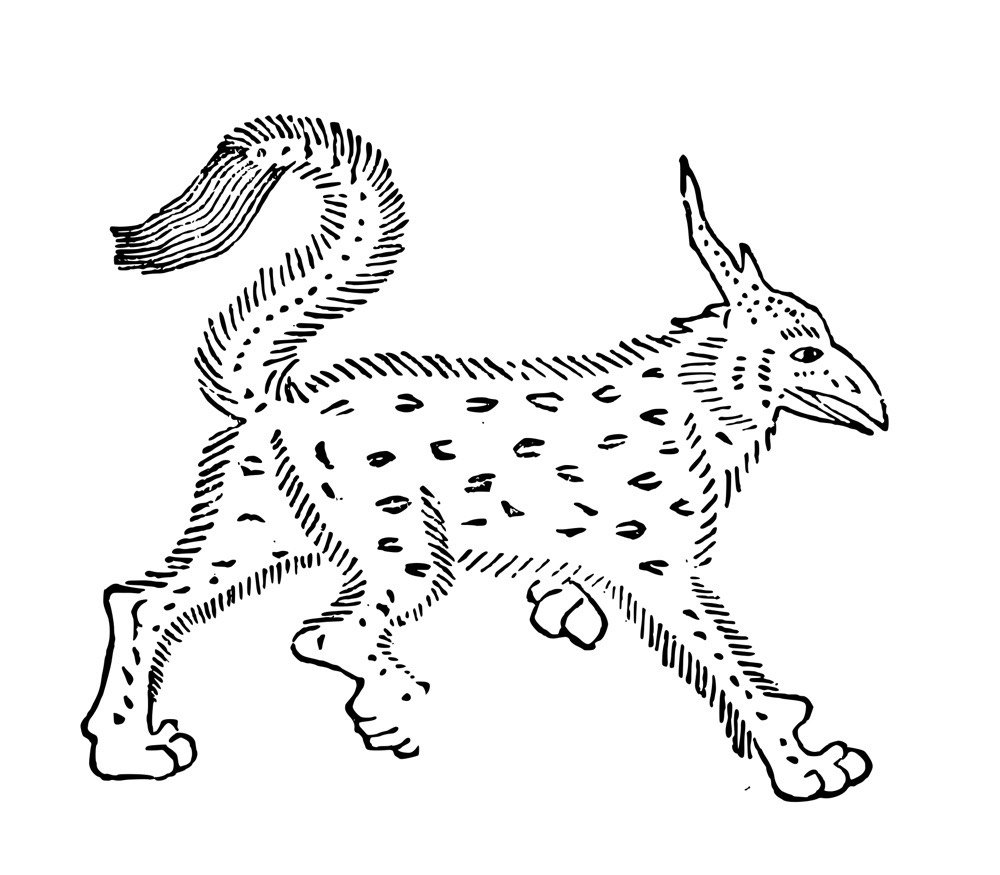
Mount Luwu bears no plants, only gold and stone. From it flows the Zegeng River, running south into the Pang, and in its waters lives the gudiao. The Classic of the Southern Mountains gives it three clauses: shaped like an eagle but horned, voiced like a human infant, and an eater of men. The text pointedly calls this bird-shaped thing a 'beast', and every boundary — bird and beast, water and land — fails on its body.
The pairing of an infant's cry with man-eating occurs twice in this volume: the nine-tailed fox of Mount Qingqiu wails like a baby, and the gudiao raises the same sound over its river. A child's cry is the one noise that disarms all wariness, which makes it the coldest possible voice for a predator. The fox went on to a long afterlife as omen and temptress; the gudiao acquired no further legend at all, remaining fixed in its three clauses. Ming and Qing illustrators split over it, some drawing a single-horned giant eagle, others a leopard-bodied beast with a raptor's beak — two honest readings of 'like an eagle, but horned'.
Academic Discussion & Critique
Exchange peer-reviewed hypotheses, comparative Indo-European etymologies, and archaeological field interpretations regarding Gudiao.
You Might Also Like
Changyou
A beast of Mount Changyou shaped like a macaque but with four ears, its voice like a human groan; whichever district it appears in will suffer great floods.
Nine-Tailed Fox
A fox with nine tails from Mount Qingqiu whose cry sounds like a wailing infant; it eats people, yet its flesh wards off gu sorcery. Later ages recast it from royal omen to bewitching temptress.
Mafu
A man-eating beast of Mount Manqu with a human face on a tiger's body, whose cry mimics a wailing infant; the Yi River rises from its mountain.
Xiqu
A man-eating beast of Mount Li shaped like an ox, its whole body dark blue-grey, its voice a wailing infant — the same lure used by the Mafu of the same Yi-Luo basin.