

Ershu
Mythological Narrative
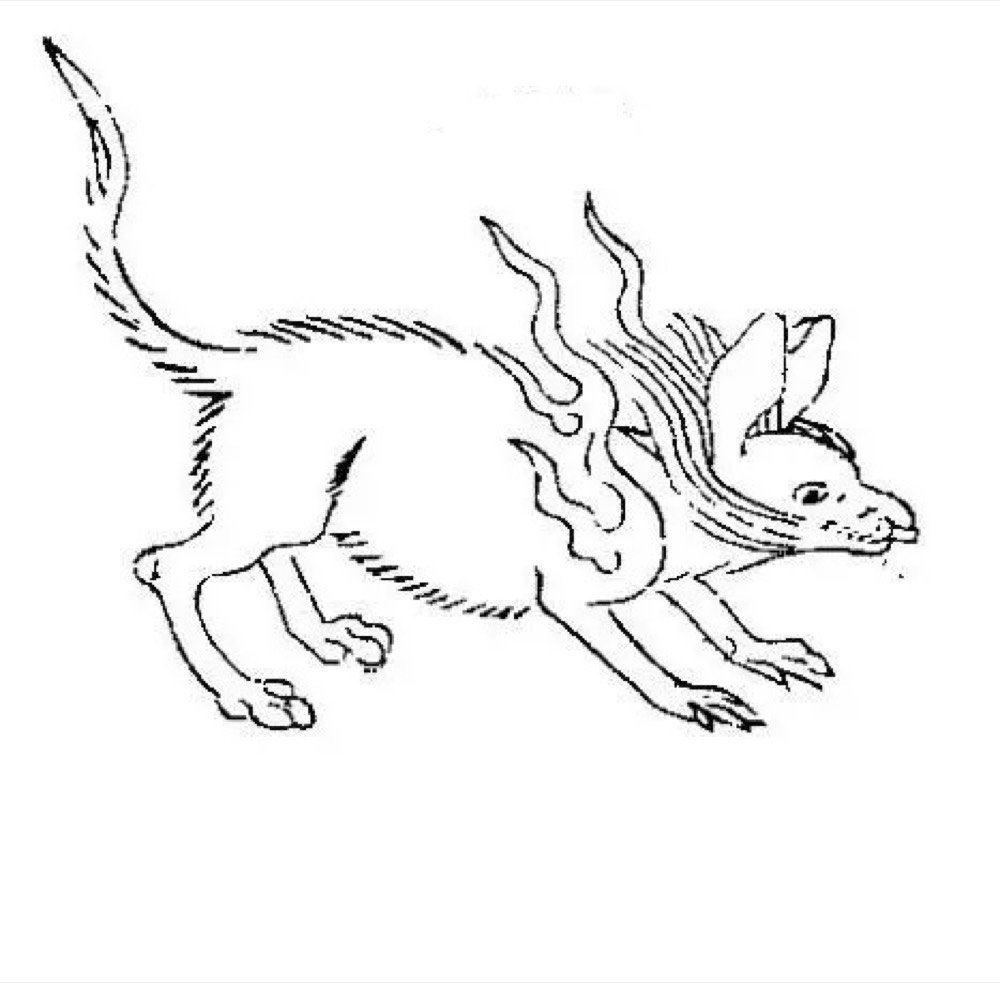
Danxun Mountain, in the first guideway of the Northern Mountains, grows ailanthus and cypress, wild chives and rocambole, and yields cinnabar pigment. Its beast is at base a rat, but it wears a hare's head, its body has the build of an elaphure deer, and its voice is the howl of a dog. Strangest is its manner of flight: 'it flies by means of its tail' — no wings, just the one appendage. The classic appends the pharmacology: eating its flesh prevents distension of the belly and guards against the hundred poisons.
Flying beasts in the classic each have their own technique. The feishu of Tianchi Mountain 'flies by means of its back'; the ershu flies by its tail. Later commentators and naturalists reached for the flying squirrel — the membrane-winged glider that steers with a plume of a tail — and the match with 'flies by its tail' is fair, though the hare's head and deer's body refuse to cooperate. An identification is only ever an identification.
The phrase 'guards against the hundred poisons' places the ershu high in the classic's pharmacopoeia. Most animal remedies in the book treat a single complaint — abscesses, warts, sore throats, one ailment apiece. A universal antidote is rare. A small beast combining rat, hare, deer, and dog, which flies on its tail and neutralizes every poison: for one entry, Danxun Mountain packs an uncommon density of marvels.
Academic Discussion & Critique
Exchange peer-reviewed hypotheses, comparative Indo-European etymologies, and archaeological field interpretations regarding Ershu.
You Might Also Like
Heluo Fish
A strange fish of the Qiao River below Qiaoming Mountain: a single head trailing ten bodies, barking like a dog. Eating it was said to cure abscesses.
Tianma
A beast of Macheng Mountain shaped like a white dog with a black head. The moment it sees a person it takes to the air, crying out what sounds like its own name.
Menghuai
A protective beast of Qiaoming Mountain, shaped like a porcupine with scarlet bristles and a rolling 'liu-liu' cry. Keeping it, or its painted image, was believed to ward off evil.
Dugu
A beast of Beixiao Mountain: a tiger's frame, all white, with a dog's head, a horse's tail, and a boar's bristling mane. The second character of its name is a rare graph coined for it; Guo Pu glosses it 'gu'.