

Princess Bari
Also known as: Princess Bari, Baridegi, Bari-degi
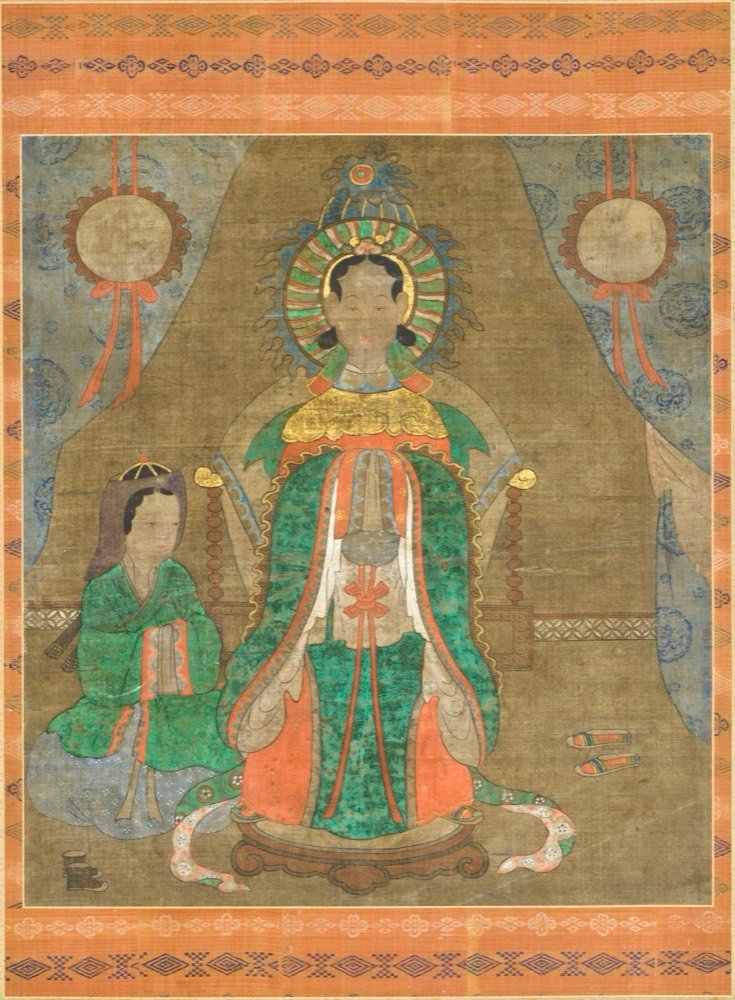
Mythological Narrative
No chronicle records the story of Princess Bari; it survives in performance, as a shamanic narrative song for the dead sung through the night at the jinogwi-gut of the Seoul region and the ssitgim-gut of the southern coast. King Ogu fathered six princesses in a row; diviners promised the seventh child would be a son, but a girl was born. The enraged king sealed the infant in a jade casket and cast her away, into a river or the wilds depending on the version, which earned her the name Baridegi, the abandoned one. A pious old couple drew her out and raised her.
Years later the king and queen fell mortally ill, and only medicinal water from the land beyond the western sky could save them. Each of the six pampered princesses made excuses; the foundling, sought out and restored, put on men's clothes and set off alone. In the western land she served Mujangseung, keeper of the water: three years hauling water, three tending fires, three cutting wood, and after the nine years married him and bore seven sons before receiving the water of life and the flowers that restore flesh and bone. On the road home she met her parents' funeral procession, halted the biers, revived their bodies with the flowers and their breath with the water.
Offered half the kingdom, she declined, asking instead to guide the souls of the dead. As the goddess Ogu she is honored as the ancestress of all shamans, and the dead cross their bridge along the road she points out. Dozens of regional versions have been transcribed; the Seoul text recorded by Akamatsu and Akiba in 1937 is among the earliest full scholarly records. In 2007 Hwang Sok-yong's novel Baridegi recast the abandoned girl as a North Korean refugee.
Scholarly Commentary & Evolution
## A song for the dead
The story of Princess Bari is a *muga*, a shamanic narrative song, sung by Korean shamans in rites for the dead such as the Seoul *jinogwi-gut* and the east-coast *ogu-gut*, where the shaman guides the soul of the dead to the other world as Bari did. It exists in many dozens of recorded versions; one of the first to be written down was recorded from a Seoul shaman and published by Akiba Takashi and Akamatsu Chijō in 1937, and the folklorist Kim Tae-gon later recorded many more.
## The story
In a common version, King Ogu marries Queen Gildae in an inauspicious year, as a fortune-teller had warned, and they have only daughters. When the seventh daughter is born, the king in anger has her cast away in a jade box into the water. She is rescued and raised by an old couple, or in some versions protected by the Buddha or by animals. Years later the king and queen fall mortally ill, and learn that only medicinal water from the Western Heaven can save them. The six elder daughters refuse. Bari, found and summoned, agrees to go, repaying the debt of her birth if not of her upbringing.
## The journey and the return
Dressed as a man, she crosses mountains, rivers, and hells, sometimes helped by the Buddha. At the source of the water, its guardian demands years of labor: drawing water, cutting firewood, and tending fire, and in many versions he marries her and she bears him seven sons. At last she returns with the water and the flowers that restore bone, flesh, and breath, and meets her parents' funeral procession. She revives them. Offered wealth and half the kingdom, she asks instead to become the one who guides the dead, and she is honored as the ancestor of shamans.
## Meaning
The story reverses the Confucian preference for sons: the rejected daughter alone fulfills filial duty. It is one of the best-known Korean myths and has been retold in modern novels, plays, and music.
Cross-Pantheon Parallels & Archetypes
Academic Discussion & Critique
Exchange peer-reviewed hypotheses, comparative Indo-European etymologies, and archaeological field interpretations regarding Princess Bari.
You Might Also Like
Samsin Halmoni
The grandmother goddess of conception, safe delivery, and small children, honored with rice and seaweed soup in the birthing room; the blue spot on a newborn's bottom is said to be her hurrying slap.
Cheonyeo Gwisin
The ghost of a woman who died unmarried, white-robed with loose black hair, bound to the world by grievance; the wronged Arang of Miryang frightened magistrate after magistrate to death until one stayed to hear her.
Inanna
Queen of Heaven and goddess of love and war. Inanna is the most complex and dynamic deity of the Mesopotamian pantheon, embodying both desire and destruction.
Bak Hyeokgeose
The egg-born founder of Silla, found by the six village chiefs beside the Najeong well where a white horse knelt and then rose into heaven; crowned at thirteen with his queen Aryeong, born from a dragon at another well.