

Yuki-onna
Mythological Narrative
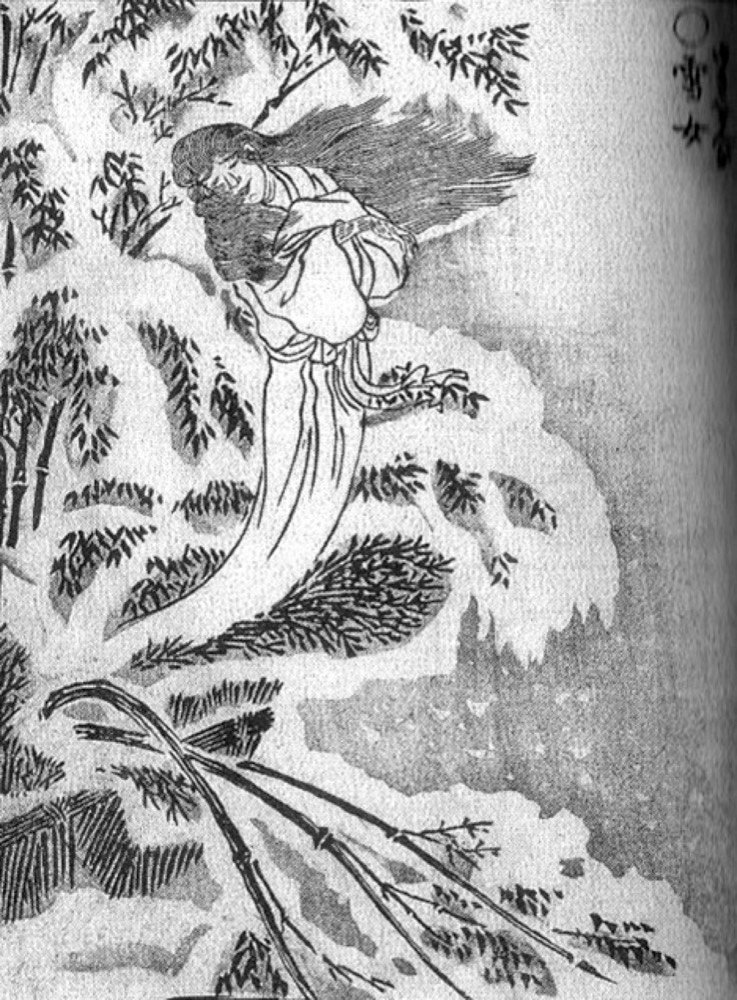
The yuki-onna wears white, her long hair black, her skin pale to the point of translucence; she appears on mountain paths, ferry crossings, and snowfields in the dead of a blizzard night. The snow country of Tohoku and Hokuriku knows her in many forms: some freeze travelers with a puff of white breath, others stand at crossroads on snowy nights holding an infant and asking passersby to take it, and whoever accepts is frozen where he stands, a variant that shades into the ubume legend. Toriyama Sekien had already drawn her in his 1776 bestiary Gazu Hyakki Yagyo.
The version everyone now knows comes from Lafcadio Hearn's Kwaidan (1904). Old Mosaku and eighteen-year-old Minokichi, woodcutters of Musashi province, are trapped by a storm in a ferryman's hut. At midnight a woman in white bends over Mosaku and freezes him with her breath, but spares Minokichi for his youth and beauty, on the condition that he never speak of her. The next winter he meets a lovely girl called O-Yuki; they marry and raise ten children while her face never ages. One night, watching her sew by lamplight, he tells her of the night in the hut. She rises: 'That was I.' For the children's sake she spares him, and dissolves into white mist through the smoke hole. Hearn noted that he heard the tale from a farmer of Chofu in Nishitama, Musashi.
She has haunted film ever since; the Yuki-onna episode of Masaki Kobayashi's Kwaidan (1964) adapts Hearn's telling.
Academic Discussion & Critique
Exchange peer-reviewed hypotheses, comparative Indo-European etymologies, and archaeological field interpretations regarding Yuki-onna.
You Might Also Like
Tamamo no Mae
A fox spirit who charmed Retired Emperor Toba as a peerless court lady; unmasked by a diviner, hunted down on the Nasu plain, she became the poison-breathing Killing Stone, later tied to the nine-tailed fox and Daji.
Zashiki-warashi
A child spirit dwelling in the parlors of old houses in northeastern Japan, heard as night footsteps and pillow-turning pranks. A house it inhabits prospers; when it leaves, the family's fortune goes with it.
Skin-walker
In Navajo tradition, a practitioner of witchcraft who dons an animal skin to travel by night as coyote, wolf, or owl and do harm. A deeply tabooed subject, traditionally not discussed.
Ama-no-Iwato
Outraged by Susanoo's violence, Amaterasu sealed herself in a rock cave and the world went dark, until the gods lured her out with a mirror, jewels, and Ame-no-Uzume's wild dance.