

Kappa
Mythological Narrative
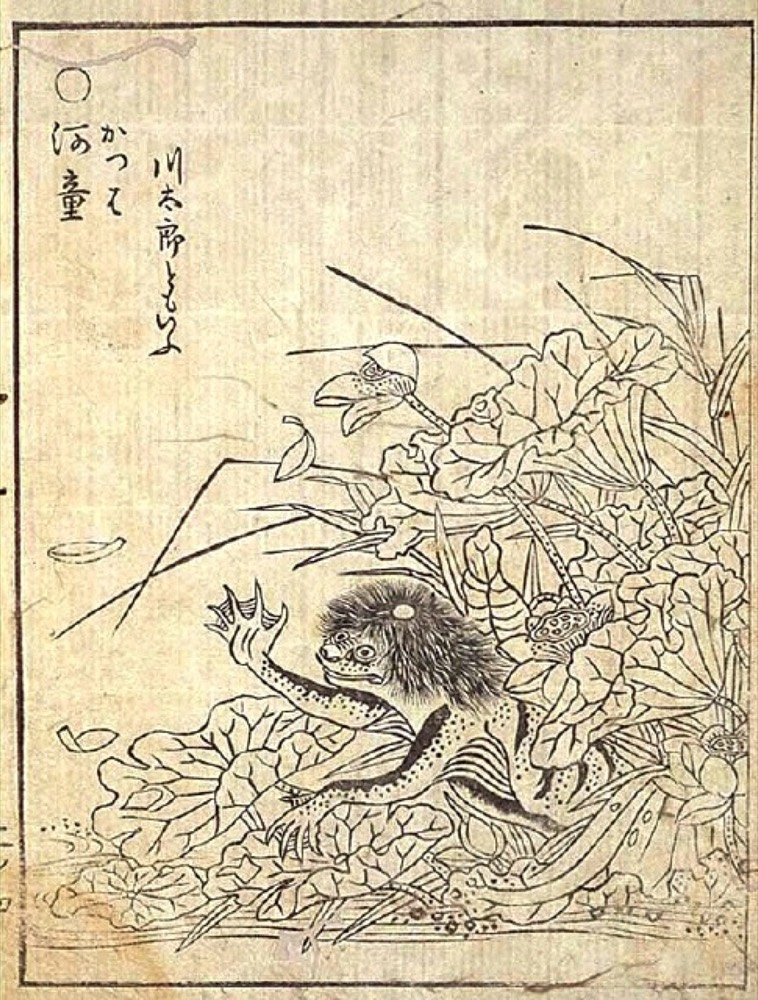
A kappa stands about as tall as a four- or five-year-old child, carries a turtle shell on its back, has webbed hands and feet, and is usually green, though around Tono the kappa are said to be red-faced. Its vital point is the saucer-like hollow on its crown, which holds water: full, the creature can out-wrestle a grown man; spilled, it goes limp. The classic countermeasure is a deep bow, which a well-mannered kappa must return, tipping out its own water. Regional names abound, kawataro in Kyushu, gataro around Osaka. The 1712 encyclopedia Wakan Sansai Zue describes it under 'kawataro' as child-shaped and fond of sumo, and Toriyama Sekien drew it in his 1776 bestiary.
A whole cycle of stock tales surrounds it: caught trying to drag a horse into the water, a kappa writes a letter of apology and swears off mischief; when its arm is cut off, it trades a secret bone-setting salve to get it back. It loves cucumbers, whence the cucumber sushi roll called kappa-maki, and it extracts the legendary shirikodama ball from the human anus, an old explanation for drowning that doubled as a warning to keep children from the riverbank. In folk religion kappa are often counted as servants or diminished forms of the water god, and small riverside shrines to them survive.
Yanagita Kunio's Tono Monogatari (1910) records the pranks of the kappa of Tono in Iwate; the pool called Kappabuchi behind Jokenji temple, with its unique kappa guardian statues, remains a landmark of the town.
Scholarly Commentary & Evolution
## The River Child with a Dish of Water
Kappa appear in Edo encyclopedias and local river law: a child-sized turtle-backed being whose strength lives in the water-filled sara on its head. Bow, it bows, the water spills, it weakens. They drown horses, steal shirikodama, and keep cucumber offerings.
The corpus is folkloric and regional, not a Kojiki chapter.
## Cucumbers and bargains
Kappa are said to love cucumbers, which is why cucumber-filled sushi rolls are called kappamaki, and in many local stories a captured kappa, spared, teaches its captor bone-setting or medicine, or promises never to drown anyone in that river again. Warning signs featuring kappa still stand beside rivers and ponds in parts of Japan, a continuation of the creature's old role as a warning to children about deep water.
Academic Discussion & Critique
Exchange peer-reviewed hypotheses, comparative Indo-European etymologies, and archaeological field interpretations regarding Kappa.
You Might Also Like
Tengu
Red-faced, long-nosed mountain goblins in the garb of ascetic monks, wielding feather fans and given to flight and abduction; a name borrowed from a Chinese meteor omen that grew into the emblematic spirit of Japan's mountains.
Zashiki-warashi
A child spirit dwelling in the parlors of old houses in northeastern Japan, heard as night footsteps and pillow-turning pranks. A house it inhabits prospers; when it leaves, the family's fortune goes with it.
Yamata no Orochi
A colossal serpent with eight heads and eight tails, its back grown over with moss and cypress, that devoured a maiden each year until Susanoo slew it drunk and found the sword Kusanagi in its tail.
Kitsune
Intelligent fox spirits who grow additional tails as they age, up to nine. They can be benevolent guardians or mischievous tricksters, and possess powerful shapeshifting abilities.