

Nyarlathotep
Mythological Narrative
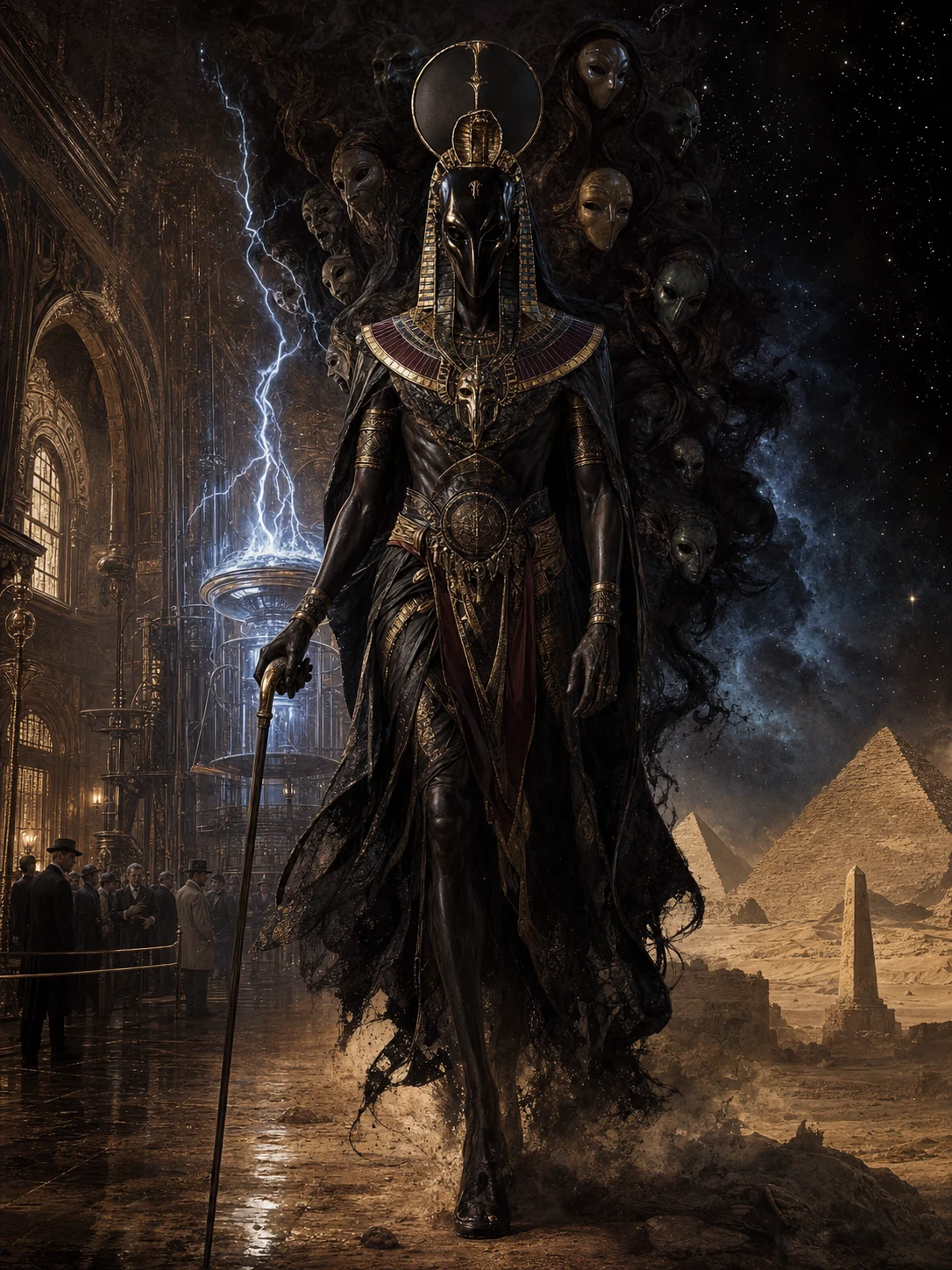
Nyarlathotep first enters literature in the 1920 prose poem bearing its name, appearing as an itinerant lecturer newly returned from Egypt. It demonstrates electrical marvels and impossible images; audiences depart in feverish processions as the city slips into nightmare, cold, and dissolution. Unlike the sleepers, remote powers, and nearly mindless forces around it, Nyarlathotep speaks, tempts, mocks, and seems to enjoy translating cosmic indifference into malice that a single person can feel.
In The Dream-Quest of Unknown Kadath it wears the majestic form of a black pharaoh, carries messages for the Outer Gods, and plots to send Carter toward the court of Azathoth. Lovecraft supplied several manifestations but never wrote a fixed catalogue of one thousand masks. Novels, games, and roleplaying traditions have continued adding them. Nyarlathotep therefore behaves like a mythology still at work: every age can fashion an appropriate face, while the office behind the mask remains constant—to make humanity hear, in a recognizable voice, how little the cosmos requires it.
Academic Discussion & Critique
Exchange peer-reviewed hypotheses, comparative Indo-European etymologies, and archaeological field interpretations regarding Nyarlathotep.
You Might Also Like
Azathoth
A blind, mindless presence seething at ultimate chaos, surrounded by flutes and drums beyond ordered space.
Hastur
A name transformed by Bierce, Chambers, Lovecraft, and Derleth, accumulating Carcosa, the Yellow Sign, and later mythos rank.
Yog-Sothoth
A confluence of luminous spheres coextensive with time and space, present wherever forbidden thresholds open.
Dreamlands
A persistent realm beyond waking life, filled with ports, gods, moon-beasts, cats, and roads known to practiced dreamers.