

Innsmouth
Mythological Narrative
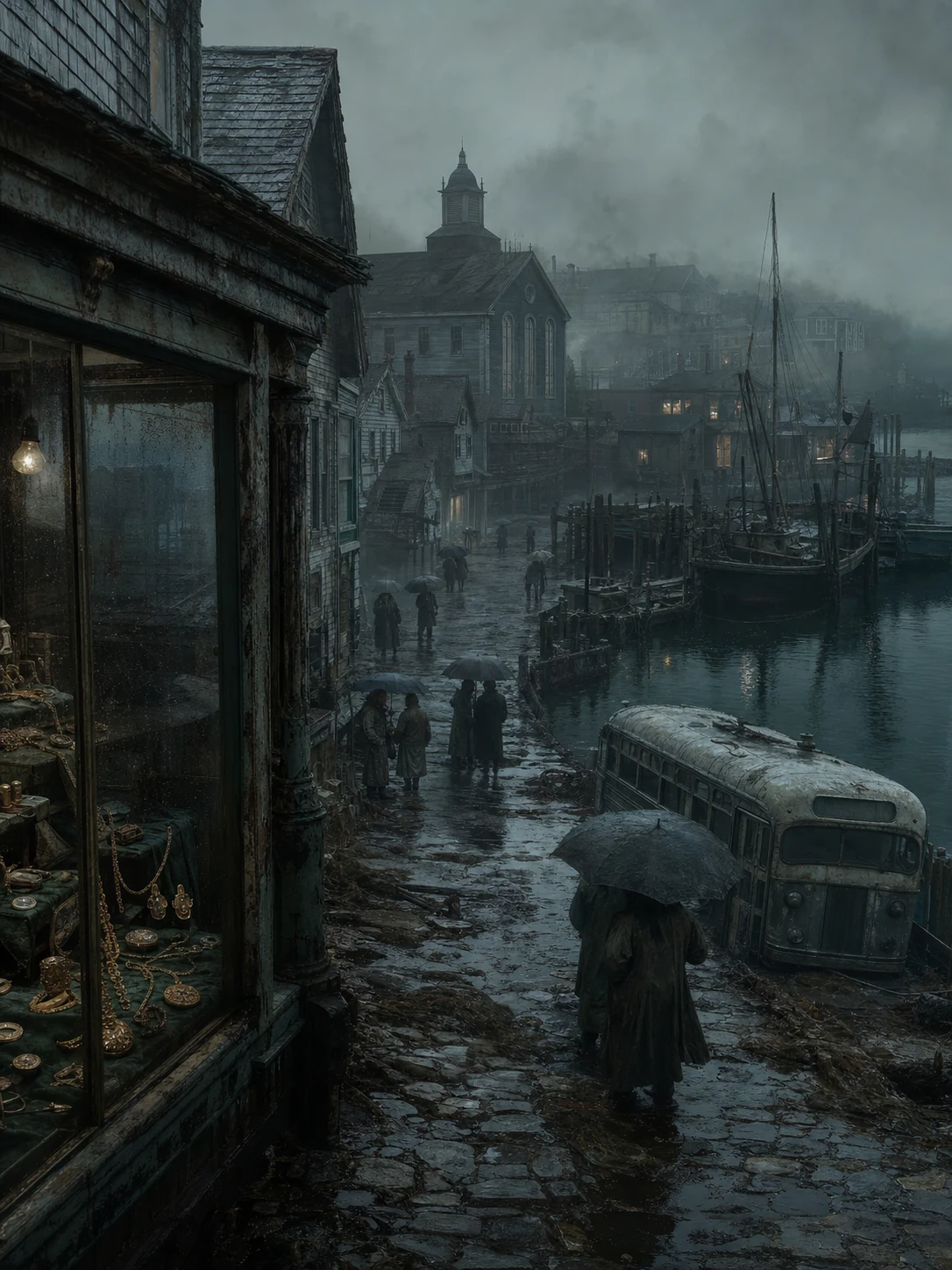
Innsmouth prospered through shipping and a refinery before becoming a grey port avoided by outsiders. Houses decay toward the water, and people in the streets share what neighboring towns call the “Innsmouth look”: broad mouths, prominent eyes, and a rigid gait. Captain Obed Marsh learned Pacific rites for contacting the Deep Ones, trading ceremony and intermarriage for gold and plentiful catches, then founded the Esoteric Order of Dagon. Economic recovery and bodily alteration were clauses in the same agreement from the beginning.
The Shadow over Innsmouth lets its narrator first inspect this isolation as a traveler, then discover that his own genealogy descends toward the sea. Horror turns from the other toward the self, and the ending makes oceanic return sound dangerously liberating. Historically, the story also exposes Lovecraft’s obsessive fear of racial mixture; preserving atmosphere without that intellectual context would reproduce its prejudice unexamined. Innsmouth endures because port capital, family secrecy, state violence, and transformation are locked into one town. Even after federal forces destroy the reef, no file can prove that the relatives below have vanished.
Academic Discussion & Critique
Exchange peer-reviewed hypotheses, comparative Indo-European etymologies, and archaeological field interpretations regarding Innsmouth.
You Might Also Like
Deep Ones
An immortal marine people who interbreed with humans, purchasing Innsmouth’s devotion with gold, fish, and a tidal inheritance.
Arkham
A fictional Massachusetts town where Miskatonic scholarship, colonial witch-lore, and inherited secrets occupy neighboring streets.
Dagon
A sea-name revered by the Deep Ones and Innsmouth’s Esoteric Order, joining an ancient god to modern oceanic dread.
Mother Hydra
The mother-name invoked in Innsmouth’s sea cult, powerful in ritual yet almost entirely undescribed by Lovecraft.