

Pangu
Also known as: Pan Gu, Primordial Giant
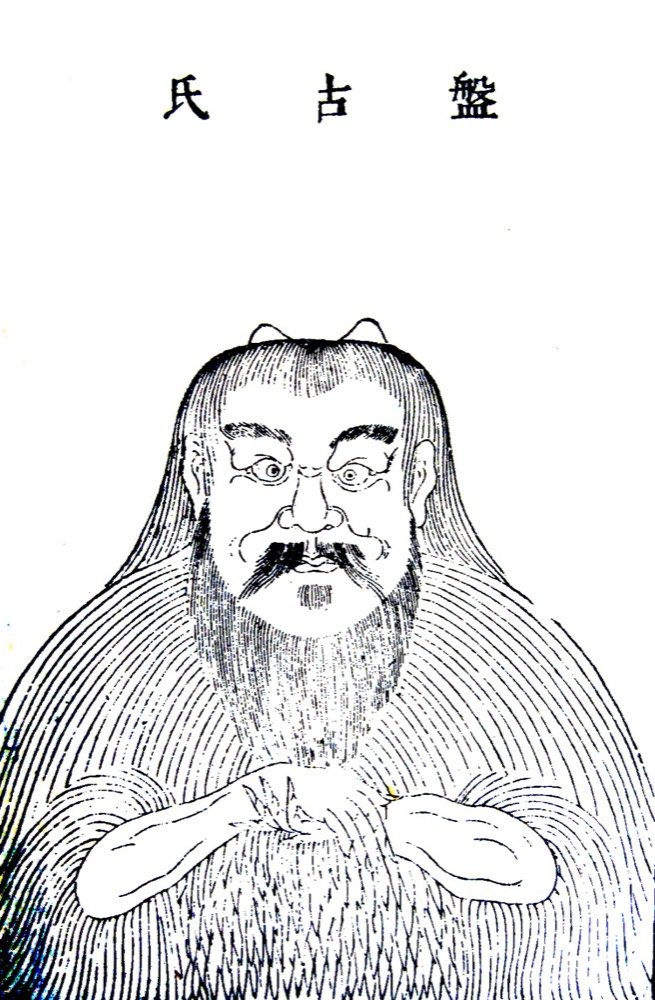
Mythological Narrative
Pangu is the primordial giant of the Chinese creation story. According to the Sanwu Liji by Xu Zheng, a scholar of the third-century state of Wu, the cosmos began as a chaos shaped like a hen's egg, with Pangu gestating inside it. After eighteen thousand years the egg split: the light, clear part rose to become heaven, and the heavy, murky part sank to become earth. Pangu then grew ten feet taller each day, and heaven rose ten feet with him, until after another eighteen thousand years sky and ground stood immensely far apart.
The Wuyun Linian Ji records his death. His breath became wind and cloud, his voice thunder; his left eye turned into the sun and his right eye into the moon. His limbs and trunk became the four quarters and the five sacred peaks, his blood the rivers, his flesh the fields, his hair the stars, his skin and body hair the plants and trees, his teeth and bones metals and stones, his sweat the falling rain.
No pre-Qin text mentions Pangu, and scholars generally date the myth's entry into written literature to the late Han or Three Kingdoms period, possibly drawing on traditions of southern peoples. The sixth-century Shuyiji already notes a tomb of Pangu by the southern sea and a shrine to him near Guilin, and his world-opening act became the standard opening of Chinese cosmogony.
Scholarly Commentary & Evolution
## The First Being
Pangu is the creator deity of Chinese mythology, a primordial giant whose birth, life, and death created the universe as we know it. His story is one of the most profound creation myths, combining themes of sacrifice, transformation, and the origin of cosmic order.
### Birth from Chaos
In the beginning, there was only chaos (hundun), formless and dark, contained within a cosmic egg. Within this egg, the opposing forces of yin (dark, heavy, feminine) and yang (light, airy, masculine) were undifferentiated. For 18,000 years, these forces slowly separated and coalesced, and within the egg, Pangu took form.
### The Separation
When Pangu awoke, he found himself cramped in darkness. With a great axe, he split the egg. The light, clear yang rose up to become Heaven (Tian), while the heavy, turbid yin sank down to become Earth (Di). Fearing they might merge again, Pangu stood between them, growing taller each day.
### The Long Labor
For 18,000 years, Pangu stood with his arms pushing up Heaven and his feet pressing down Earth. Each day, Heaven rose ten feet higher, Earth grew ten feet thicker, and Pangu grew ten feet taller to keep them apart. After this immense span of time, Heaven and Earth were finally stable.
### The Ultimate Sacrifice
When his work was done, Pangu died. But from his death came the world's features. His breath became wind and clouds. His voice became thunder. His left eye became the sun, his right eye the moon. His limbs became the four directions. His blood became rivers, his veins the roads. His flesh became soil, his hair the plants. His bones and teeth became minerals. His sweat became rain. And the parasites on his body became humanity.
### Significance
Pangu's myth teaches that creation requires sacrifice and that all things in the universe are interconnected, having originated from a single being. The story also establishes the fundamental dualism of yin and yang that underlies all Chinese philosophy.
Cross-Pantheon Parallels & Archetypes
Academic Discussion & Critique
Exchange peer-reviewed hypotheses, comparative Indo-European etymologies, and archaeological field interpretations regarding Pangu.
You Might Also Like
Nüwa
Serpent-bodied creator goddess who molded the first humans from yellow clay, smelted five-colored stones to mend the broken sky, and is paired with Fuxi as ancestor of humankind.
Fuxi
First of the Three Sovereigns, serpent-bodied like his consort Nüwa. He devised the eight trigrams from the patterns of sky and earth, taught net-fishing, and instituted marriage rites.
Purusha
The primordial cosmic being of Rigveda 10.90, the Purusha Sukta, whom the gods sacrificed so that the world could be made from his body: the sun from his eye, the moon from his mind, the sky from his head, the earth from his feet, and the four social classes from his mouth, arms, thighs, and feet.
Ymir
The first living being, formed when the fire of Muspelheim met the ice of Niflheim in the void of Ginnungagap. Ymir is the ancestor of all frost giants and, after being slain by Odin and his brothers, his body became the physical material of the world.