

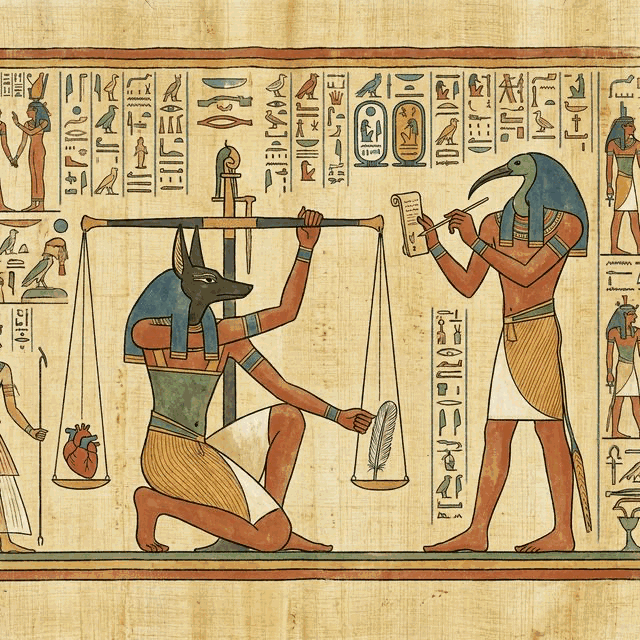
The Journey to the Hall of Two Truths
When an Egyptian died, their soul, known as the ba, embarked on the most important journey it would ever take. Guided by Anubis, the jackal-headed god of mummification, the deceased traveled through the underworld to reach the Hall of Two Truths, known as the Hall of Ma'ati. This was the great courtroom of the afterlife, where Osiris sat upon his throne surrounded by forty-two assessor gods.
The journey itself was perilous. The dead had to navigate through gates guarded by demons, across lakes of fire, and past serpents and other dangers. The Book of the Dead, a collection of spells and instructions placed in the tomb with the deceased, served as a guidebook for this treacherous passage.
The Negative Confession
Upon reaching the Hall of Two Truths, the deceased was required to make the Negative Confession, addressing each of the forty-two assessor gods by name and declaring their innocence of specific sins. The confessions covered the full range of moral behavior: "I have not stolen. I have not killed. I have not told lies. I have not waded in water. I have not been angry without cause."
O my heart which I received from my mother, do not stand against me as a witness. Do not oppose me in the tribunal. Do not be hostile to me before the Keeper of the Balance.
This was not merely a ritual recitation but a magical act. By naming each sin and denying it, the deceased sought to purify their soul through the power of truthful speech, one of the most sacred concepts in Egyptian religion.
The Weighing
The central moment of the ceremony was the weighing of the heart. Anubis led the deceased to a great set of scales. On one side was placed the heart of the dead person, the organ the Egyptians believed contained the soul, memory, and moral character. On the other side was placed the feather of Ma'at, the goddess of truth, justice, and cosmic order.
Anubis carefully adjusted the scales while Thoth, the ibis-headed god of wisdom and writing, stood ready with his reed pen and palette to record the result. The moment was one of absolute truth: the heart could not lie, and no magic could alter its weight.
If the heart balanced with the feather, it proved the deceased had lived a life of justice and truth. If the heart was heavier, weighed down by sin and wrongdoing, a terrible fate awaited.
Paradise or Oblivion
For the righteous, the reward was Aaru, the Field of Reeds, an idealized version of Egypt where the crops grew tall, the weather was always perfect, and the deceased could live in eternal peace among the gods. They would be reunited with loved ones and enjoy all the pleasures of life without any of its hardships.
For the wicked, the consequence was final and absolute. The monstrous Ammit, a terrifying hybrid creature with the head of a crocodile, the body of a lion, and the hindquarters of a hippopotamus, crouched beside the scales, waiting. If the heart was heavy with sin, Ammit devoured it, and the deceased suffered the Second Death, a complete annihilation of existence. They would not persist in any afterlife, good or bad. They would simply cease to be, erased from the cosmos forever.