

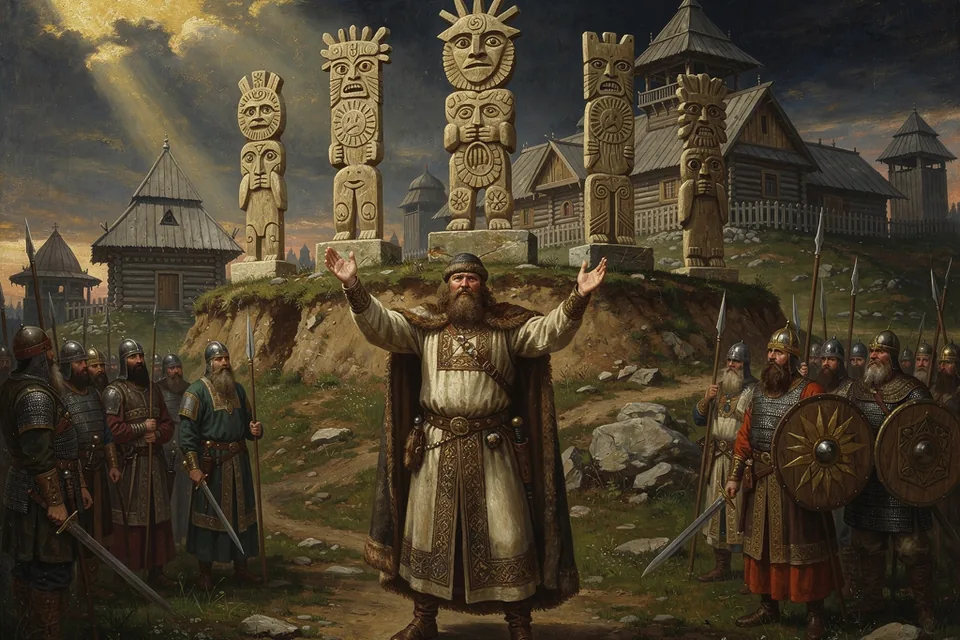
A prince's pantheon
According to the *Russian Primary Chronicle*, in the year 980, having just secured sole rule over Kiev by defeating his brother Yaropolk, Vladimir Sviatoslavich set up a row of wooden idols on a hill outside his palace: Perun, carved with a head of silver and a moustache of gold, standing first among Khors, Dazhbog, Stribog, Simargl, and Mokosh, the only goddess in the group. The chronicle says the people of Kiev brought their sons and daughters to sacrifice before these images, "defiling the land with their offerings."
A political pantheon
Historians generally read the 980 pantheon less as a snapshot of settled East Slavic religion than as a deliberate act of statecraft: a newly secure prince gathering gods associated with different peoples and regions under his rule — Iranian-tinged names like Khors and Simargl alongside clearly Slavic ones — into a single, visible cult at the seat of his power, much as he would later choose a single foreign religion (Byzantine Christianity) for the same unifying purpose.
Torn down in 988
Eight years later, having decided to convert, Vladimir had the same idols destroyed. The chronicle singles out Perun for a detailed, almost theatrical demolition: bound to a horse's tail, dragged down the hill while twelve men beat it with sticks "not because the wood feels blows, but to mock the demon who deceived men in this guise," then thrown into the Dnieper with men posted along the bank to push it past the city and the rapids so no one could retrieve or venerate it again. Mass baptism of Kiev's population in the river followed.