

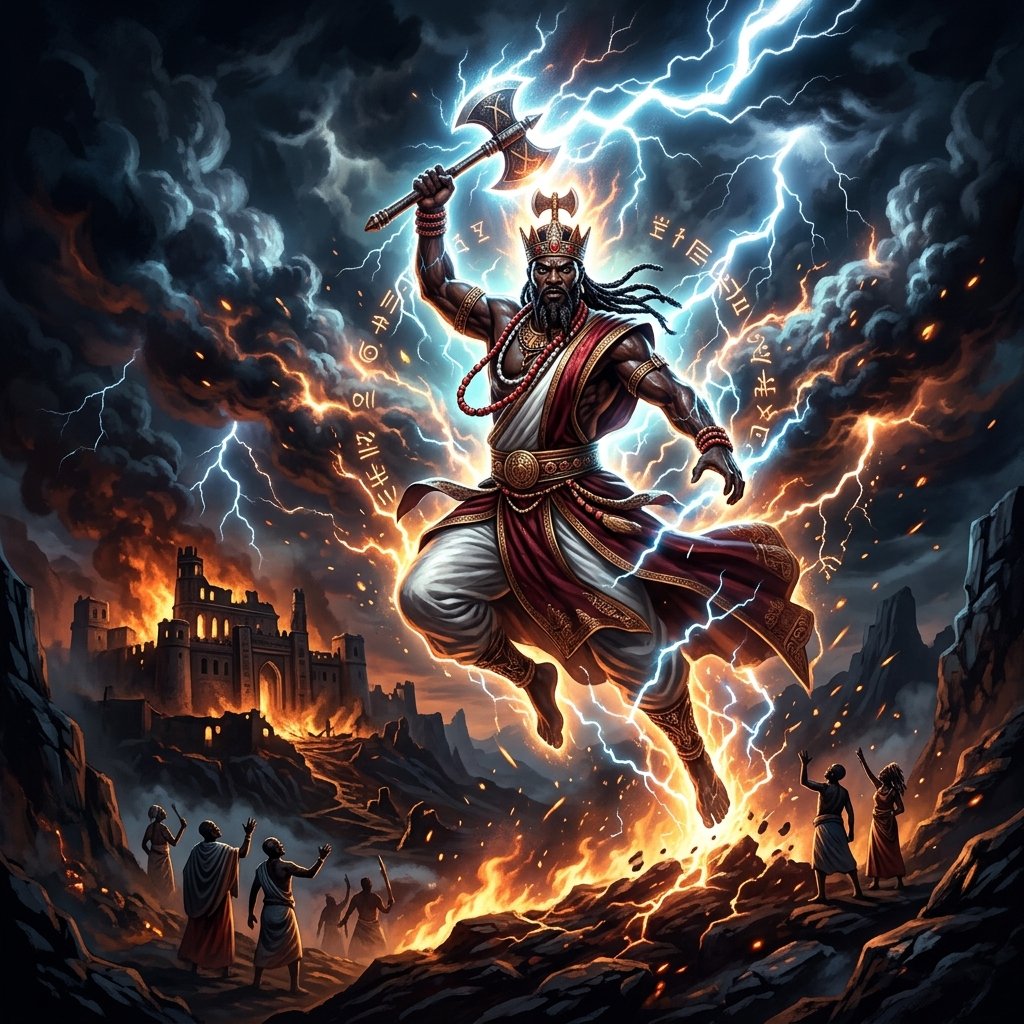
The Fourth King of Oyo
**Shango** was the fourth Alaafin (king) of the great Oyo Empire. He was not born an Orisha but a mortal man, though no ordinary one. His presence commanded fear and respect in equal measure. His voice was like thunder, his anger like lightning. It was said he had learned the secret of summoning storms from the sky.
Shango ruled with power and passion. He was a great warrior who expanded the empire through conquest. He was a lover with three wives - **Oya**, **Oshun**, and **Oba** - each powerful in her own right. But his temperament was volatile, his pride immense.
The Secret of the Thunderstones
Shango possessed medicine that could call down lightning from the heavens. With a word and a gesture, he could destroy his enemies with fire from the sky. He kept this power secret, using it to terrify his subjects and devastate his opponents.
But his generals, Timi and Gbonka, grew jealous of his power and began to challenge his authority. The empire was divided between those loyal to Shango and those who whispered that the king's power was too dangerous, too unpredictable.
The Tragic Demonstration
One day, to demonstrate his power and cow his rivals, Shango decided to call lightning from his palace roof. But something went wrong. Whether his medicine failed or the storm escaped his control, the lightning struck his own palace instead of his enemies.
The fire consumed everything. The palace burned. Shango's own family members, including some of his children, perished in the flames. The king who controlled thunder had destroyed his own household.
Shango was devastated. The accident shattered his pride and his heart. His enemies mocked him. His supporters fell away. The king who had terrorized armies now wandered in shame.
The Ayan Tree
Shango traveled to a place called Koso, seeking solitude to mourn what he had lost. There, according to some versions of the story, he hanged himself from an ayan tree, unable to bear his grief and humiliation.
But his followers refused to accept his death. When they arrived at Koso, they declared that Shango had not died but had descended into the earth, becoming one with the storms he had once commanded.
Oba Koso - The King Did Not Hang
Those who had mocked Shango's death soon learned their error. Lightning began to strike his detractors. Thunder rolled across clear skies when his name was spoken in mockery. Fire appeared where none should be.
Shango's followers proclaimed: **'Oba koso!'** - 'The king did not hang!' Shango had not died but had transformed. He had become something greater than a mortal king. He had become the Orisha of thunder and lightning.
The Thunder God
Shango's worship spread rapidly throughout Yorubaland and beyond. Where he had been a mortal king of one empire, he became a god worshipped across West Africa and, eventually, throughout the African diaspora.
His symbol became the double-headed axe, oshe, representing his power to strike in any direction. The thunderstones found after lightning strikes became his sacred objects. The ram became his animal, its forceful nature matching his own.
A Living God
Unlike other Orishas who were created in the time before time, Shango walked the earth as a man within historical memory. His transformation demonstrates a profound Yoruba belief: divinity is not limited to ancient times. Mortals of sufficient power, passion, and destiny can become Orishas themselves.
Shango's story also teaches that tragedy can become transcendence. The king who destroyed his own palace in a moment of hubris became the god who brings justice through lightning. His worshippers call upon him to punish liars and evildoers, and they say that when lightning strikes, Shango has passed judgment on the wicked.