

The Miraculous Birth
Li Jing was a military commander serving the last king of the Shang dynasty. His wife, Lady Yin, became pregnant but did not give birth for three years and six months. When she finally went into labor, she produced not a child but a ball of flesh.
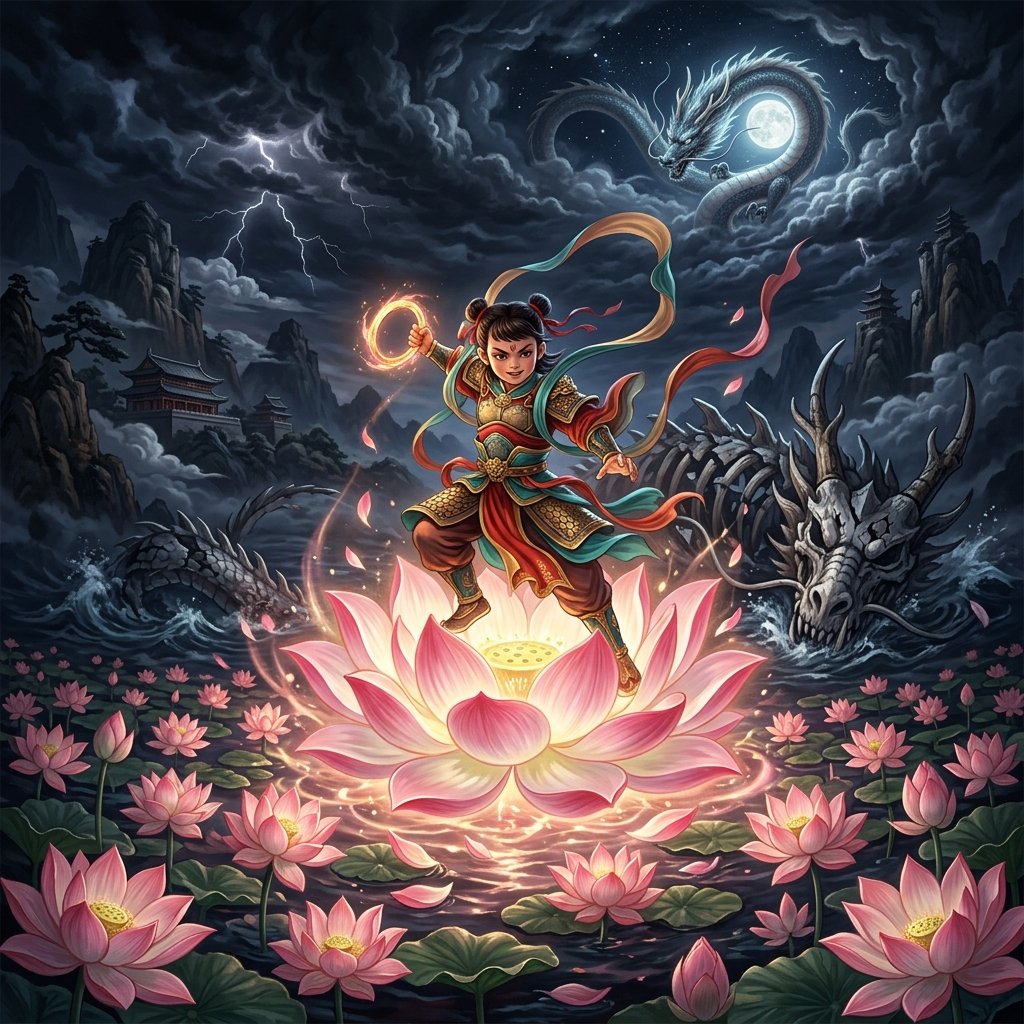
Thinking his wife had given birth to a demon, Li Jing drew his sword and struck the fleshy ball. It split open, and out leaped a boy already the size of a seven-year-old, wearing a golden bracelet on his wrist and a red silk sash around his waist. These were divine gifts from the immortal Taiyi Zhenren, who had placed his spirit in the child's body.
Taiyi Zhenren arrived shortly after and named the child Nezha. He would become the boy's master, teaching him the ways of immortals.
The Dragon Prince
At age seven, Nezha went to bathe in the Eastern Sea. His presence disturbed the Crystal Palace of the Dragon King Ao Guang. When a yaksha servant came to investigate, Nezha killed him with his Universe Ring. The Dragon King sent his third son, Ao Bing, to punish the boy.
Ao Bing transformed into his true dragon form and attacked. Nezha, not intimidated, fought back. With a few moves, he killed the dragon prince. Then, to make a gift for his father, Nezha stripped the dragon's tendons to make a belt.
"What's a dragon to me?" laughed Nezha, standing over the body of a prince of the sea. "If his father wants revenge, I'll kill him too."
The Dragon's Vengeance
Ao Guang, the Dragon King, was devastated by his son's death. He complained to the other Dragon Kings, and together they ascended to Heaven to petition the Jade Emperor. They demanded justice: the Li family must be executed for Nezha's crimes.
Nezha, learning of this, intercepted the Dragon King on his way to Heaven and beat him savagely, threatening to skin him alive if he continued. Ao Guang agreed to withdraw his complaint but secretly continued to the Jade Emperor's court.
The Sacrifice
The Jade Emperor ordered Li Jing to bring Nezha for punishment. Nezha's parents would also be executed for failing to control their son. Li Jing was torn between duty to Heaven and love for his child.
Nezha made the choice for him. To save his parents from execution, he cut off his own arm and disemboweled himself, returning his flesh to his mother and his bones to his father. "Now I owe you nothing," he declared, and died.
Rebirth from the Lotus
Nezha's spirit went to his master, Taiyi Zhenren. The immortal constructed a new body for Nezha from lotus flowers - two lotus roots for legs, lotus leaves for clothing, and a lotus flower for his face. This lotus body made Nezha even more powerful than before, immune to normal weapons.
Reborn, Nezha sought out his father Li Jing, furious that he had destroyed the temple his mother had built to honor Nezha's spirit. Father and son fought a terrible battle until the Buddha himself intervened, giving Li Jing the Linglong Pagoda to suppress Nezha when necessary.
The Warrior of Heaven
Nezha went on to become one of the greatest warriors in Heaven, serving as Marshal of the Central Altar. Armed with his Universe Ring, Fire-Tipped Spear, Red Armillary Sash, and Wind Fire Wheels (which allow him to fly), he fought demons and served the gods with the same fierce energy he once used to rebel.
His story became central to the Investiture of the Gods, where he helped overthrow the Shang dynasty and establish the Zhou, earning his place in the celestial hierarchy.