

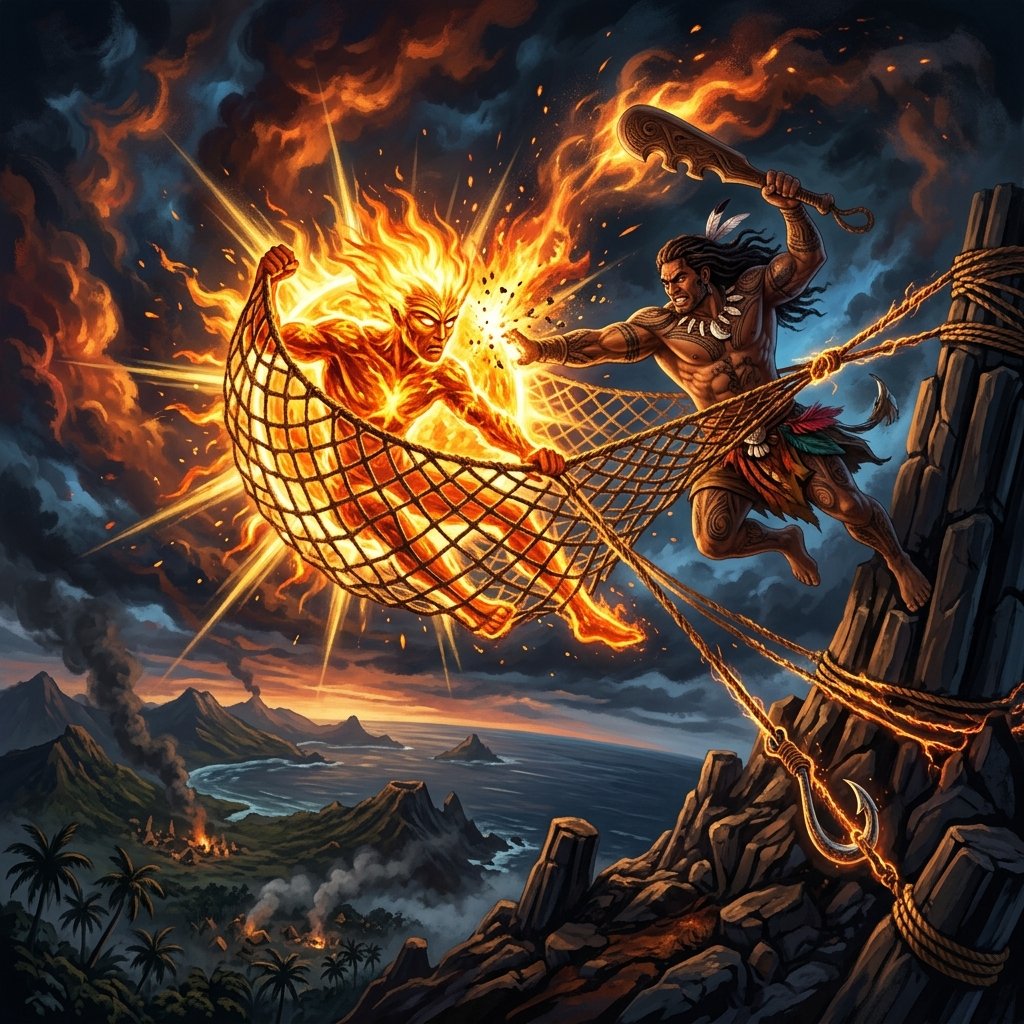
The Problem of Short Days
In the early times, the sun raced across the sky so quickly that the days were too short for people to accomplish their work. Food could not be properly cooked before darkness fell. Tapa cloth could not be dried. Crops withered for lack of sunlight. The people cried out in distress.
Maui's mother Taranga (or Hina, in some versions) complained bitterly as she tried to dry her tapa cloth. "The sun moves too fast! My cloth never dries properly. Someone should do something about this!"
Maui, hearing his mother's complaint, decided he would be that someone.
The Preparation
Maui knew he would need special ropes to capture the sun - ordinary ropes would burn in its heat. He went to his sister (or grandmother, depending on the tradition) and asked for strands of her hair, which possessed supernatural properties.
"Sister, I need your hair to make ropes. I am going to capture the sun and teach it to move slowly."
His sister thought him mad, but she cut her hair and gave it to him. Maui wove the hair into strong ropes, plaiting them with sacred chants that gave them power to withstand fire.
He also gathered his brothers and taught them what they must do. They would journey to Te Rua o te Ra - the Pit of the Sun - where the sun rose each morning.
The Ambush
The brothers traveled east for many days until they reached the edge of the world where the sun emerged each morning. They built walls of clay on either side of the sun's path, creating an ambush point. Then they waited in the darkness before dawn.
As the first light appeared, Maui readied his ropes. The sun began to rise, not suspecting the trap. When it was halfway out of its pit, Maui shouted the signal.
"Now! Cast the ropes!"
The brothers threw their nooses over the sun's rays. The ropes, made from sacred hair, did not burn. The sun thrashed and struggled, trying to break free, but the ropes held fast.
The Beating
Maui approached the bound sun, carrying the jawbone of his grandmother (the same bone from which his fishhook was made, in some versions). The sun roared and blazed with anger, but it could not escape.
"You have made our days too short!" Maui cried. "People cannot finish their work. The land suffers from your haste. I am going to beat you until you agree to travel slowly!"
Maui struck the sun again and again with the sacred jawbone. The sun screamed and begged for mercy, but Maui did not stop until it made a solemn promise.
"I will move slowly! I will give people long days to do their work! Only stop beating me!"
The Covenant
Maui made the sun swear a sacred oath. In summer, it would move slowly, giving long days for planting and harvesting. In winter, it would move faster, but still slowly enough for people to accomplish their essential tasks. The sun agreed, and Maui released the ropes.
Since that day, the sun has kept its promise. It rises and sets at a measured pace, giving humanity the daylight they need. The marks of Maui's beating can still be seen - the spots and flares on the sun's surface are the bruises left by the jawbone.
Regional Variations
**Maori version**: Maui and his brothers travel to Te Rua o te Ra and use flax ropes strengthened with karakia (sacred chants). The jawbone belongs to his ancestor Murirangawhenua.
**Hawaiian version**: Maui climbs to the summit of Haleakala ("House of the Sun") on Maui island. The crater is where he trapped the sun. The mountain is sacred because of this deed.
**Tahitian version**: Maui uses ropes made from coconut fiber blessed by the gods. The sun's agreement created the regular seasons.