

The Wager at Ardea
During the siege of Ardea, the young Roman princes grew bored and fell to drinking and boasting. They wagered over whose wife was most virtuous. Prince Collatinus proposed they ride to Rome unannounced and catch their wives unaware. What they found would settle the matter.
The king's daughters-in-law were discovered at a lavish banquet, drinking wine and entertaining guests. But when they came to the house of Collatinus, they found his wife Lucretia sitting among her handmaidens, spinning wool by lamplight. She alone was engaged in honest labor while her husband served the state.
The Crime of Sextus
Sextus Tarquinius, son of King Tarquinius Superbus, was inflamed not with admiration but with dark desire. Days later, he returned alone to Collatinus' house and was received with hospitality, as was proper for a prince. In the depths of night, he crept to Lucretia's chamber with sword drawn.
He threatened her with death, but Lucretia declared she would die before submitting. Then Sextus made a viler threat: he would kill her and a slave, placing their bodies together, and claim he had caught her in adultery. The thought of such disgrace was unbearable. To preserve her family's honor, she submitted to the violation.
She sent for her father and husband, bidding each to bring a trusted friend. They must come quickly; a terrible thing had happened.
The Oath and the Dagger
At dawn, Lucretia sent messengers to her father Spurius Lucretius and her husband Collatinus, bidding them come with witnesses. When they arrived with Lucius Junius Brutus and Publius Valerius, they found her in deepest mourning.
Lucretia told them everything. Her father and husband tried to comfort her, saying her mind was innocent though her body had been violated. But Lucretia would not be moved. She drew a dagger she had concealed beneath her robes.
"My body only has been violated," she said. "My heart is guiltless. But I cannot live as an example for unchaste women." Before anyone could stop her, she plunged the blade into her heart and died at her husband's feet.
The Birth of the Republic
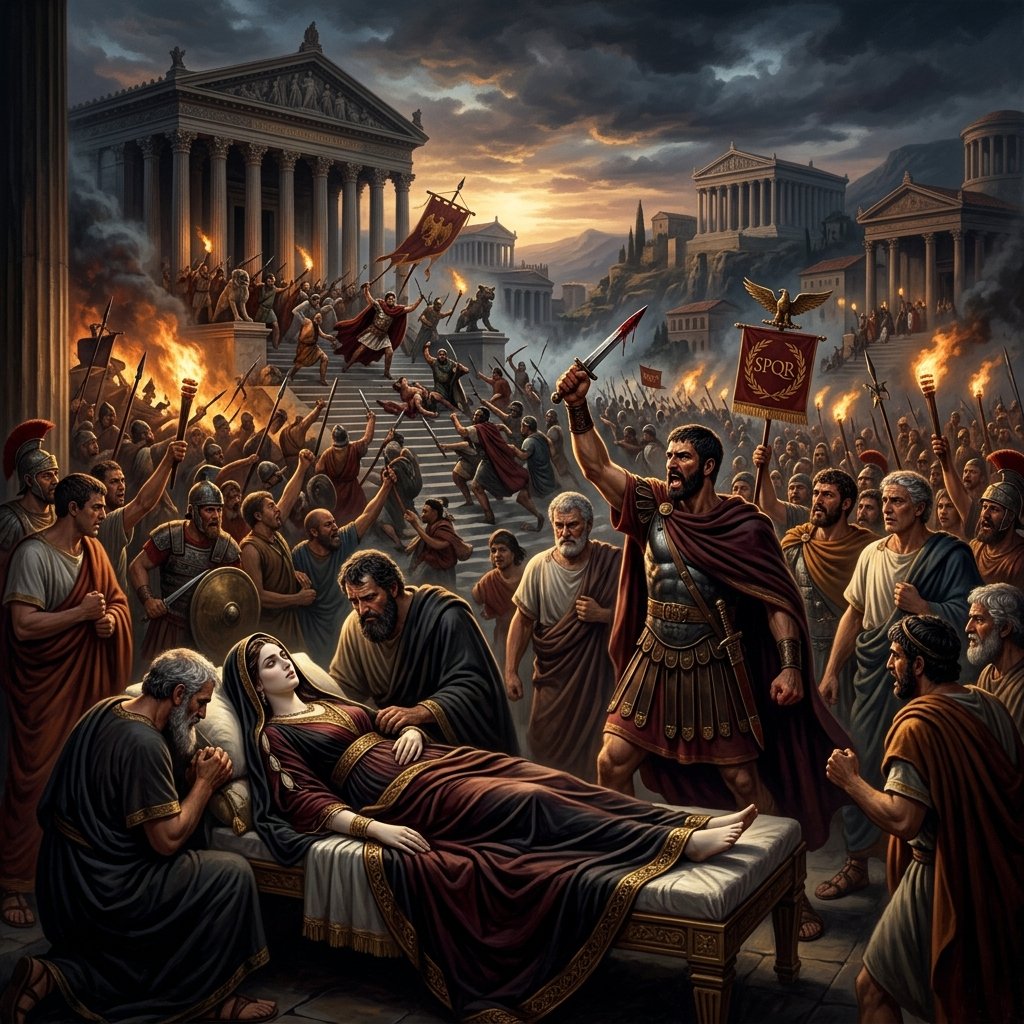
Brutus seized the bloody dagger from Lucretia's body and held it aloft. Though he had long played the fool to survive under the tyrannical king, his true nature emerged in that moment of crisis.
"By this blood most chaste before the prince's crime," he swore, "I vow to pursue Lucius Tarquinius Superbus, his wicked wife, and all their children, with fire, sword, and whatever else I can command, and never again to suffer any man to be king in Rome."
They carried Lucretia's body to the Forum, where the people, horrified by the crime and inspired by Brutus' words, rose up against the Tarquins. The king was in the field with his army and found the gates of Rome barred against him. He fled into exile with his family.
The New Order
In place of kings, Rome established the consulship: two men elected annually, each able to check the other's power. Brutus and Collatinus were the first consuls. The year was 509 BCE, and the Roman Republic had begun.
Lucretia became a symbol of Roman virtue—her sacrifice proving that honor mattered more than life itself. Her name echoed through the centuries as Rome grew from city to empire, a reminder of the price paid for liberty.